The Bombay High Court has held that administrative delays by the State in conducting recruitment for Additional Public Prosecutor posts cannot be visited upon eligible candidates who otherwise meet the prescribed qualifications. The Court granted ad-interim relief allowing petitioners to apply for the examination despite having exceeded the cut-off age limit, emphasizing that the State must bear the consequences of its own inaction.
Background & Facts
The Dispute
The petitioners, who are currently in regular employment with the State of Maharashtra, seek permission to appear in the examination for the post of Additional Public Prosecutor, Group-A, under Advertisement No.006/2026 issued on 18.03.2026. They contend that they are eligible for the post but have been de facto barred due to the State’s prolonged delay in initiating the recruitment process, which caused them to exceed the upper age limit of 38 years as revised under the Maharashtra Additional Public Prosecutor, Group-A, Recruitment Rules, 1997.
Key Facts
- The Supreme Court, in its order dated 03.12.2019, directed the State of Maharashtra to complete the process of appointment of Additional Public Prosecutors within six months.
- Despite this directive, the State failed to act promptly.
- The State forwarded the requisition to the Maharashtra Public Service Commission (MPSC) only on 11.02.2025.
- The advertisement for the post was issued on 18.03.2026, more than six years after the Supreme Court’s order.
- The cut-off age limit for the post was 36 years, later revised to 38 years.
- The petitioners, having applied for the post, were found to have crossed the 38-year age limit as of the date of the advertisement.
- The petitioners are not contractual employees but are in regular State service, placing them on a stronger footing than petitioners in a related case (WP No.4462 of 2026).
Procedural History
- 03.12.2019: Supreme Court directs completion of recruitment process within six months.
- 11.02.2025: State forwards requisition to MPSC.
- 18.03.2026: Advertisement No.006/2026 issued for Additional Public Prosecutor posts.
- 09.04.2026: Bombay HC grants ad-interim relief in WP No.4462 of 2026 to contractually appointed candidates, allowing them to apply if applications are submitted by 17.04.2026.
- 15.04.2026: Present writ petition filed by petitioners in regular service seeking similar relief.
- 15.04.2026: Court passes order granting ad-interim relief to petitioners in the present case.
Relief Sought
The petitioners seek:
- Direction to Respondent No.3 (Directorate of Prosecution) to permit them to appear in the examination under Advertisement No.006/2026.
- Issuance of experience certificate upon application to the competent authority.
The Parties' Positions
The petitioners argue that the delay in recruitment is attributable solely to the State, and they should not be penalized for administrative lassitude. They rely on the principle that equitable relief must be granted where the State’s inaction causes prejudice to otherwise eligible candidates.
The State, through the Additional Government Pleader, did not oppose the ad-interim relief sought, acknowledging the delay and the petitioners’ regular service status.
The Legal Issue
Can candidates who have exceeded the upper age limit for recruitment to the post of Additional Public Prosecutor be permitted to apply when the delay in conducting the recruitment process is attributable to the State, and the candidates are in regular State service?
Arguments Presented
For the Petitioners
The petitioners argued that the Supreme Court’s directive of 03.12.2019 was binding and that the State’s failure to comply for over six years cannot be used to disqualify eligible candidates. They cited the doctrine of equitable estoppel and the principle that the State cannot take advantage of its own wrong. They emphasized their status as regular employees, distinguishing them from contractual candidates in the earlier case, and asserted that their service record qualifies them for the post.
For the Respondent/State
The State did not contest the petitioners’ request for ad-interim relief. The Additional Government Pleader acknowledged the delay and conceded that the petitioners, being in regular service, were entitled to the same relief granted in WP No.4462 of 2026.
The Court's Analysis
The Court observed that the State’s failure to initiate recruitment within the timeframe mandated by the Supreme Court in 2019 was inexcusable. The delay of over six years, culminating in an advertisement issued in March 2026, rendered the cut-off age limit effectively meaningless for those who had remained eligible throughout.
"The Petitioners should not be made to suffer on account of delay on the part of the Respondent-State in taking the necessary steps towards such appointments."
The Court noted that the petitioners were not merely applicants but were already in regular employment with the State, thereby demonstrating their suitability and commitment to public prosecution. This placed them on a stronger footing than the petitioners in WP No.4462 of 2026, who were contractually engaged.
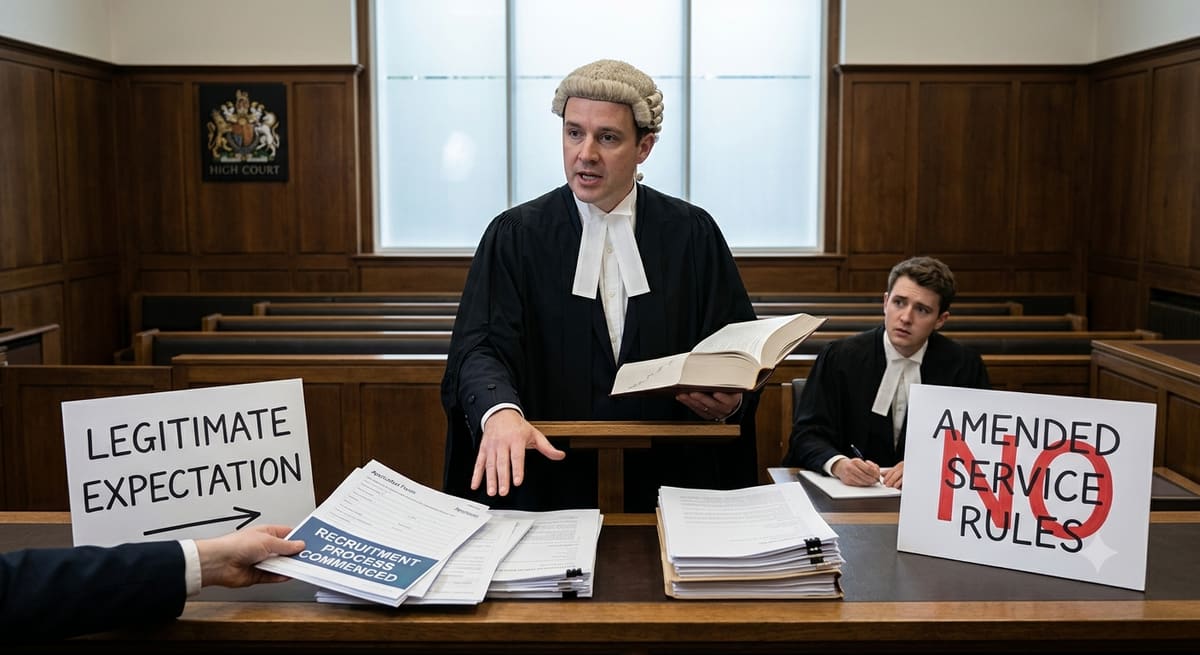
The Court emphasized that the principle of fairness and the doctrine of legitimate expectation require that candidates not be penalized for administrative failures. The Court further held that the experience certificate application must be processed by the competent authority on its merits, as per law.
The Court explicitly limited the relief to the petitioners before it and clarified that the order does not create any enforceable equity beyond the immediate context.
The Verdict
The petitioners succeeded. The Court directed the State to accept their applications for the examination under Advertisement No.006/2026 if submitted by 5.00 p.m. on 17.04.2026. The Court also directed the competent authority to decide applications for experience certificates on their merits. The order is subject to the final outcome of the writ petition and does not create any binding precedent or equitable claim beyond the petitioners. The State was directed to file its affidavit-in-reply by 24.04.2026, and the petitioners may file a rejoinder by 30.04.2026.
What This Means For Similar Cases
Administrative Delay Cannot Invalidate Eligibility
- Practitioners representing candidates in public recruitment cases must highlight the State’s failure to adhere to court-mandated timelines.
- Where candidates are otherwise qualified and the delay is attributable to the State, courts are likely to grant equitable relief even if age or other criteria have technically been exceeded.
Regular Service Status Strengthens Claims
- Candidates in regular government service have a stronger claim than contractual or temporary employees when seeking relief for recruitment delays.
- Service records and prior employment with the State can be pivotal in establishing legitimate expectation and fairness.
Relief Is Narrow and Conditional
- Courts will grant ad-interim relief only for the specific petitioners and will not set broad precedents.
- Any relief granted is explicitly subject to the final adjudication of the writ petition and does not create enforceable rights beyond the immediate order.