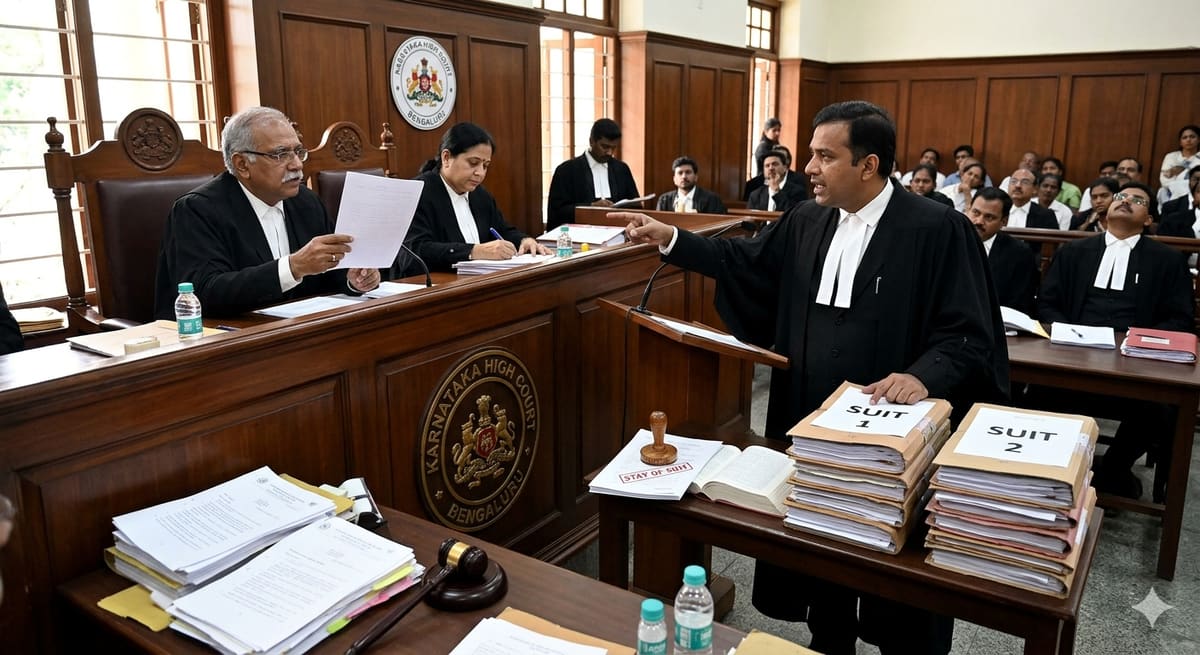
The Karnataka High Court has affirmed that co-plaintiffs asserting independent titles to property may each adduce evidence separately, even if their affidavits contain overlapping content. The judgment clarifies that similarity in testimony does not invalidate the right to present evidence, and courts must not deny this right on speculative grounds of collusion or repetition.
Background & Facts
The Dispute
The petitioners, Sri K.V. Ramesh Kumar and Sri Babulal Kothari, filed Original Suit No. 830/2015 before the Court of V Additional Civil Judge and JMFC, Shivamogga, seeking a permanent injunction against the respondents to restrain interference with their possession of two properties - Schedule 'A' and Schedule 'B'. The petitioners claimed ownership of both properties through a registered sale deed dated 09.04.2007. The respondents, who are the defendants in the suit, denied the claim and asserted their own title and possession.
Key Facts
- The petitioners are brothers and co-plaintiffs in the suit
- Both claim independent rights over Schedule 'A' and Schedule 'B' properties
- The registered sale deed dated 09.04.2007 is the foundational document for their title
- Plaintiff No. 2 (Babulal Kothari) examined himself as PW1 and underwent cross-examination
- Plaintiff No. 1 (K.V. Ramesh Kumar) filed an affidavit in lieu of examination-in-chief to prove his title to Schedule 'B' property
- The defendants filed I.A. No. IX seeking to strike off the affidavit of Plaintiff No. 1 on the ground that its contents were identical to PW1’s testimony
- The Trial Court allowed the application and struck off the affidavit on 27.10.2022
Procedural History
- 09.04.2007: Registered sale deed executed for Schedule 'A' and Schedule 'B' properties
- 2015: Original Suit No. 830/2015 filed for permanent injunction
- Prior to 27.10.2022: PW1 (Plaintiff No. 2) examined and cross-examined
- 27.10.2022: Trial Court passed impugned order allowing I.A. No. IX and striking off affidavit of Plaintiff No. 1
- 26.11.2022: Writ Petition No. 26209/2022 filed before Karnataka High Court under Article 227
- 13.03.2026: Notice served on Respondent No. 1
- 08.04.2026: Notice served on Respondents No. 2 to 6
- 08.04.2026: Hearing before Justice Vijaykumar A. Patil
The Parties' Positions
Petitioners: Argued that each plaintiff has an independent substantive right to prove title to the properties. Plaintiff No. 1 seeks to prove his title to Schedule 'B' property through the registered sale deed and his own affidavit. The similarity in affidavits is natural due to shared transaction and does not justify exclusion of evidence.
Respondents: Contended that PW1 admitted to deposing on behalf of both plaintiffs, making PW2’s affidavit redundant and an attempt to circumvent the admission made during cross-examination.
Relief Sought
The petitioners sought quashing of the impugned order dated 27.10.2022, setting aside the rejection of their affidavit, and directing the Trial Court to permit Plaintiff No. 1 to adduce evidence and allow cross-examination.
The Legal Issue
Can a Trial Court strike off the affidavit-in-lieu-of-examination of a co-plaintiff solely on the ground that its contents are similar to the testimony of another plaintiff, when both claim independent titles to distinct properties?
Arguments Presented
For the Petitioner
Learned counsel for the petitioners submitted that each plaintiff has a distinct and independent right to prove title to the suit properties. The affidavit of Plaintiff No. 1 is not a repetition but a necessary means to establish his individual claim over Schedule 'B' property. The registered sale deed is central to his case and cannot be proven without his testimony. The Trial Court’s reasoning - that similarity implies collusion - is legally flawed and violates the principle of natural justice. Reliance was placed on the settled position that courts must permit all relevant evidence unless it is clearly irrelevant or scandalous.
For the Respondent
No appearance or representation was made by the respondents. The Trial Court’s order was based on the defendants’ application, which alleged redundancy and procedural impropriety, but no substantive legal authority was cited to justify striking off evidence.
The Court's Analysis
The Court observed that the petitioners are not merely co-plaintiffs in a joint claim but are asserting independent titles over two distinct properties under a single sale deed. The fact that both plaintiffs are brothers or that their affidavits contain similar language does not negate their separate legal rights.
"It is to be noticed that both the plaintiffs are claiming independent source of title and possession over the suit schedule properties. Hence, the Trial Court cannot deny the opportunity to adduce evidence to plaintiff No.1."
The Court rejected the Trial Court’s reasoning that PW1’s admission during cross-examination rendered PW2’s evidence redundant. It clarified that an admission by one plaintiff does not bind the other, especially when each has a distinct interest. The Court emphasized that the Trial Court’s duty is to evaluate evidence, not to pre-emptively exclude it on speculative grounds.
The Court further noted that the defendants’ objection - that the affidavit was filed to overcome an admission - could be addressed during cross-examination. The proper forum to test credibility is not through striking off evidence, but through rebuttal and argument.
The Court held that the impugned order was not only erroneous but also prejudicial, as it deprived Plaintiff No. 1 of the opportunity to produce the registered sale deed, which is the cornerstone of his claim.
The Verdict
The writ petition was allowed. The impugned order dated 27.10.2022 passed in I.A. No. IX in O.S. No. 830/2015 was set aside. The application filed by the defendants to strike off the affidavit of Plaintiff No. 1 was rejected. The Trial Court was directed to permit Plaintiff No. 1 to adduce his affidavit as evidence and allow the defendants to cross-examine him.
What This Means For Similar Cases
Independent Claims Require Independent Evidence
- Practitioners must argue that co-plaintiffs with separate titles to different properties are entitled to file separate affidavits, even if factual overlap exists
- Similarity in affidavits cannot be grounds for exclusion unless proven to be fraudulent or collusive
- Courts must distinguish between redundancy and legitimate corroboration
Affidavits Are Not Inferior to Oral Testimony
- An affidavit-in-lieu-of-examination is a valid mode of evidence under Order XVIII Rule 4 of CPC
- Its admissibility cannot be denied merely because another witness has testified on similar facts
- The burden shifts to the opposing party to demonstrate prejudice or bad faith, not to demand exclusion
Trial Courts Must Avoid Prejudicial Pre-emptive Rulings
- Striking off evidence at the preliminary stage violates the principle of fair trial
- Courts must permit evidence and then assess its weight during final arguments
- This judgment reinforces that procedural fairness outweighs speculative concerns about repetition