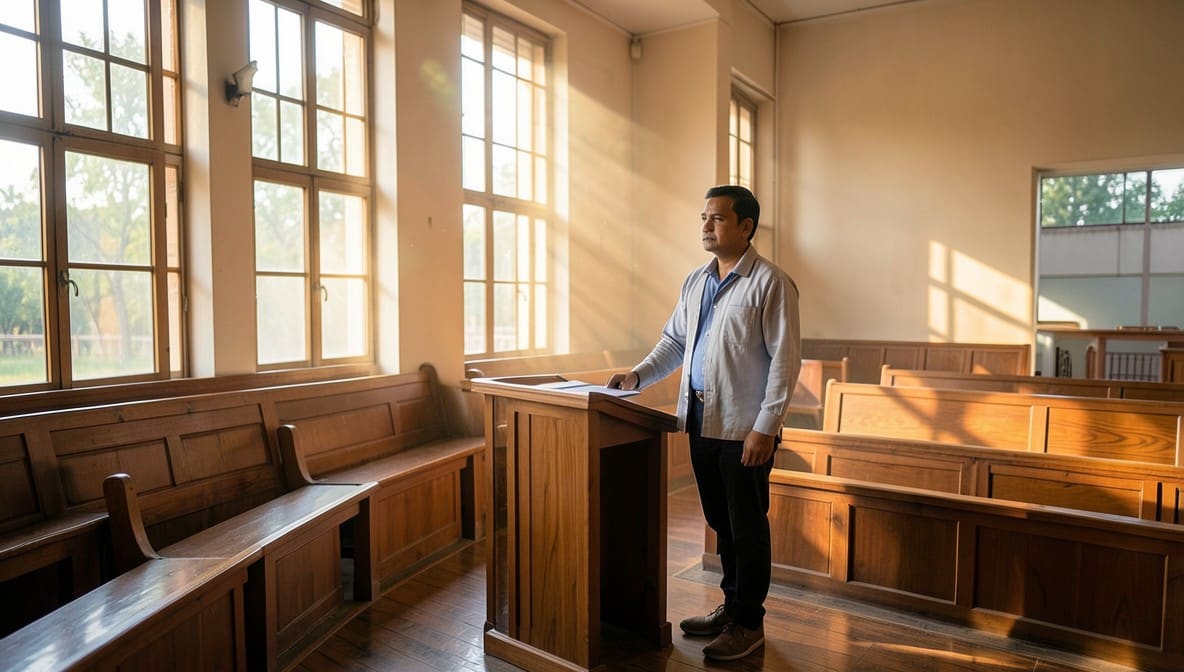
The Karnataka High Court has reaffirmed that the right to a fair hearing is non-negotiable in civil litigation, setting aside a trial court’s judgment for denying a defendant the opportunity to complete her evidence. The ruling underscores that procedural fairness cannot be sacrificed for expediency, even in cases involving complex property disputes.
Background & Facts
The Dispute
The plaintiffs, Sri Sangappa and four others, filed Original Suit No. 60/2010 before the Principal Senior Civil Judge and JMFC, Hubballi, seeking a declaration that a sale deed executed by Defendant No. 2 (as GPA holder) in favour of Defendant No. 3 on 26.05.2005 was not binding on their 1/5th share in ancestral joint family properties. The suit also sought permanent injunction against interference with their possession and partition of three properties: R.S. No. 249 (10 acres), R.S. No. 246 (13 acres), and a residential house with open space at Bogenaragakoppa (VPC No. 44).
Key Facts
- The plaintiffs and Defendant No. 1 are members of the same joint Hindu family.
- Defendant No. 1, the father of Defendant No. 3, executed a General Power of Attorney (GPA) in favour of Defendant No. 2 on 25.05.2005.
- Defendant No. 2, acting as GPA holder, executed a sale deed in favour of Defendant No. 3 on 26.05.2005 for R.S. No. 249.
- Plaintiffs alleged collusion between Defendant No. 1 and the other defendants to defeat their share in the property.
- Defendant No. 3 claimed the sale was for legal necessity: discharge of a loan of Rs. 89,244/- owed by Defendant No. 1 to Hubli Agriculture and Rural Development Co-operative Bank Ltd.
- Defendant No. 3 produced three bank receipts dated 07.06.2005 showing payment of Rs. 61,678/- in the names of Shivappa Sangappa Buradi and Mahadevappa Sangappa Buradi, along with two Wardis from the bank confirming discharge of the charge.
- Defendant No. 3 also claimed to have taken a further loan to improve the land after purchase.
Procedural History
- 15.04.2010: Original Suit No. 60/2010 filed.
- 28.03.2015: Defendant No. 3 adduced evidence through her husband and GPA holder (D.W.1), filing an affidavit in lieu of examination-in-chief and marking documents.
- 08.04.2015: Defendant No. 3 filed an application seeking permission to produce six additional documents and to examine evidence on them. Plaintiffs’ counsel raised no objection to admission but objected to marking the GPA on grounds of insufficient stamping.
- 08.04.2015 to 24.11.2015: Matter adjourned multiple times for hearing on stamp duty and penalty for the GPA.
- 24.11.2015: Arguments concluded on stamping issue; case reserved for order by 02.12.2015.
- 02.12.2015 to 19.08.2016: No order pronounced despite 260 days of inaction.
- 19.08.2016: Trial Court held the GPA was duly stamped and permitted Defendant No. 3 to adduce evidence on the additional documents.
- 25.08.2016: D.W.1 (Defendant No. 3’s husband) failed to appear for further examination-in-chief. Trial Court closed defendants’ evidence, noting absence as ‘nil’.
- 29.08.2016: Case posted for arguments; no appearance by any party.
- 02.09.2016: Last chance for arguments; no appearance.
- 03.09.2016: Final opportunity for appearance; no party appeared.
- 08.09.2016: Trial Court pronounced judgment decreeing the suit in favour of plaintiffs, holding the sale deed not binding on plaintiffs’ share and granting permanent injunction.
- 08.09.2016: Judgment and decree dated 08.09.2016 passed.
- 08.04.2016: Regular First Appeal No. 100278/2016 filed under Section 96 CPC.
- 25.03.2026: Appeal heard and reserved.
- 08.04.2026: Judgment delivered by the Division Bench.
The Parties' Positions
For the Appellant (Defendant No. 3)
- Argued that the Trial Court denied her the opportunity to complete her evidence, particularly the examination-in-chief of D.W.1.
- Highlighted that the court had taken over a year to decide on the stamping of the GPA, yet closed evidence within 20 days of allowing it.
- Contended that the absence of D.W.1 on 25.08.2016 did not justify closing evidence without granting further opportunity.
- Asserted that the Trial Court’s conduct violated principles of natural justice under Article 14 and Section 114 CPC.
For the Respondents (Plaintiffs)
- Argued that Defendant No. 3 had ample opportunity to lead evidence and failed to avail it.
- Claimed that the Trial Court gave multiple adjournments and final chances for appearance.
- Maintained that the suit was rightly decreed as the sale deed was collusive and no legal necessity was established.
Relief Sought
Appellant sought:
- Setting aside of the judgment and decree dated 08.09.2016.
- Remand of the suit for fresh disposal with opportunity to complete evidence.
- Costs of litigation.
The Legal Issue
The central question was whether the Trial Court’s failure to afford Defendant No. 3 a reasonable opportunity to complete her evidence, particularly the examination-in-chief of D.W.1, amounted to a violation of the principles of natural justice under Section 114 of the Code of Civil Procedure and Article 14 of the Constitution.
Arguments Presented
For the Appellant
The appellant’s counsel relied on State of U.P. v. Mohammad Noor and K. S. Puttaswamy v. Union of India to argue that the right to be heard is a fundamental component of natural justice. He emphasized that the Trial Court had already permitted the admission of additional documents and had reserved the matter for evidence, making the abrupt closure of evidence on 25.08.2016 arbitrary. The absence of D.W.1 on one date, without any inquiry into the reason or grant of further opportunity, rendered the proceeding fundamentally unfair. The delay in adjudicating the stamping issue for over a year, followed by hasty disposal, demonstrated procedural bias.
For the Respondent
The respondents’ counsel contended that the Trial Court had granted multiple adjournments and that the appellant had failed to appear on four consecutive dates after the evidence was reopened. He argued that the court was justified in closing evidence and proceeding to judgment under Order XVIII Rule 17 CPC, which permits the court to close evidence if a party fails to appear. He maintained that the plaintiffs’ case was strong on merits and that the appellant’s failure to prosecute her defence should not result in remand.
The Court's Analysis
The Division Bench conducted a meticulous review of the order sheet and found that the Trial Court’s conduct was inconsistent with the foundational principles of fair trial. The court noted that while the absence of a party may justify closure of evidence, it does not absolve the court of its duty to ensure justice is done.
"The Trial Court, having permitted the appellant to adduce evidence on the additional documents and having reserved the matter for further examination, could not, in the absence of any application for ex parte evidence or any finding of wilful neglect, abruptly close the defendants’ case on the first day of non-appearance."
The court observed that the Trial Court had taken over 260 days to decide on the admissibility of the GPA, indicating a deliberate and careful approach. Yet, within 20 days of allowing evidence, it closed the case without inquiry into the reason for D.W.1’s absence. The court further noted that the record showed no representation from either side between 25.08.2016 and 08.09.2016, suggesting a systemic lapse in case management.
The Bench held that natural justice requires not merely the opportunity to be heard, but the opportunity to be heard meaningfully. Closing evidence without exploring the cause of non-appearance, without issuing notice, and without affording a final chance to produce evidence, especially after the court itself had reopened the evidence, was a clear violation of Section 114 CPC and the doctrine of audi alteram partem.
The court distinguished S. R. Batra v. Tarun Batra, where closure of evidence was upheld due to repeated non-appearance despite notices, noting that here, the court had itself reopened the evidence and thus assumed a duty to ensure its completion.
The Verdict
The appeal was allowed. The judgment and decree dated 08.09.2016 passed in O.S. No. 60/2010 are set aside. The matter is remanded to the Trial Court for fresh disposal from the stage of further examination-in-chief of D.W.1. The parties are directed to appear before the Trial Court on 29.04.2026 at 11.00 a.m. The Trial Court is directed to dispose of the suit on merits within 180 working days from 29.04.2026. The Registry is directed to return the record to the Trial Court at the earliest. Each party shall bear its own costs.
What This Means For Similar Cases
Fair Opportunity Must Be Meaningful, Not Perfunctory
- Practitioners must argue that reopening evidence creates a duty to complete it, not to truncate it.
- Courts cannot treat non-appearance as automatic waiver if the court itself has created the expectation of further evidence.
- Absence must be investigated before evidence is closed - mere non-appearance is not sufficient grounds for summary disposal.
Remand Is the Correct Remedy for Procedural Defects
- When natural justice is violated, setting aside the judgment and remanding for fresh hearing is the only legally sound remedy.
- Merits of the case cannot override procedural fairness - even strong factual claims cannot justify a flawed trial.
- Appellate courts must intervene where trial courts exhibit inconsistent pacing - prolonged delays followed by rushed disposal indicate arbitrariness.
Procedural Compliance Is Non-Negotiable in Civil Trials
- Order XVIII Rule 17 CPC permits closure of evidence only after due diligence, not mechanical application.
- Courts must record reasons for closure of evidence, especially when the party has been permitted to lead it.
- Failure to do so invites remand, regardless of the strength of the opposing party’s case.