The Bombay High Court has clarified that a party to a civil suit may lead personal evidence through an affidavit after examining a power of attorney holder, provided the trial court has implicitly permitted such evidence. This ruling reinforces that Order XVIII Rule 3A of the Code of Civil Procedure is directory, not mandatory, and procedural deviations do not automatically invalidate evidence if the court’s discretion is exercised.
Background & Facts
The Dispute
The present writ petition challenges the order dated 14.03.2019 passed by the learned 3rd Joint Civil Judge, Junior Division, Aurangabad in Regular Civil Suit No. 1438 of 2012. The suit was filed by Plaintiff No. 1, Raghunath Siddhanath Nalawade, seeking specific performance of a contract and a perpetual injunction restraining the defendants (petitioners herein) from interfering with his possession over the suit property.
Key Facts
- The plaintiff filed the suit through his power of attorney holder, Gorakh Nalawade, who is his son.
- Gorakh Nalawade was examined as a witness, and his examination-in-chief was filed and duly cross-examined by the defendants.
- Subsequently, Plaintiff No. 1 filed his own affidavit in lieu of examination-in-chief, to be treated as PW-2.
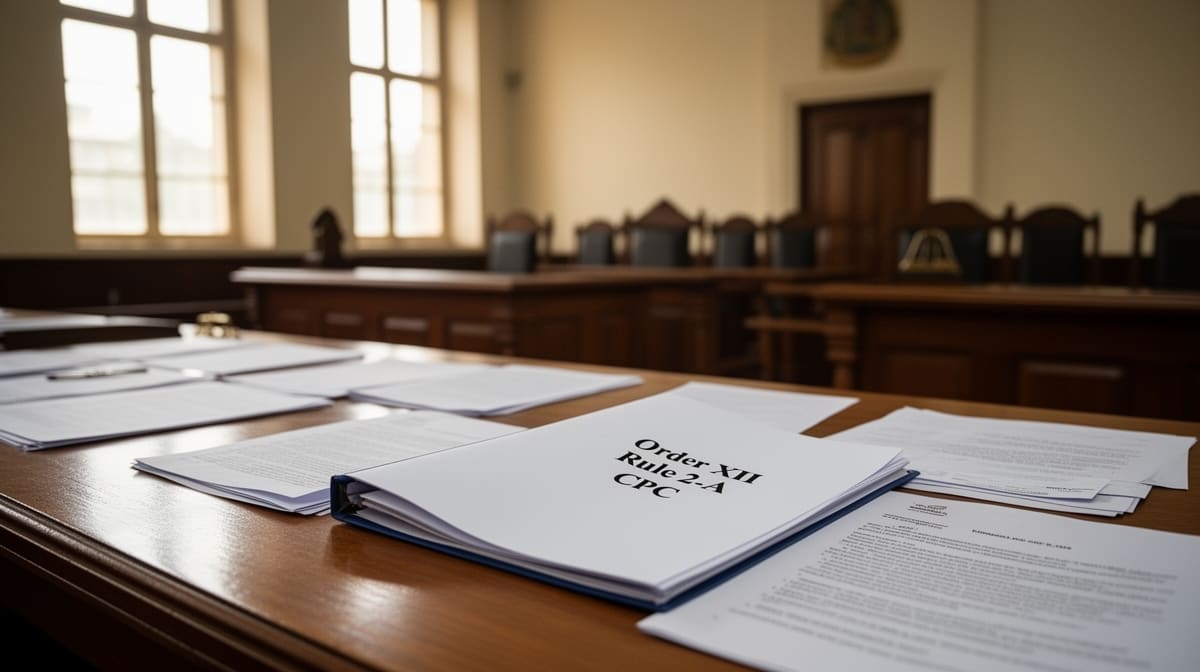
- The defendants filed an application (Exhibit-128) seeking to strike off or discard this affidavit, arguing that the plaintiff had violated Order XVIII Rule 3A CPC by not appearing as a witness before any other witness was examined.
- The Trial Court rejected the application, allowing the plaintiff’s affidavit to be recorded.
Procedural History
- 2012: Original suit filed for specific performance and injunction.
- Pre-2019: Issues framed; power of attorney holder (Gorakh Nalawade) examined and cross-examined.
- 14.03.2019: Trial Court rejected the defendants’ application (Exhibit-128) to discard the plaintiff’s affidavit.
- 23.03.2019: Defendants filed the present writ petition before the Bombay High Court, Aurangabad Bench.
- 23.03.2026: Judgment delivered by the High Court.
The Parties' Positions
Petitioners (Defendants): Argued that the plaintiff’s affidavit was inadmissible because he failed to appear as a witness before the power of attorney holder was examined, as mandated by Order XVIII Rule 3A CPC. They contended that the affidavit was a deliberate attempt to fill lacunae exposed during cross-examination.
Respondents (Plaintiff): Did not appear or file any written submissions despite service.
Relief Sought
The petitioners sought quashing of the Trial Court’s order dated 14.03.2019 and direction to discard the affidavit evidence of Plaintiff No. 1 as violative of Order XVIII Rule 3A CPC.
The Legal Issue
Whether the failure of a party to appear as a witness before examining any other witness, under Order XVIII Rule 3A of the Code of Civil Procedure, renders the subsequent affidavit evidence inadmissible, or whether the trial court’s implicit permission validates such evidence.
Arguments Presented
For the Appellant/Petitioner
The learned counsel for the petitioners relied on Hari Shrawan Sutar v. Ramdas Tukaram Patil (1985 Mh.L.J. 197), which held that Order XVIII Rule 3A CPC imposes a normal rule requiring a party to appear as a witness before any other witness, and departure from this rule requires express reasons recorded by the court. He further cited Sanj Dainik Lokopchar v. Gokulchand Govindlal Sananda (2018(6) ALL MR 393), emphasizing that the legislative intent behind Rule 3A is to prevent parties from biding their time to fill evidentiary lacunae after cross-examination of other witnesses. He argued that since no permission was sought or recorded, the plaintiff’s affidavit was procedurally defective and should be discarded.
For the Respondent/State
No appearance or submissions were made by the respondents.
The Court's Analysis
The Court examined the language and purpose of Order XVIII Rule 3A CPC, which states: "Where a party himself wishes to appear as a witness, he shall so appear before any other witness on his behalf has been examined, unless the Court, for reasons to be recorded, permits him to appear as his own witness at a later stage."
The Court noted that while the rule prescribes a preferred procedural sequence, it does not impose a mandatory bar on subsequent examination. The judgment in Devkabai Chudaman Patil & Anr. v. Santosh Supadu Patil & Anr. (2013(3) Mh.L.J. 945) was cited to affirm that Rule 3A is directory, not mandatory. The Court observed:
"The law enacts and lays down the normal rule, in that the party as a witness must offer itself as a witness before any other witness is examined. This salutary rule can be departed by leave of the Court for which reasons are required to be recorded. Once such reasons are recorded, examination of a party at a later stage would be quite regular and keeping with the rule."
The Court further held that the Trial Court’s decision to allow the plaintiff’s affidavit to be recorded constitutes an implicit exercise of discretion under Rule 3A. The absence of an express order recording reasons does not invalidate the permission, as the court’s conduct - permitting the evidence to be marked and considered - demonstrates acquiescence. The Court emphasized:
"Once such permission is granted and the evidence is already brought on record, it cannot be said that the same was without leave of the Court."
The Court rejected the argument that the affidavit was filed to cure lacunae, noting that the mere fact of timing does not establish bad faith. The burden to prove mala fide or prejudice lies with the objecting party, which was not discharged.
The Verdict
The writ petition was dismissed. The High Court upheld the Trial Court’s order dated 14.03.2019, affirming that the affidavit evidence of Plaintiff No. 1 was validly admitted. No costs were awarded. The Court held that Order XVIII Rule 3A CPC is directory, and implied permission through the court’s conduct suffices to validate a party’s later examination.
What This Means For Similar Cases
Implied Permission Under Rule 3A CPC Is Valid
- Practitioners must now argue that non-compliance with Order XVIII Rule 3A CPC does not automatically invalidate evidence if the court has allowed it to be recorded.
- Objections based solely on timing of party examination must be supported by proof of prejudice or mala fide intent.
- Courts may infer permission from the act of admitting evidence, even without an express order.
Lacunae-Filling Is Not Per Se Improper
- The mere fact that a party’s personal testimony follows cross-examination of a proxy witness does not constitute an abuse of process.
- The burden shifts to the objecting party to demonstrate that the late evidence was introduced to conceal weaknesses, not to supplement the record.
- Courts are expected to evaluate the probative value of evidence, not strike it on procedural grounds alone.
Strategic Implications for Civil Litigation
- Parties should still seek express permission under Rule 3A to avoid disputes, but failure to do so is not fatal.
- Counsel should focus objections on the substance and credibility of the evidence, not merely its procedural sequence.
- Trial courts are encouraged to record reasons for permitting late party testimony to avoid appellate challenges.