The Karnataka High Court has clarified that Section 10 of the Code of Civil Procedure cannot be invoked to stay a subsequent suit unless the matter in issue is directly and substantially identical in both proceedings. This ruling reinforces the doctrinal boundary between overlapping property claims and truly duplicative litigation.
Background & Facts
The Dispute
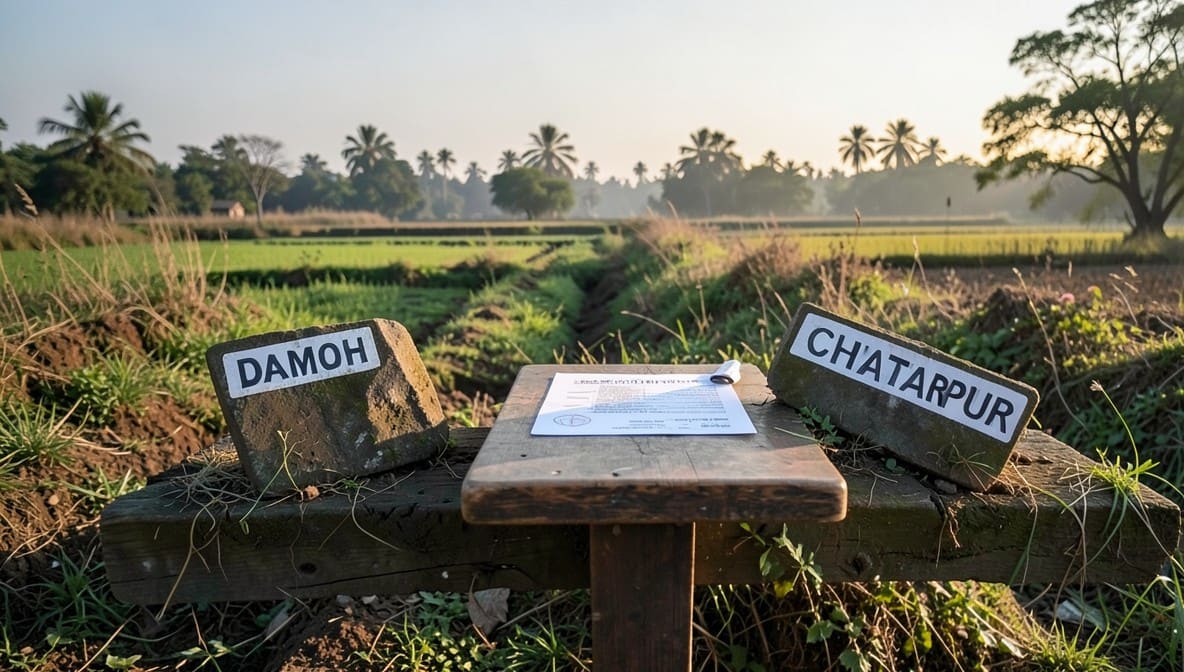
The dispute arises from competing claims over adjacent residential plots in Junnasandra Village, Varthur Hobli, Bengaluru East Taluk. The petitioners, M/s Vigneshwara Estates and its partners, filed O.S. No. 1938/2019 on 11.03.2019 seeking declaration of ownership and permanent injunction over land in Survey No. 34/4 measuring 24.79 guntas. The respondent, Mrs. P. Rajitha, filed O.S. No. 26214/2019 on 19.09.2019 seeking injunction against the petitioners over land in Survey No. 34/2 measuring 3 acres 5 guntas. Both suits involve claims of title based on registered sale deeds and gift deeds, and both allege encroachment and obstruction of possession.
Key Facts
The petitioners purchased the property in Survey No. 34/4 via a registered sale deed dated 21.08.2012.
On 21.08.2012, the petitioners acquired title to the property in Sy. No. 34/4.
In August 2018, the petitioners attempted to construct a compound wall and were obstructed by the defendant in O.S. 1938/2019.
On 30.08.2018, the petitioners conducted a survey of the property through the Taluk Surveyor.
In January 2019, the petitioners attempted to resolve the dispute amicably with the defendant.
The respondent claims title to Sy. No. 34/2 through a gift deed and asserts that the petitioners encroached upon her property on 12.09.2019.
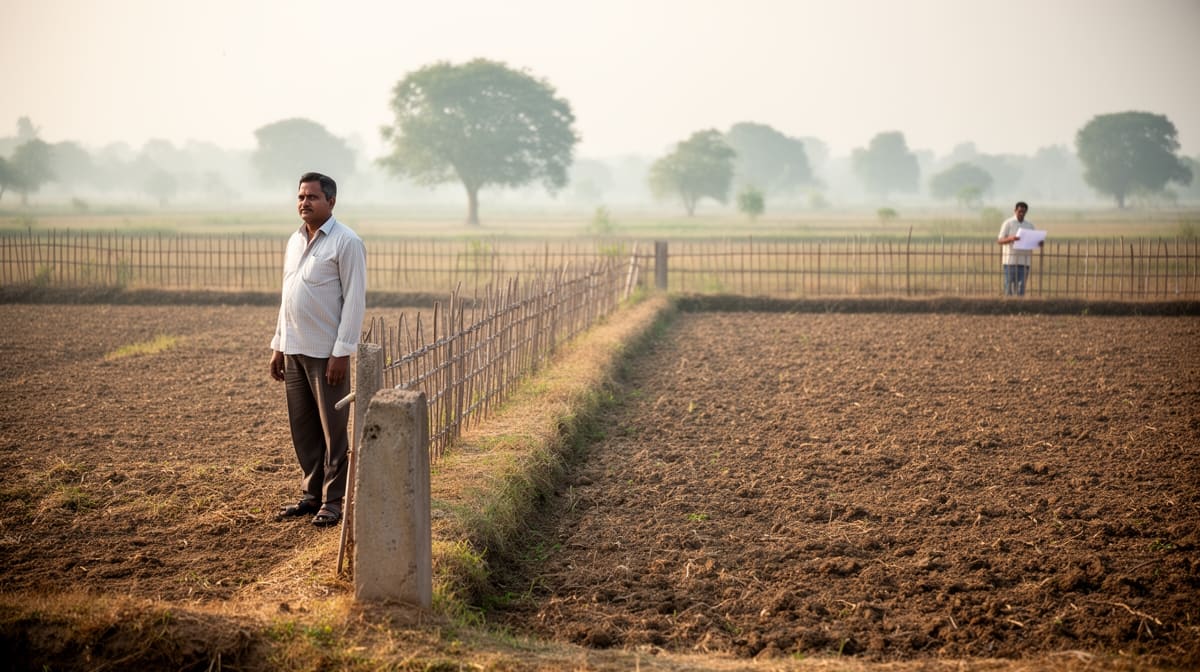
The boundaries of the two properties are distinct: Sy. 34/4 is bounded by Sy. 34/4 (east), a 40-feet road (west), Sy. 34/2 (north), and Sy. 34/4 (south); Sy. 34/2 is bounded by Sy. 34/3 and 34/4 (east), a 40-feet road (west), a 60-feet road (north), and Sy. 34/4 (south).
The respondent was not originally a party in O.S. 1938/2019; an application for impleadment was filed on 23.10.2019.
The respondent filed her suit on 19.09.2019, prior to the impleadment application.
Procedural History
11.03.2019: Petitioners file O.S. No. 1938/2019 before the XIII Additional City Civil and Sessions Judge, Bengaluru.
19.09.2019: Respondent files O.S. No. 26214/2019.
23.10.2019: Petitioners file application for impleadment of respondent in O.S. 1938/2019.
07.06.2021: Trial Court dismisses I.A. No. 3 filed by petitioners under Section 10 CPC seeking stay of O.S. 26214/2019.
23.04.2026: Written submissions and documents submitted by respondent in support of her position.
28.04.2026: Writ Petition No. 19309/2021 decided by the Karnataka High Court.
The Parties' Positions
For the Petitioners
The petitioners contended that both suits involve the same core issue - whether the property claimed by each party is one and the same or whether there is a boundary dispute. They argued that the subject matter is substantially identical, as both suits require the court to determine the true extent of ownership and possession over contiguous land. They relied on Gupte Cardiac Care Centre v. Olympic Pharma Care and Sri B. Krishnappa v. Sri Venkatachalapathi to argue that Section 10 CPC mandates stay to prevent conflicting decrees.
For the Respondent
The respondent argued that the suits involve entirely different properties (Sy. 34/4 vs. Sy. 34/2), different causes of action (obstruction in 2018 vs. encroachment in 2019), and different parties (initially). She contended that Section 10 CPC does not apply because the matter in issue is not directly and substantially identical. She relied on Ramalingam Chettiar v. P.K. Pattabiraman, Aspi Jal v. Khushroo Rustom Dadyburjor, and Uma Devi v. Anand Kumar to assert that the suits are distinct and that Section 21 of the Limitation Act rendered her suit prior in time for impleadment purposes.
Relief Sought
The petitioners sought quashing of the order dated 07.06.2021 dismissing I.A. No. 3 under Section 10 CPC, and a direction to stay O.S. No. 26214/2019. They also sought consolidation of both suits to avoid conflicting findings.
The Legal Issue
The central question was whether Section 10 of the Code of Civil Procedure, 1908 applies to stay a subsequent suit when the subject matter involves adjacent but legally distinct survey numbers, and the causes of action arise from different alleged acts of encroachment.
Arguments Presented
For the Appellant/Petitioner
The petitioners argued that despite different survey numbers, the core dispute is identical - the boundaries and ownership of contiguous land. They cited Gupte Cardiac Care Centre to assert that identity of parties is not absolute if the suits arise from the same transaction and involve overlapping claims. They emphasized that the trial court must determine whether the properties are one or two, making the issue directly and substantially in issue in both suits. They relied on Sri B. Krishnappa to argue that Section 10 applies when the final decision in one suit would operate as res judicata in the other.
For the Respondent/State
The respondent countered that the properties are legally distinct under revenue records, with different survey numbers, extents, and boundaries. She argued that the cause of action in O.S. 1938/2019 arose from obstruction in 2018, while in O.S. 26214/2019 it arose from encroachment in 2019. She cited Aspi Jal to stress that Section 10 requires strict identity of the matter in issue, not merely related disputes. She also invoked Ramalingam Chettiar to argue that the suit filed by her was prior in time under Section 21 of the Limitation Act, as impleadment did not alter the date of institution.
The Court's Analysis
The Court undertook a meticulous analysis of Section 10 CPC, emphasizing its mandatory nature: "No court shall proceed with the trial of any suit in which the matter in issue is also directly and substantially in issue in a previously instituted suit..." (Aspi Jal). The Court held that the phrase "directly and substantially in issue" excludes matters that are merely incidental, collateral, or overlapping.
"Section 10 applies only in a case where the whole of the subject-matter in both the suits is identical. The key words... are used in contradistinction to the words 'incidentally or collaterally in issue'."
The Court examined the plaints in both suits and found that the properties claimed were described with distinct survey numbers, boundaries, and extents. The petitioners’ suit concerned Sy. 34/4, bounded by Sy. 34/2 to the north; the respondent’s suit concerned Sy. 34/2, bounded by Sy. 34/4 to the south. The Court noted that while the properties are geographically adjacent, they are legally separate under revenue records.
Further, the causes of action were distinct: the petitioners’ suit arose from obstruction in 2018, while the respondent’s suit arose from alleged encroachment in September 2019. The Court held that these are not the same events, nor do they arise from the same transaction.
The Court acknowledged the respondent’s earlier filing of her suit (19.09.2019) before the impleadment application (23.10.2019), and noted that even if Section 21 of the Limitation Act applied, it did not alter the fundamental requirement of identity of matter in issue under Section 10 CPC.
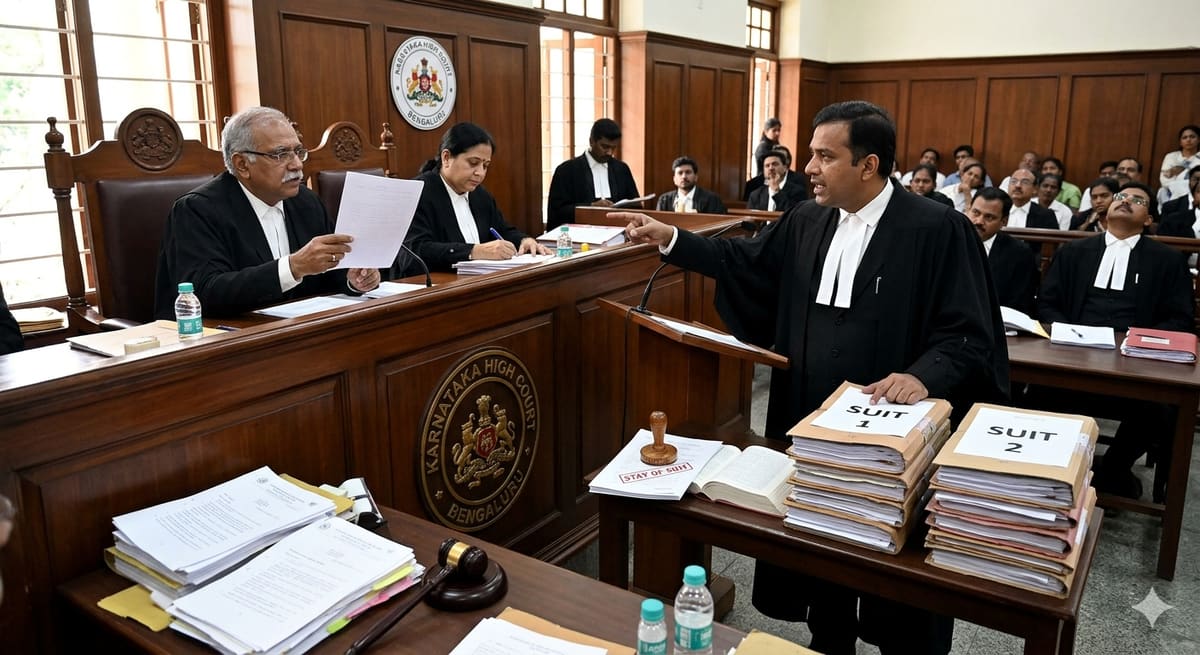
However, the Court observed that the respondent had filed Misc. Petition No. 1260/2024 seeking transfer of her suit to the court where the petitioners’ suit was pending - and that petition had been allowed. This meant both suits were now before the same court. The Court emphasized that while Section 10 CPC did not mandate a stay, the ends of justice required consolidation to avoid conflicting findings by the same court.
"There cannot be any divergent opinion of the same Court in two different suits... ends of justice would be met if both the suits are clubbed/consolidated together and disposed of to avoid conflicting views."
The Court explicitly declined to decide the merits of either suit or determine whether the properties are one or two, stating that such determination must be made at trial.
The Verdict
The writ petition was disposed of by directing the Trial Court to consolidate O.S. No. 1938/2019 and O.S. No. 26214/2019 and dispose of them together in accordance with law. The Court provided sufficient opportunity to both parties to present evidence and arguments on the nature of the property and the validity of their titles. No costs were awarded.
What This Means For Similar Cases
Section 10 CPC Requires Strict Identity of Matter in Issue
Practitioners must demonstrate that the core legal issue - not just the subject property - is identical in both suits.
Adjacent properties with different survey numbers, even if geographically contiguous, do not satisfy the "directly and substantially in issue" test under Section 10 CPC.
A claim of boundary dispute alone is insufficient; the pleadings must show that the same title, possession, or ownership question is being litigated in both suits.
Consolidation Is a Viable Alternative to Stay
When two suits involving overlapping claims are pending before the same court, consolidation under Order I Rule 8 or inherent powers is preferable to a Section 10 stay.
Courts may exercise discretion to consolidate even when Section 10 does not apply, to prevent conflicting judgments.
Practitioners should consider filing applications for consolidation early, especially when parties have already sought transfer of suits.
Limitation Act Does Not Override Section 10 CPC Requirements
Section 21 of the Limitation Act affects the date of institution for impleaded parties but does not alter the substantive test under Section 10 CPC.
A suit filed after impleadment cannot be treated as "prior" for Section 10 purposes if the original suit did not involve the same matter in issue.