A landmark ruling by the Bombay High Court has clarified that a counter-claim for partition and separate possession against co-defendants remains maintainable even when no relief is sought against the original plaintiff, reinforcing the principle that procedural technicalities must not defeat substantive justice. The judgment redefines the scope of Order VIII Rule 6-C of the CPC and reaffirms the applicability of Section 99 to preserve valid decrees.
Background & Facts
The Dispute
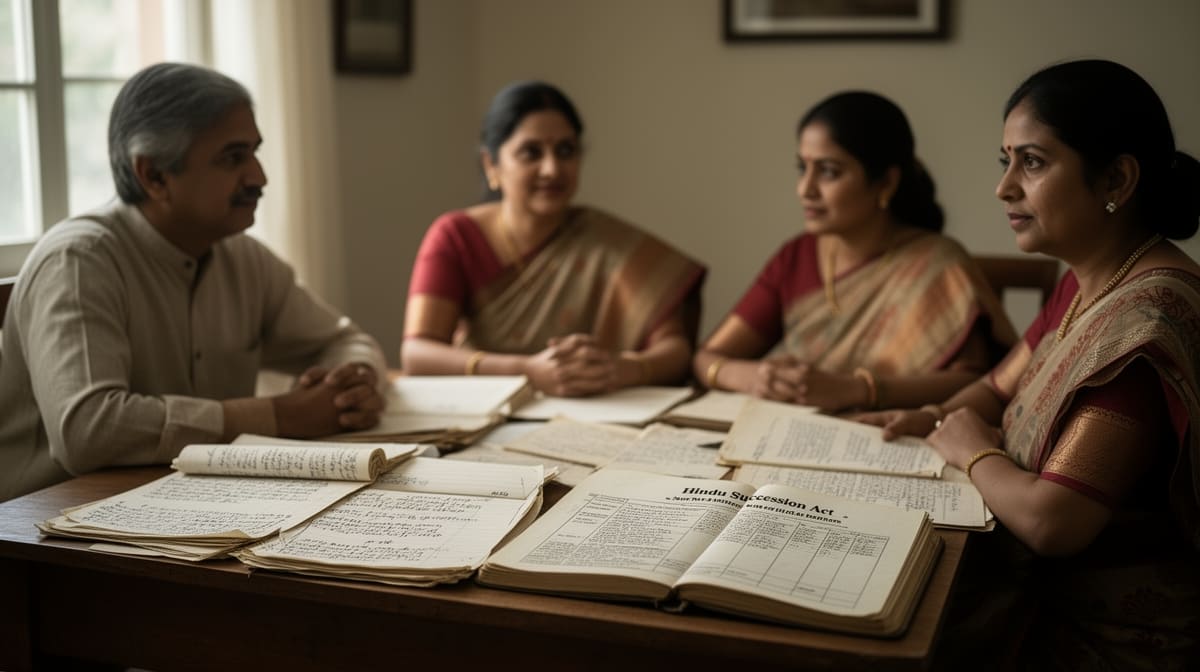
The dispute arose from a family partition matter involving ancestral property owned by a deceased Hindu male who died intestate after the commencement of the Hindu Succession Act, 1956. The original plaintiff, son of one of the sons, filed a suit for partition and separate possession of the property. The defendants included the deceased’s other sons and widow. After the widow’s death, her daughters were brought on record as legal representatives and filed a counter-claim seeking partition and separate possession of all suit properties, including two that had been sold by defendant Nos. 1, 2, and 3 to defendant No. 6.
Procedural History
- 2019: Trial Court dismissed the plaintiff’s suit but partially decreed the counter-claim, granting shares to the daughters of the deceased widow.
- 2021: First Appellate Court reversed the Trial Court’s decree, holding the counter-claim non-maintainable because no relief was sought against the original plaintiff.
- 2022: Second Appeal No. 275 of 2022 was admitted on five substantial questions of law, including maintainability of counter-claim and applicability of Section 99 CPC.
- 2026: Bombay High Court allowed the second appeal, restoring the Trial Court’s decree and granting partition rights to the daughters, including in the sold properties.
- 2026: Review applications filed under Section 114 read with Order 47 Rule 1 CPC, challenging the High Court’s reasoning on maintainability and Section 99.
Relief Sought
The applicants sought review of the High Court’s judgment, arguing that the counter-claim was legally non-maintainable due to absence of relief against the plaintiff, and that the Court erred in invoking Section 99 CPC to overlook jurisdictional defects.
The Legal Issue
The central question was whether a counter-claim for partition and separate possession against co-defendants is non-maintainable under Order VIII Rule 6-C of the CPC merely because no relief is sought against the original plaintiff, and whether such an objection constitutes a jurisdictional defect that cannot be cured under Section 99 CPC.
Arguments Presented
For the Appellant
Mr. M.G. Bhangde, Senior Advocate, contended that a counter-claim must seek relief against the plaintiff to be maintainable, citing Rohit Singh v. State of Bihar and Rajul Manoj Shah v. Kiranbhai Patel. He argued that the absence of a prayer against the plaintiff rendered the counter-claim jurisdictionally defective, akin to a suit without a cause of action. He further asserted that Section 99 CPC cannot override jurisdictional infirmities, and that the High Court erred by addressing a question not framed - namely, the scope of Section 99 - while ignoring the two core substantial questions on maintainability.
For the Respondent
The respondents, through their counsel, argued that the counter-claim was essentially a suit for partition in the form of a counter-claim, and that the Trial Court had full subject-matter jurisdiction. They relied on Multicon Builders v. Sumandevi, where this Court held that in partition suits, all parties are both plaintiffs and defendants, making the distinction between plaintiff and co-defendant artificial. They emphasized that dismissing the decree on technical grounds would force the claimants into redundant litigation, violating the spirit of Section 99 CPC and the principle of substantive justice.
The Court's Analysis
The Court undertook a rigorous analysis of the nature of partition suits and the procedural flexibility afforded under the CPC. It observed that in a partition suit, every party is simultaneously a plaintiff and a defendant, as each asserts a claim to the property against others. Therefore, the rigid distinction between plaintiff and co-defendant loses practical relevance.
"In a suit for partition, the legal position is that every party is both plaintiff and defendant. The counter-claim for partition against co-defendants is not a separate suit in form only - it is the same cause of action, merely pleaded differently."
The Court distinguished Rohit Singh and Rajul Manoj Shah, noting that those cases involved counter-claims where the relief sought was not inherently tied to the main suit’s subject matter. In contrast, the counter-claim here was for partition - a relief inherently co-extensive with the main suit. The Court held that the objection to maintainability was procedural, not jurisdictional, and thus fell squarely within the purview of Section 99 CPC, which mandates that no decree shall be reversed or modified merely on account of a technical defect if the merits are unaffected.
The Court further emphasized that the Trial Court had correctly computed shares, applied the Hindu Succession Act, 1956, and recognized the daughters’ equal inheritance rights. The sale deed to defendant No. 6 was held binding only to the extent of the sellers’ shares, not the appellants’. The Court cited multiple Supreme Court precedents - including Manohar Lal v. N.B.N. Supply, Union of India v. Jyoti Chit Fund, and Sugandhi v. P. Rajkumar - to underscore that procedural rules are handmaidens of justice, not instruments of denial.
The Court also corrected the erroneous observation in its earlier judgment that no objection to maintainability had been raised, acknowledging that the written statement did raise the issue. However, it held that this did not alter the outcome, as the objection was procedural and not jurisdictional.
The Verdict
The applicants’ review applications were dismissed. The Court held that a counter-claim for partition against co-defendants is maintainable even without a prayer against the original plaintiff, provided the subject matter is identical to the main suit. The decree granting partition rights to the daughters, including in the sold properties, was upheld. Section 99 CPC was held applicable to cure procedural irregularities that do not affect the merits.
What This Means For Similar Cases
Counter-Claims in Partition Suits Are Presumptively Maintainable
- Practitioners may now file counter-claims for partition against co-defendants without needing to name the original plaintiff as a respondent in the counter-claim.
- Courts must treat such claims as part of the same cause of action, not as jurisdictionally defective.
- The burden shifts to the objecting party to prove actual prejudice from the form of pleading, not mere non-compliance with formalistic requirements.
Section 99 CPC Shields Valid Decrees from Technical Attacks
- Any objection to form - such as omission of a party in a counter-claim - must be evaluated under Section 99 CPC before being grounds for reversal.
- Appellate courts must ask: Did the error affect the merits? If not, the decree stands.
- This prevents multiplicity of litigation and promotes judicial economy in family property disputes.
Judicial Discretion Must Favor Substantive Justice Over Procedural Formalism
- Courts must actively resist using technical objections to deny rightful inheritance claims, especially under the Hindu Succession Act.
- Advocates should routinely invoke Manohar Lal, Sugandhi, and Multicon Builders to counter objections based on pleading form.
- Drafting tip: Even if relief is sought only against co-defendants, include a general prayer for ‘such other relief as may be deemed fit’ to preempt technical challenges.