The Madras High Court recently dismissed a writ petition challenging the denial of promotion, clarifying that service regulations do not provide for automatic time-bound promotions. The judgment underscores that eligibility for promotion requires compliance with feeder category requirements and submission of willingness, reinforcing the principle that administrative promotions are vacancy-based and not guaranteed by mere tenure completion.
Background & Facts
The Dispute
The petitioner, A. Anand, was appointed as a Typist in the Chennai Metropolitan Development Authority (CMDA) on 19.05.2010. His probation was declared on 29.05.2012, and his services were regularized from 24.05.2010. The petitioner contended that under the Madras Metropolitan Development Authority Non-Technical Subordinate Service Regulations, 1980, he was eligible for promotion to the post of Junior Assistant after completing five years of service as a Typist. However, the respondent promoted him to Junior Assistant only on 19.07.2018, allegedly depriving him of his rightful promotion.
Key Facts
Appointment and Regularization:
Temporary appointment as Typist: 19.05.2010
Probation declared: 29.05.2012
Services regularized from: 24.05.2010
Qualifications:
Obtained Diploma in Electrical Engineering (DEE) during service
Submitted representations for promotion to Junior Engineer (Electrical) on 13.10.2015 and 16.03.2016, which were rejected on 09.08.2016
Promotion Eligibility:
Completed 5 years of service as Typist on 23.05.2015
Crucial date for panel preparation for 2016-2017: 31.03.2016
Submitted willingness for promotion to Junior Assistant only on 30.05.2018
Promoted to Junior Assistant on 19.07.2018
Representations for Direct Promotion to Assistant:
Submitted representations on 20.03.2019 and 03.06.2019 seeking direct promotion to Assistant from Typist
Procedural History
03.06.2019: Respondent issued impugned order (Memo No.E3/3987/2019) denying direct promotion to Assistant
Filing of Writ Petition: W.P.No.20654 of 2019 under Article 226 seeking quashing of the impugned order and direction for promotion
Miscellaneous Petition: WMP.No.10127 of 2022 seeking amendment to include prayer for retrospective seniority fixation from 2015
Judgment Date: 28.04.2026
Relief Sought
The petitioner sought:
Quashing of the impugned order dated 03.06.2019
Direction to the respondent to consider his promotion to Assistant directly from Typist
Fixation of seniority retrospectively from 2015
The Legal Issue
The central question was whether the Madras Metropolitan Development Authority Non-Technical Subordinate Service Regulations, 1980 provide for:
Automatic time-bound promotion upon completion of five years of service as Typist, or
Promotion by transfer of service requiring submission of willingness and compliance with feeder category requirements.
Arguments Presented
For the Petitioner
Eligibility for Promotion: Contended that under the Regulations, 1980, he became eligible for promotion to Junior Assistant upon completing five years of service as Typist.
Arbitrary Action: Argued that the respondent’s action in denying promotion and requiring willingness submission was illegal and arbitrary, as the Regulations did not prescribe such a requirement.
Direct Promotion to Assistant: Claimed that the Regulations permitted promotion directly to Assistant from Typist, bypassing the feeder category of Junior Assistant.
Lack of Awareness: Asserted that he was deputed to the Secretariat and was unaware of the requirement to submit willingness for promotion.
For the Respondent
No Automatic Promotion: Contended that the Regulations did not provide for automatic time-bound promotion and required submission of willingness for consideration.
Feeder Category Compliance: Argued that promotion to Junior Assistant required completion of five years in the feeder category (Typist/Steno Typist) and submission of willingness by the crucial date (31.03.2016).
Ratio for Promotion: Stated that vacancies for Junior Assistant were filled in the ratio of 5:1 (Direct Recruitment: Promotion), and not all eligible employees were automatically considered.
No Direct Promotion to Assistant: Contended that promotion to Assistant required prior appointment as Junior Assistant and compliance with Regulation No.3 and Regulation No.5 of the Regulations.
Petitioner’s Awareness: Asserted that the petitioner was aware of the promotion process, as evidenced by his representations for Junior Engineer (Electrical).
The Court's Analysis
The Court conducted a detailed examination of the Madras Metropolitan Development Authority Non-Technical Subordinate Service Regulations, 1980, focusing on the following key aspects:
1. No Automatic Time-Bound Promotion
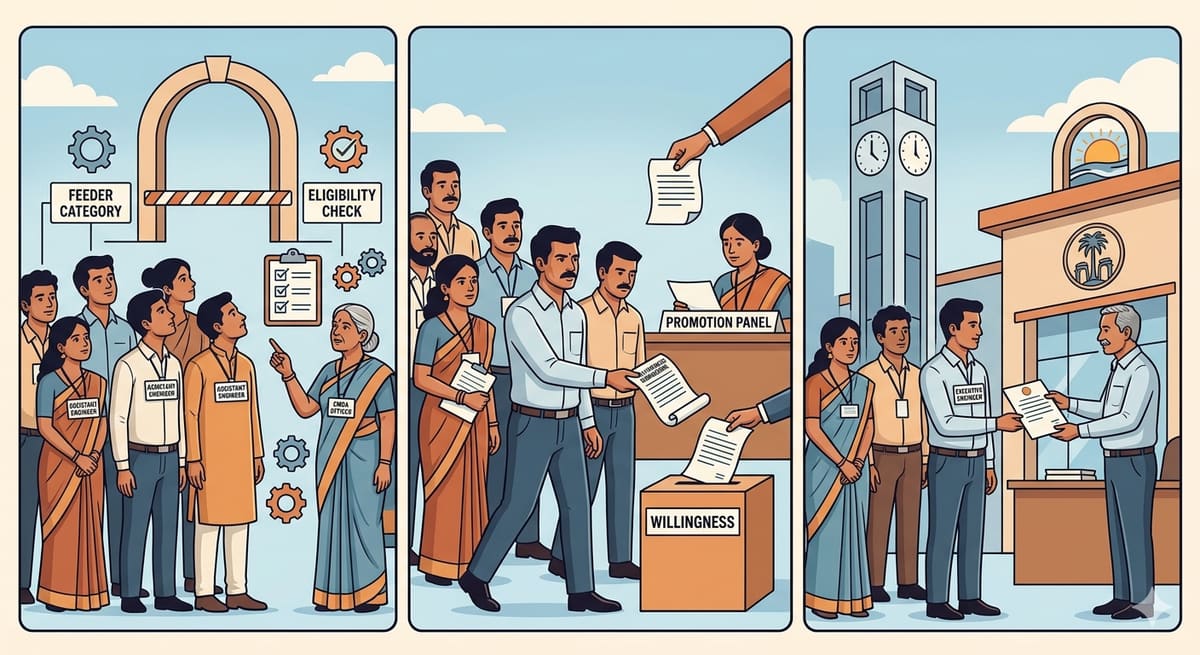
The Court held that the Regulations do not provide for automatic time-bound promotion upon completion of five years of service. Promotion to Junior Assistant is contingent upon:
Eligibility: Completion of five years in the feeder category (Typist/Steno Typist)
Willingness Submission: Expression of willingness to be considered for promotion
Vacancy Availability: Filling of vacancies in the ratio of 5:1 (Direct Recruitment: Promotion)
"The claim of the petitioner of he having become entitled for a time bound promotion is not borne out from the Regulation and thus, the said contention is liable to be rejected."
2. Promotion by Transfer of Service
The Court clarified that promotion to Junior Assistant is not automatic but requires transfer of service from the feeder category. The respondent is not obligated to consider all eligible employees unless they submit willingness by the crucial date (31.03.2016).
"The post of Junior Assistant being a separate category of post, the same was sought to be filled up by way of Direct Recruitment as well as by way of promotion from the feeder category."
3. Petitioner’s Lack of Compliance
The Court noted that the petitioner did not submit willingness for promotion to Junior Assistant by the crucial date (31.03.2016). His promotion on 19.07.2018 was accepted without protest, thereby estopping him from claiming retrospective seniority.
"Since the crucial date for the year 2015 being 31st March, 2015, by which time the petitioner having not completed 5 years of service, the petitioner cannot claim that he became eligible for being considered to the post of Junior Assistant."
4. Direct Promotion to Assistant Not Permissible
The Court examined Regulation No.3 and Regulation No.5 of the Regulations and held that promotion to Assistant requires:
Prior Appointment as Junior Assistant: The employee must be working in category-5 (Junior Assistant) or on deputation in the Tamil Nadu Secretariat Service or Tamil Nadu Ministerial Service
Qualification Compliance: Possession of a degree or experience in category-5, 7, or 8 for the prescribed period
"In order to be appointed to the post of ‘Assistant’ on promotion by way of transfer of service, one must be working in the category - 5 that is, Junior Assistant..."
The Court observed that the petitioner failed to file complete Regulations, specifically omitting pages 31 and 32, which likely contained critical provisions. The Court relied on the Government-approved Regulations (G.O.Ms.No.210, dated 26.02.1980) to interpret the legal framework.
5. Harmonious Construction of Regulations
The Court applied the principle of harmonious construction to reconcile Regulation No.3 and Regulation No.5, holding that:
Method of Appointment (Regulation No.3) takes precedence over Special Qualifications (Regulation No.5)
Employees in category-7 or 8 cannot bypass the requirement of working in category-5 (Junior Assistant) to be promoted to Assistant
The Verdict
The Court dismissed the writ petition, holding:
The petitioner’s claim for automatic time-bound promotion was without merit, as the Regulations required submission of willingness and compliance with feeder category requirements.
The petitioner failed to submit willingness by the crucial date (31.03.2016) and thus was not entitled to retrospective seniority fixation.
Direct promotion to Assistant from Typist was not permissible under the Regulations, as the petitioner did not satisfy the prerequisite of working in category-5 (Junior Assistant).
The impugned order dated 03.06.2019 was legal and valid, and no directions were issued for retrospective promotion or seniority fixation.
No costs were awarded.
What This Means For Similar Cases
Promotion Eligibility Requires Active Compliance
Employees must actively submit willingness for promotion within the prescribed timeline. Mere completion of tenure does not guarantee promotion.
Crucial dates for panel preparation (e.g., 31.03.2016) are binding, and failure to comply may result in forfeiture of promotion opportunities.
Feeder Category Compliance is Mandatory
Promotion to higher posts (e.g., Assistant) requires prior appointment in the feeder category (Junior Assistant). Employees cannot bypass intermediate cadres.
Regulation No.3 (Method of Appointment) prevails over Regulation No.5 (Special Qualifications), emphasizing the importance of harmonious construction of service rules.
Retrospective Seniority Fixation is Rare
Courts are reluctant to grant retrospective seniority unless there is clear arbitrariness or violation of statutory rules.
Employees accepting promotions without protest may be estopped from claiming retrospective benefits later.
Documentary Completeness is Critical
Parties must file complete and accurate copies of Regulations to avoid adverse inferences. Omission of critical provisions (e.g., pages 31 and 32) may weaken legal arguments.
Courts may rely on Government-approved Regulations over incomplete filings to interpret legal frameworks.