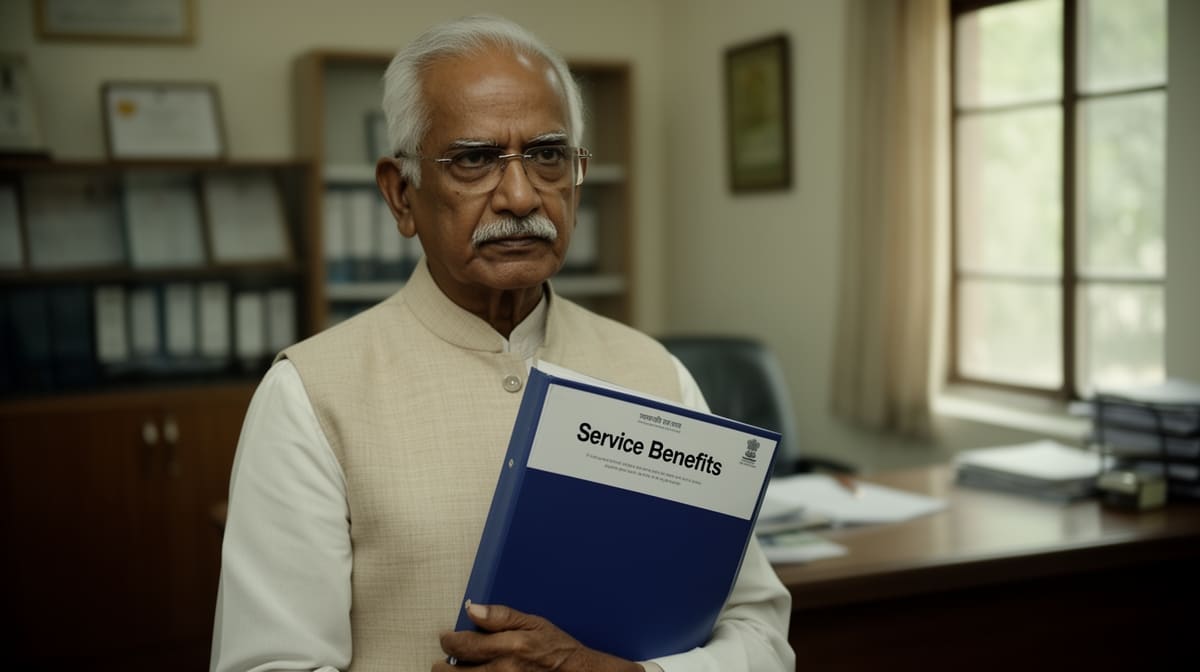
A landmark ruling by the Madras High Court has affirmed that an employee’s accrued right to promotion, established on the crucial eligibility date, cannot be extinguished by administrative delays in governmental approval - even if superannuation occurs before formal sanction. This decision reinforces the principle that procedural laches of the state cannot prejudice the legitimate expectations of public servants.
Background & Facts
The Dispute
The respondent, K. Harikrishnan, was promoted to Assistant Director in 2007-08 and to Deputy Director in 2013-14. He became eligible for promotion to Joint Director of Agriculture on the crucial date of 01.04.2017, as per the applicable service rules. His name was duly included in the promotion panel, which was forwarded to the Government for approval. However, the Government delayed approval until 19.07.2017. The respondent superannuated on 30.06.2017, prior to approval, and was consequently denied the promotion.
Procedural History
- 01.04.2017: Respondent became eligible for promotion to Joint Director
- Before 30.06.2017: Name included in promotion panel and submitted to Government
- 30.06.2017: Respondent superannuated
- 19.07.2017: Government approved the panel
- 2018: Writ petition filed in Madras High Court challenging denial of promotion
- 14.02.2025: Writ Court allowed the petition, directing notional promotion
- 2026: Government filed writ appeal under Clause 15 of the Letters Patent
Relief Sought
The respondent sought notional promotion to the post of Joint Director of Agriculture, with consequential benefits, arguing that his right had accrued on 01.04.2017 and that administrative delay could not defeat a vested right.
The Legal Issue
The central question was whether an employee’s accrued right to promotion, established on the crucial eligibility date, can be denied solely due to administrative delay in governmental approval, even if superannuation occurs before formal sanction.
Arguments Presented
For the Appellants
The State contended that since the promotion panel was approved only on 19.07.2017 - after the respondent’s superannuation on 30.06.2017 - he was no longer in service and therefore ineligible for any form of promotion, including notional promotion. Reliance was placed on the principle that promotion is a privilege contingent on active service at the time of sanction.
For the Respondent
The respondent argued that his eligibility had crystallized on 01.04.2017, and his inclusion in the panel demonstrated the State’s recognition of his entitlement. He cited precedents holding that administrative inaction cannot deprive a public servant of a right that has already accrued. He emphasized that notional promotion is a judicial remedy to rectify state-caused delays, not a discretionary benefit.
The Court's Analysis
The Court examined the doctrine of accrued rights in service law and distinguished between eligibility and sanction. It held that once an employee meets the qualifying conditions on the crucial date, the right to consideration becomes vested. The Court observed that the State’s delay in approving the panel was neither attributable to the respondent nor justified by any legal or procedural requirement.
"The right of consideration for promotion has accrued as on 01.04.2017... denial to him even of notional promotion because of the administrative delay caused by the approving authority cannot be accepted."
The Court rejected the State’s argument that promotion must be granted while in service, noting that notional promotion is a well-established equitable remedy in service jurisprudence to prevent injustice arising from bureaucratic inertia. It cited State of Punjab v. Jagjit Singh and Union of India v. R.S. Sharma to affirm that when a candidate is eligible and included in the panel, the State cannot use its own delay as a shield to deny benefits.
The Court further clarified that the doctrine of laches applies against the State when it fails to act expeditiously in matters affecting fundamental service rights. The respondent’s right was not contingent on the date of approval but on the date of eligibility.
The Verdict
The respondent won. The Madras High Court upheld the Writ Court’s order, holding that an employee’s accrued right to promotion on the crucial eligibility date cannot be defeated by administrative delay. The Court directed the Department to grant notional promotion with all consequential benefits within eight weeks.
What This Means For Similar Cases
Accrued Rights Trump Administrative Laches
- Practitioners must now argue that eligibility on the crucial date creates a vested right, irrespective of when approval is granted
- Denial of promotion due to delayed approvals is legally unsustainable if the employee was eligible and included in the panel
- Administrative delays by government departments cannot be invoked to circumvent statutory or service rule entitlements
Notional Promotion Is a Remedial, Not Discretionary, Remedy
- Notional promotion is not a favor but a corrective measure to undo injustice caused by state inaction
- Courts will not permit the State to benefit from its own procedural failures
- This precedent applies equally to promotions, pay fixation, and seniority claims where eligibility is fixed on a specific date
Procedural Compliance Must Be Timely
- Government departments must establish internal timelines for processing promotion panels
- Delays beyond reasonable periods will invite judicial intervention under Article 14 and 16 of the Constitution
- Service rules must be interpreted to protect employees from systemic inefficiencies