The Central Excise and Service Tax Appellate Tribunal, Hyderabad, has reaffirmed a foundational principle in indirect tax jurisprudence: substantive rights cannot be forfeited due to technical or procedural lapses when the underlying transaction is genuine and tax has been duly paid. This ruling provides critical clarity for businesses relying on input service credits across multiple operational units.
Background & Facts
The Dispute
The appellant, M/s South India Corporation Ltd, engaged in stevedoring operations for M/s Tamil Nadu Electricity Board at its Visakhapatnam unit, outsourced ancillary services - including water sprinkling, yard cleaning, and supervision - to M/s Chettinad Port Services Pvt Ltd, Chennai. Between June 2008 and March 2009, the service provider issued five invoices to the appellant for these services. The appellant availed Cenvat credit on these invoices during the half-year ending September 2009. The department denied the credit, asserting procedural non-compliance with Rule 4(A) of the Service Tax Rules, 1994.
Key Facts
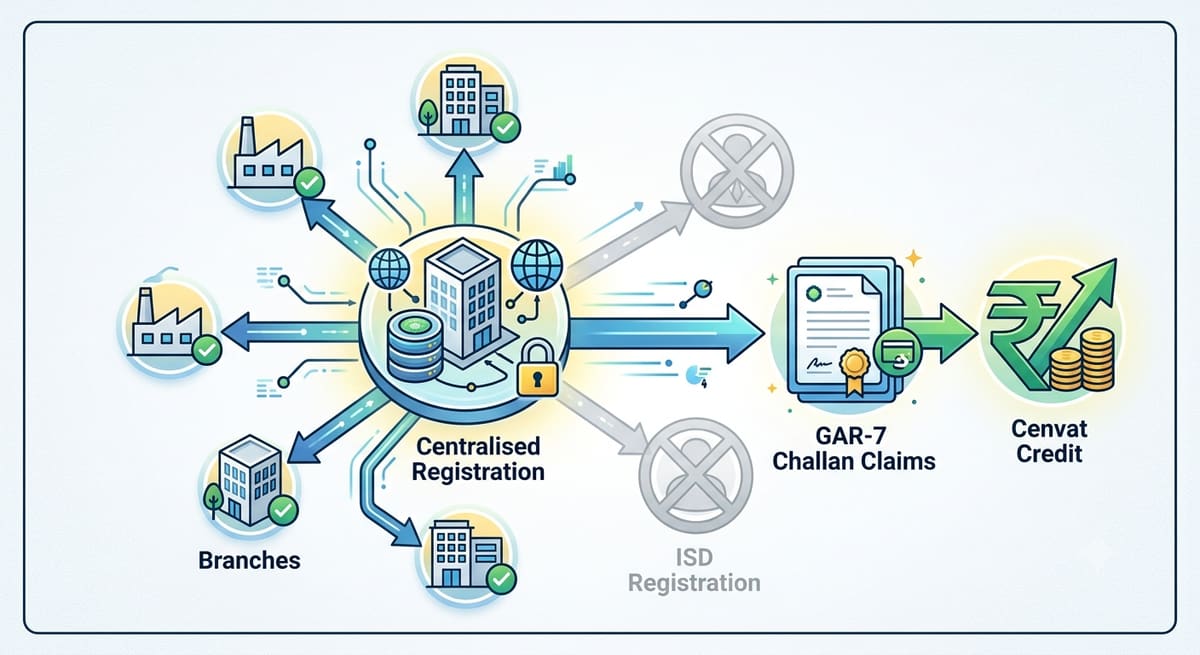
- The appellant’s head office is located in Chennai; all contractual and financial dealings with clients and service providers are managed from there.
- The Visakhapatnam unit is a branch office solely executing stevedoring operations under the supervision and direction of the Chennai head office.
- Daily operational reports from the Visakhapatnam unit are sent to Chennai, which then raises bills to M/s Tamil Nadu Electricity Board.
- Payments from the client are received at the Chennai head office; funds for branch expenses are transferred accordingly.
- The five invoices were issued by the service provider from Chennai, addressed to the appellant’s Chennai office, though services were physically rendered at Visakhapatnam.
- The invoices did not include the appellant’s service tax registration number, were issued prior to the appellant’s registration, and did not reflect the Visakhapatnam address.
- The appellant had not registered as an Input Service Distributor (ISD) under the Service Tax Rules.
- The service tax on the invoices was paid by the service provider, and the appellant did not dispute the receipt or use of the services.
Procedural History
- 30.05.2012: Commissioner of Customs, Central Excise & Service Tax, Visakhapatnam-I, passed Order-in-Original No. VIZ-STX-001-078-12 denying Cenvat credit of Rs. 1,07,07,142/- with interest and penalty under Section 11AC of the Central Excise Act, 1944.
- 17.12.2025: Hearing before the CESTAT Hyderabad Division Bench.
- 10.04.2026: Final Order passed allowing the appeal.
Relief Sought
The appellant sought reversal of the order dated 30.05.2012, restoration of the Cenvat credit of Rs. 1,07,07,142/-, and cancellation of interest and penalty imposed under Section 11AC.
The Legal Issue
The central question was whether Cenvat credit can be denied solely on account of procedural deficiencies in invoices - such as address mismatch, issuance prior to registration, and non-registration as an Input Service Distributor - when the services were actually received, the tax was paid, and the recipient and provider are part of the same legal entity.
Arguments Presented
For the Appellant
The appellant’s counsel argued that the head office and branch are part of a single legal entity, and the procedural irregularities in the invoices were technical and curable. She relied on CCE v. MDS Switchgear Ltd and Doshion Ltd v. CCE, Ahmedabad to establish that denial of credit for non-adoption of ISD mechanism or address mismatch is unjustified where there is no revenue loss. She emphasized that the appellant had not claimed any undue benefit and that the transaction was fully compliant in substance.
For the Respondent
The respondent reiterated the adjudicating authority’s position that the invoices failed to comply with Rule 4(A) of the Service Tax Rules, 1994, particularly regarding mandatory particulars such as registration number and correct address. It was contended that non-registration as an ISD rendered the credit ineligible, and that the mismatch between invoice address and place of service receipt invalidated the claim.
The Court's Analysis
The Tribunal examined the nature of the procedural defects and their impact on revenue. It observed that the service tax had been paid by the service provider, the services were actually received and utilized in the course of business, and the appellant and its branch are part of the same legal entity. The Court held that the denial of credit on grounds of invoice irregularities was misplaced.
"The omission to take registration as an Input Service Distributor can at best be considered as procedural irregularity and in view of the decisions cited, has to be considered sympathetically. Further, it is also noticed that appellant has not got any extra benefit by doing this. In fact from the statement of Shri Chandresh C. Shah, as explained that above Cenvat credit available to them, 20% of service tax payable only was paid and balance was paid in cash. In fact, proper distribution would have enabled them to utilise full credit. It would show that the exercise is totally Revenue neutral and no loss has been caused to the Revenue (infact Revenue has gained)."
The Tribunal distinguished between substantive non-compliance and technical irregularities. It held that the absence of registration number and address mismatch on invoices were curable defects under settled jurisprudence. The non-adoption of the ISD mechanism, while not ideal, did not create any tax advantage or revenue loss, as the credit was not claimed twice and the tax had been paid. The Court emphasized that the principle in CCE v. MDS Switchgear Ltd applies squarely: substantive benefit cannot be denied for procedural lapses.
The Verdict
The appeal was allowed. The Tribunal set aside the order dated 30.05.2012, restored the Cenvat credit of Rs. 1,07,07,142/-, and cancelled the interest and penalty imposed under Section 11AC of the Central Excise Act, 1944. The order directed consequential relief as per law.
What This Means For Similar Cases
Procedural Defects Are Curable in Tax Credit Claims
- Practitioners may now confidently challenge denial of Cenvat credit where services are received, tax is paid, and the recipient is the same legal entity, even if invoices lack registration numbers or reflect head office addresses.
- The burden shifts to the department to prove actual revenue loss or fraud - not mere technical non-compliance.
ISD Registration Is Not Mandatory for Credit Eligibility
- Businesses operating through branches without ISD registration can claim input service credit if the services are used for output services and no double claim is made.
- The absence of ISD registration is a procedural oversight, not a disqualifying condition under the law as it stood during the relevant period.
Substantive Compliance Trumps Formalities
- Tax authorities must distinguish between genuine non-compliance and administrative oversights.
- Invoices issued prior to registration are valid if tax is subsequently paid and services rendered.
- Legal advice should now emphasize documenting service receipt and tax payment to fortify credit claims against technical objections.