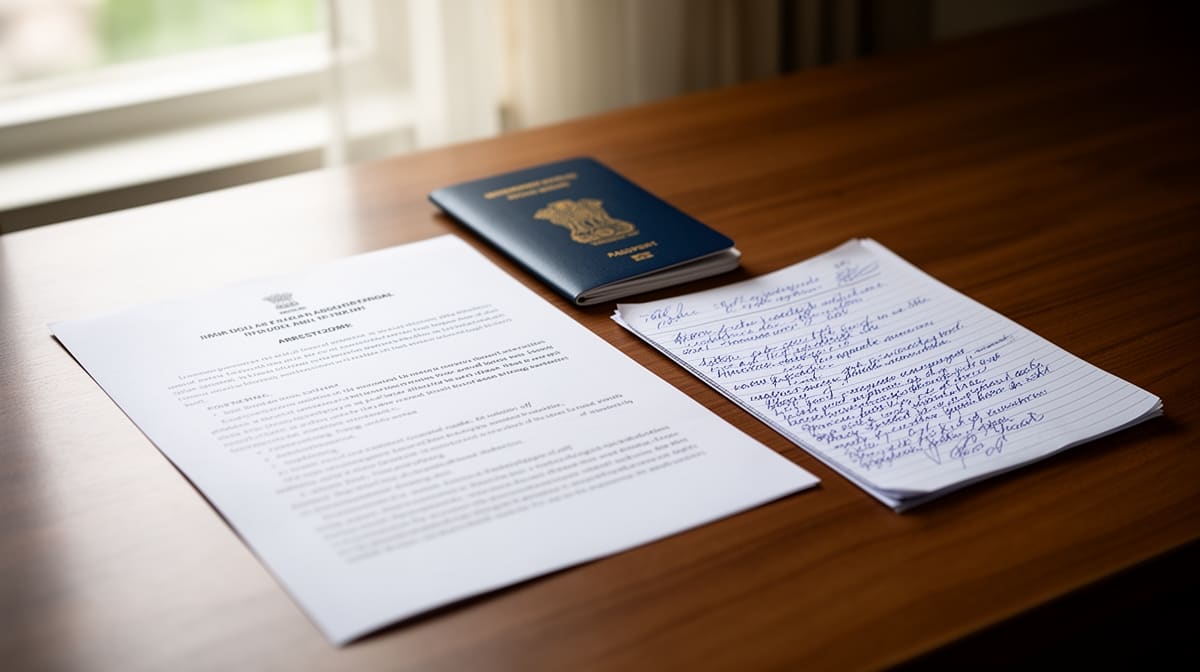
The High Court of Kerala has reaffirmed that the constitutional right to be informed of the grounds of arrest is not a procedural formality but a non-negotiable safeguard under Article 22(1). In a landmark ruling, the Court granted bail to an accused charged with murder and acid attack after finding that the police failed to communicate the grounds of arrest in writing, rendering the arrest and subsequent remand legally void.
Background & Facts
The Dispute
The applicant, Praseeth G, was arrested on 14 April 2024 in connection with Crime No. 277/2024 of Manimala Police Station, Kottayam. He is accused alongside another individual of conspiring to commit murder under Section 302 IPC, causing grievous hurt by acid under Section 326A IPC, and criminal conspiracy under Section 120B IPC, all read with Section 34 IPC. The prosecution alleges a premeditated attack involving intoxication and acid, resulting in the victim’s death.
Procedural History
- 13 April 2024: Alleged incident occurred.
- 14 April 2024: Applicant arrested without written communication of grounds.
- 3 November 2025: Bail application rejected by Additional District and Sessions Court, Kottayam.
- 9 February 2026: Bail application filed before Kerala High Court under Section 483 of the Bharatiya Nagarik Suraksha Sanhita, 2023 (BNSS).
Relief Sought
The applicant sought regular bail on the ground that his arrest was illegal due to non-compliance with the mandatory requirement under Article 22(1) of the Constitution and Section 47 of BNSS to communicate the grounds of arrest.
The Legal Issue
The central question was whether failure to communicate the grounds of arrest in writing, as required by Article 22(1) and Section 47 of BNSS, renders the arrest illegal and entitles the accused to bail, even in cases involving grave offences like murder.
Arguments Presented
For the Petitioner
The petitioner’s counsel argued that the arrest was void ab initio because the police failed to inform the accused of the grounds of arrest in writing or orally at the time of arrest. Reliance was placed on Pankaj Bansal v. Union of India, Prabir Purkayastha v. State (NCT of Delhi), and Mihir Rajesh Shah v. State of Maharashtra, which collectively establish that written communication of grounds is mandatory and non-negotiable. The counsel emphasized that the absence of such communication violates Article 21 and Article 22(1), and cannot be cured by subsequent filing of the charge sheet.
For the Respondent
The Special Public Prosecutor contended that the arrest was lawful under Chapter V of BNSS and that the accused was aware of the nature of the allegations through the FIR and subsequent proceedings. It was argued that substantial compliance was sufficient and that no demonstrable prejudice was shown. The State also relied on State of Karnataka v. Sri Darshan to suggest that oral communication may suffice in absence of written notice.
The Court's Analysis
The Court undertook a comprehensive review of recent Supreme Court jurisprudence on the right to be informed of grounds of arrest. It held that the requirement under Article 22(1) is not a technicality but a foundational safeguard for personal liberty. The Court rejected the State’s reliance on Sri Darshan, distinguishing it on facts: that case involved bail cancellation after charge sheet filing, not initial arrest validity.
"The right to be informed about the grounds of arrest flows from Article 22(1) of the Constitution, and any infringement of this fundamental right would vitiate the process of arrest and remand."
The Court affirmed the principles laid down in Mihir Rajesh Shah and Vihaan Kumar, holding that written communication of grounds is mandatory in all cases, including those under IPC/BNS. While oral communication is permissible initially, it must be followed by written communication within a reasonable time, and in any case, at least two hours before production before the Magistrate. The Court found no evidence in the case diary that the applicant was informed of the grounds in writing or even orally.
The Court further held that the burden of proving compliance rests squarely on the investigating agency. Since the State failed to discharge this burden, the arrest and remand were declared nonest. The Court emphasized that filing a charge sheet or obtaining cognizance cannot validate an unconstitutional arrest.
The Verdict
The petitioner won. The Court held that failure to communicate the grounds of arrest in writing violates Article 22(1) and renders the arrest illegal. The applicant was granted regular bail subject to conditions, including a bond of ₹1,00,000 with two sureties, cooperation with investigation, and restrictions on witness contact and travel outside Kerala.
What This Means For Similar Cases
Arrest Is Not Automatic, Even in Heinous Crimes
- Practitioners must now challenge arrests in all cases - whether under IPC, BNSS, or special laws - where written grounds are not furnished.
- Gravity of offence does not override the constitutional mandate under Article 22(1).
- Bail applications should routinely include a ground challenging arrest legality due to non-communication of grounds.
Burden of Proof Lies with the Investigating Agency
- Police must maintain and produce documentary proof of communication (written notice, signed acknowledgment, audio/video record).
- Oral testimony by police officers alone is insufficient to discharge the burden.
- In NDPS cases, failure to specify quantity of contraband in grounds renders arrest invalid.
Written Communication Is Now the Standard
- All arrests must be accompanied by a written notice in the language understood by the accused.
- If written notice is delayed, it must be provided at least two hours before production before the Magistrate.
- Courts will not accept post-hoc justifications or reliance on FIRs as substitutes for individualized grounds.