The Madhya Pradesh High Court has clarified that the mere existence of procedural irregularities in the transportation of licensed liquor - such as route deviation or permit expiry - cannot justify denial of custody to an innocent licensee when the seizure stems from the misconduct of an employee. This ruling reinforces the principle that due process must distinguish between corporate liability and individual culpability in regulatory enforcement.
Background & Facts
The Dispute
The petitioner, Smt. Preeti Jayswal, is a licensed retail dealer of liquor under the Madhya Pradesh Excise Department. On 28.01.2026, two trucks carrying her legally purchased liquor were seized by police at Tanda Police Station, District Dhar, following the registration of Crime No. 13 of 2026 under Section 34(2) of the Madhya Pradesh Excise Act, 1915. The seized goods included 1390 boxes (16,680 bulk litres) from truck MP-09 HG-8900 and 1385 boxes (16,620 bulk litres) from truck MP-69 H-6121, both bearing the brand "Mount 6000 Beer".
Key Facts
- The petitioner had lawfully procured the liquor through authorized channels and held a valid retail license
- The liquor was intended for delivery to her licensed shop in Indore
- The transportation permit for both trucks expired on 27.01.2026 at 09:44 PM and 09:47 PM respectively
- The seizure occurred on 28.01.2026 at approximately 03:00 PM and 04:45 PM, over 137 kilometers from Indore, near Tanda
- The batch numbers on the seized boxes showed a discrepancy: batch 175 (dated 17.12.2025) was initially unverified
- The petitioner’s manager, Sunny @ Swapnil Waghmare, allegedly diverted the liquor without her knowledge
- The petitioner filed an application under Section 451 read with Section 457 of the CrPC (now Section 497 read with Section 503 of the BNSS, 2023) seeking custody of the seized liquor
Procedural History
- 28.01.2026: Seizure of liquor by police at Tanda Police Station
- 18.02.2026: Judicial Magistrate First Class, Kukshi, rejected the petitioner’s application for custody of seized liquor
- 19.06.2026: High Court directed verification of batch number records by the warehouse manager
- 23.06.2026: Final hearing before the High Court
Relief Sought
The petitioner sought quashing of the order dated 18.02.2026 and immediate release of the seized liquor, arguing that irreparable loss would occur if the liquor became unfit for consumption by its expiry date of 27.06.2026.
The Legal Issue
The central question was whether the denial of custody of seized liquor under Section 451 CrPC / Section 503 BNSS can be justified solely on grounds of permit expiry, route deviation, or minor batch number discrepancies when the licensee is not personally culpable and has established lawful ownership.
Arguments Presented
For the Petitioner
The petitioner’s counsel argued that the petitioner, as a licensed dealer, was the lawful owner of the liquor and had no knowledge of the manager’s misconduct. The batch number discrepancy had been resolved by the warehouse manager’s verification, confirming issuance to the petitioner. The route deviation and permit expiry were administrative lapses attributable to the manager, not the licensee. Denial of custody would cause irreparable financial loss as the liquor would expire by 27.06.2026, rendering it valueless. The petitioner was willing to furnish security equivalent to the value of the goods.
For the Respondent
The State’s counsel conceded that the batch number issue had been resolved but maintained that the route deviation and permit expiry were material breaches under the Excise Act. He argued that the petitioner bore responsibility for her employee’s actions and must prove lack of knowledge or complicity. He opposed release without conclusive proof of the petitioner’s innocence.
The Court's Analysis
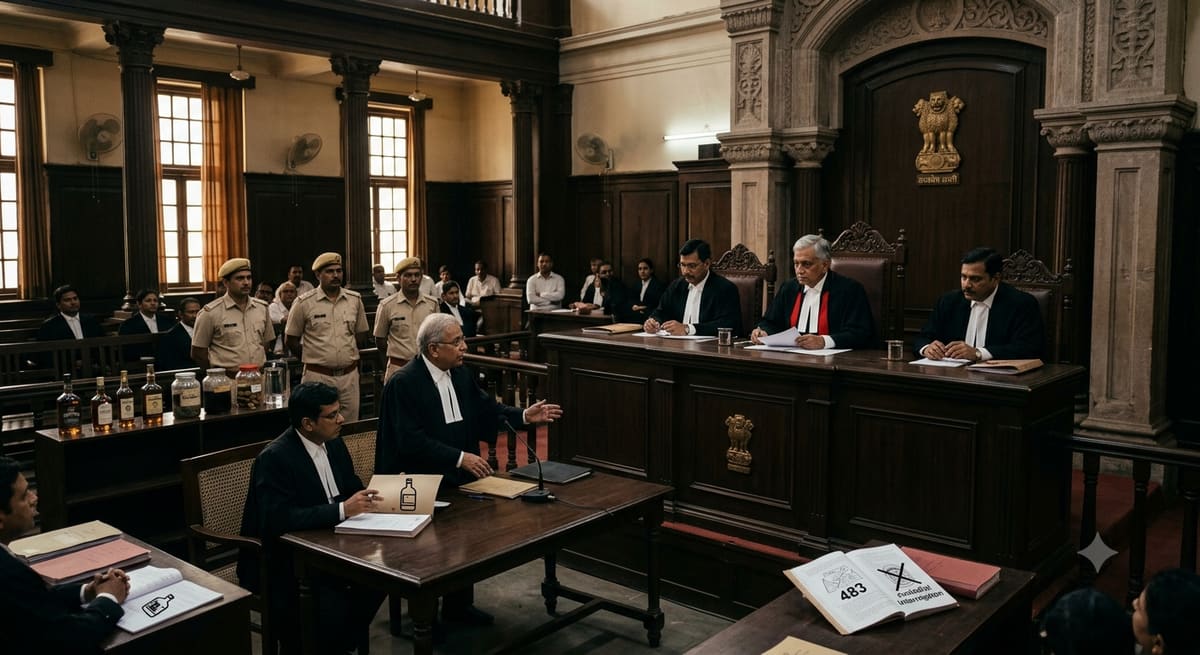
The Court examined the purpose of Section 451 CrPC / Section 503 BNSS, which permits the release of seized property to its lawful owner pending trial, provided the interests of justice and investigation are safeguarded. The Court noted that the petitioner had established lawful possession through procurement records and license status. The batch number discrepancy, once clarified, ceased to be a valid ground for denial.
"At this stage, once it has been established that the petitioner is the person to whom the seized liquor was issued by the concerned authority, for the deviation in the route and for expiry of the permit, it will not be in the interest of any of the parties, that the custody of the goods be denied."
The Court emphasized that the issues of route deviation and permit expiry were matters for trial and could not be used to deprive a lawful owner of property pending adjudication. The Court further held that the risk of loss to the State could be mitigated by requiring the petitioner to furnish security equivalent to the value of the seized goods. The Court rejected the notion that vicarious liability of an employee automatically negates the owner’s right to custody under the CrPC/BNSS.
The Verdict
The petition was allowed. The order dated 18.02.2026 rejecting custody was quashed. The petitioner is directed to be given custody of 1390 boxes (16,680 bulk litres) from truck MP-09 HG-8900 and 1385 boxes (16,620 bulk litres) from truck MP-69 H-6121. The petitioner shall furnish security equivalent to Rs. 38,36,400 for the first truck and Rs. 38,22,600 for the second truck, totaling Rs. 76,59,000. The warehouse manager shall provide the exact valuation to the trial court by 24.06.2026. All pending applications are disposed of.
What This Means For Similar Cases
Custody Rights Prevail Over Procedural Irregularities
- Practitioners may now argue that Section 451 CrPC / Section 503 BNSS entitles lawful owners to custody of seized goods even if administrative violations occurred, provided ownership is established
- Mere permit expiry or deviation from route cannot override the statutory right to custody unless there is evidence of the owner’s complicity
Security as a Substitute for Detention
- Courts may now routinely direct security deposits equivalent to the value of seized goods as a condition for release, balancing investigative needs with property rights
- This avoids destruction of perishable goods and prevents unjust enrichment of the State through forfeiture
Employee Misconduct Does Not Automatically Implicate Employer
- In excise, tax, and regulatory cases, the burden lies on the prosecution to prove the licensee’s knowledge or involvement in the violation
- Absent evidence of connivance, the owner’s innocence must be presumed for the purpose of interim custody