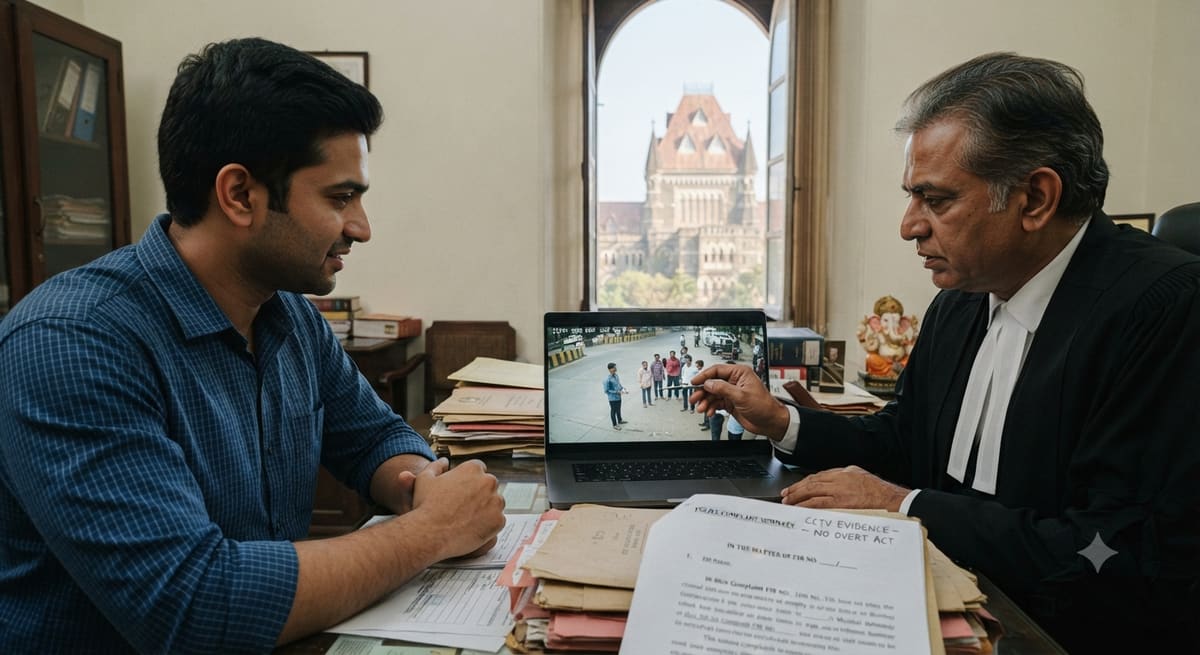
The Bombay High Court has granted regular bail to an accused in a murder case where CCTV footage failed to substantiate allegations of instigation, reinforcing that mere presence at the scene is insufficient to establish criminal liability under the Bharatiya Nyaya Sanhita, 2023.
Background & Facts
The Dispute
The applicant, Uddhav @ Baba Baburao Nimse, is accused in Crime No. 266 of 2025 registered at Adgaon Police Station, Nashik, for offences under Sections 103(1), 109, 189(2), 189(4), 190, 191, 192, 351(2), 351(3), and 352 of the Bharatiya Nyaya Sanhita, 2023, Section 135 of the Maharashtra Police Act, and Section 4 read with Section 25 of the Indian Arms Act. The prosecution alleges that on 22nd August 2025, at approximately 6:00 pm, the applicant instigated a mob to murder the brother of the first informant during a dispute.
Key Facts
- The alleged murder occurred in a lane where the applicant was not physically present, according to police and CCTV evidence.
- The applicant was present at a nearby location with a group of 40 to 50 people.
- Police officers on the scene testified that while speaking with the applicant, they heard shouts of "kill, kill" and rushed to the lane where the deceased was found lying on the ground.
- Three to four co-accused were seen fleeing the scene immediately after the assault.
- The CCTV footage, which was examined by the court, does not depict the applicant uttering inciting words or directing violence.
- The applicant has no prior criminal antecedents.
- He has been in custody since the date of arrest, exceeding six months.
Procedural History
- 22.08.2025: Alleged incident occurred at Adgaon, Nashik.
- 23.08.2025: Crime No. 266 of 2025 registered at Adgaon Police Station.
- 25.08.2025: Applicant arrested and remanded to judicial custody.
- 15.11.2025: Charge-sheet filed by police.
- 05.05.2026: Criminal Bail Application No. 584 of 2026 filed before the Bombay High Court.
- 05.05.2026: Interim Application No. 959 of 2026 filed by intervenor opposing bail.
The Parties' Positions
For the Applicant: The applicant’s counsel argued that the CCTV footage and police statements do not establish instigation. The applicant was not present at the locus of the crime, had no history of violence, and the prosecution’s case rests on speculation. Prolonged custody without trial warrants bail.
For the Respondent-State and Intervenor: The prosecution and intervenor contended that the applicant’s presence among a large mob, coupled with audible incitement ("kill, kill"), establishes liability under Section 109 BNS. Release may lead to witness tampering, given the applicant’s status as a former corporator.
Relief Sought
The applicant seeks regular bail with conditions, including a personal bond of Rs. 30,000 and sureties of like amount, along with undertakings not to tamper with evidence or contact witnesses.
The Legal Issue
The central question was whether Section 109 of the Bharatiya Nyaya Sanhita, 2023 can be invoked against an accused based solely on presence at the scene and hearsay allegations of incitement, when objective evidence (CCTV footage) fails to corroborate the charge.
Arguments Presented
For the Appellant/Petitioner
The applicant’s counsel relied on State of Maharashtra v. Suresh and K. S. Puttaswamy v. Union of India to argue that bail must be granted where the prosecution’s case is not prima facie established. The absence of the applicant from the crime scene, confirmed by CCTV, negates direct participation. Mere association with a mob does not equate to abetment under Section 109 BNS without proof of active instigation.
For the Respondent/State
The prosecution contended that Section 109 BNS requires no physical presence at the crime scene, only intentional encouragement. The shouts of "kill, kill" heard by police officers in the applicant’s presence, coupled with his leadership role in the crowd, constitute abetment. The intervenor added that the applicant’s political influence poses a risk to witness integrity.
The Court's Analysis
The Court conducted a meticulous review of the charge-sheet and CCTV transcript. It noted that while the applicant was present at the periphery of the gathering, the actual assault occurred in a separate lane, and the footage showed no gesture, word, or action by the applicant that could be construed as instigation.
"The transcript of CCTV footage also confirms the said fact. It shows that the deceased was murdered in a lane where the applicant was not present. To prove the role of the applicant in the crime, evidence is required."
The Court emphasized that abetment under Section 109 BNS demands a clear causal link between the accused’s conduct and the commission of the offence. Mere proximity, even in the presence of a volatile crowd, cannot substitute for evidentiary proof of intent or encouragement. The Court further observed that the prosecution’s case was largely based on speculative inferences drawn from police statements, which were not corroborated by visual evidence.
The Court also weighed the applicant’s prolonged custody of over six months, his clean record, and the likelihood of a protracted trial. It held that the balance of convenience and the presumption of innocence favored bail, subject to strict conditions.
The Verdict
The applicant was granted regular bail in Crime No. 266 of 2025. He is directed to execute a personal bond of Rs. 30,000 with one or two sureties of like amount. He must report to the Adgaon Police Station whenever required, and shall not tamper with evidence, contact witnesses, or influence the investigation. The Interim Application No. 959 of 2026 was dismissed. The Court clarified that these observations are strictly for bail purposes and shall not influence the trial court’s final determination.
What This Means For Similar Cases
Presence Alone Is Not Abetment
- Practitioners must now insist on direct evidence of instigation under Section 109 BNS - mere association with a crowd or hearsay allegations are insufficient.
- CCTV or digital evidence that contradicts prosecution narratives must be aggressively invoked to challenge abetment charges.
Bail Standard Clarified in Non-Violent Accused Cases
- For accused with no antecedents and where the trial is likely to be prolonged, courts will prioritize liberty absent concrete proof of active participation.
- Political or social status of the accused cannot be a ground to deny bail unless there is a specific, documented threat to witnesses.
Evidentiary Threshold for Instigation
-
Prosecution must establish a direct nexus between the accused’s words/actions and the commission of the offence.
-
Audio snippets (e.g., shouts) without visual corroboration are insufficient to prove instigation under Section 109 BNS.
-
Always request disclosure and independent verification of CCTV footage in public space crimes.
-
File applications under Section 173(8) CrPC to seek further investigation if the prosecution’s evidence is inconsistent with digital records.
-
In bail hearings, highlight the absence of physical presence at the locus of crime as a decisive factor.