The Rajasthan High Court has reaffirmed that mere presence at the scene of a death, without any corroborating evidence linking the accused to the alleged offence, cannot justify denial of bail. This ruling underscores the principle that pre-trial detention must not be used as a substitute for proof, particularly where the charge-sheet fails to establish a prima facie case against the accused.
Background & Facts
The Dispute
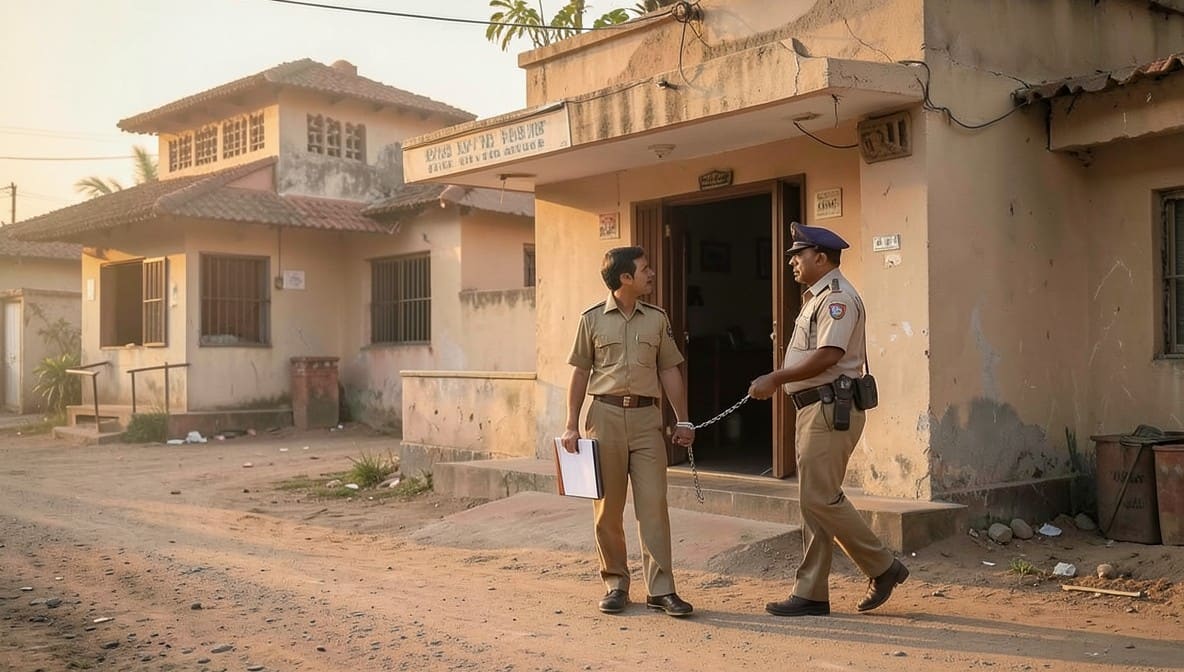
The petitioner, Manoj Kumar Urf Lala, was arrested in connection with FIR No. 501/2025 dated 30.09.2025, registered at Police Station Udhyog Nagar, Sikar, under Sections 140(1), 103(1), and 61(2) of the Bharatiya Nyaya Sanhita (BNS), 2023. The FIR arose from the death of the petitioner’s close relative on 29.09.2025 during a liquor party at the deceased’s residence. The prosecution alleged that the deceased was poisoned or otherwise harmed during the gathering, implicating the petitioner and others named in the FIR.
Key Facts
- The deceased and the petitioner were close relatives with no known disputes over land, money, or property
- The deceased was a chronic alcoholic with documented liver and health complications
- The incident occurred on 29.09.2025 at a liquor party attended by multiple persons
- The petitioner was present throughout the event but denied any involvement in the deceased’s consumption of any substance
- The charge-sheet, filed on 29.03.2026, did not establish any direct link between the petitioner and the alleged act causing death
- The prosecution’s case rested primarily on the petitioner’s presence at the scene, with no forensic, medical, or eyewitness evidence tying him to the act
- The petitioner has no prior criminal record and is employed as a bank employee in a private sector bank
Procedural History
- 29.09.2025: Death of the deceased at a liquor party
- 30.09.2025: FIR No. 501/2025 registered at Police Station Udhyog Nagar, Sikar
- 29.03.2026: Charge-sheet filed by police, naming petitioner among others
- Date of arrest: Not specified in judgment, but petitioner was in judicial custody at District Jail, Sikar at time of application
- 19.06.2026: Arguments concluded before the High Court
- 22.06.2026: Judgment pronounced granting bail
Relief Sought
The petitioner sought bail under Section 483 of the Bharatiya Nagarik Suraksha Sanhita (BNS), 2023, arguing that his detention was unjustified in the absence of any material linking him to the alleged offence.
The Legal Issue
The central question was whether the mere presence of an accused at the scene of a death, without any direct or circumstantial evidence establishing involvement in the alleged offence, is sufficient grounds to deny bail under Section 483 BNS.
Arguments Presented
For the Petitioner
The petitioner’s counsel argued that the charge-sheet contained no evidence connecting the petitioner to the deceased’s death. The prosecution failed to prove any motive, opportunity, or act attributable to the petitioner. The deceased’s pre-existing health conditions and chronic alcoholism rendered natural causes plausible. The petitioner’s presence at the party, without more, could not constitute participation in a criminal act. Reliance was placed on the principle that bail is the rule and jail is the exception, especially where the accused has no antecedents and the investigation has not established a prima facie case.
For the Respondent
The Public Prosecutor and counsel for the complainant contended that the petitioner’s presence at the scene during the incident, coupled with the fact that the deceased died under suspicious circumstances, raised sufficient suspicion to warrant continued custody. They argued that the petitioner’s proximity to the deceased and the timing of events created a reasonable ground to believe he might have been involved, even if direct evidence was lacking.
The Court's Analysis
The Court examined the nature of the allegations and the evidentiary record. It noted that the charge-sheet, which is the primary document reflecting the prosecution’s case after investigation, contained no material linking the petitioner to the act causing death. The Court emphasized that presence at the scene, without more, cannot be equated with participation in a crime. The Court observed:
"The presence of the petitioner on the unfortunate day, where the deceased died in the liquor party cannot lead to the conclusion that he committed any such alleged offence until and unless there are direct or other cogent evidence to reach such conclusion."
The Court further held that the deceased’s medical history and the absence of any dispute between the petitioner and the deceased undermined the prosecution’s theory of motive or conspiracy. The Court declined to speculate on the cause of death, but stressed that the burden of proof lies with the prosecution, and pre-trial detention cannot be sustained on suspicion alone. The Court reiterated the settled principle from Arnesh Kumar v. State of Bihar that bail must be granted unless there are compelling reasons to deny it, particularly where the accused is not a flight risk and has no criminal history.
The Verdict
The bail application was allowed. The petitioner, Manoj Kumar Urf Lala, was directed to be released on bail upon executing a personal bond of Rs. 1,00,000 with two solvent sureties of Rs. 50,000 each. He was ordered to appear before the Trial Court on all hearing dates and not to misuse his liberty. The Court clarified that its observations in the bail order would not prejudice the trial.
What This Means For Similar Cases
Presence Alone Cannot Justify Denial of Bail
- Practitioners must challenge bail denials based solely on presence at the scene, especially where the charge-sheet lacks corroborative evidence
- Courts must distinguish between association and participation; mere proximity does not equate to criminal liability
- In cases involving death under ambiguous circumstances, medical history and absence of motive must be weighed heavily in bail considerations
Charge-Sheet as a Critical Benchmark
- The conclusions in the charge-sheet are binding for bail purposes unless contradicted by compelling evidence
- If the investigating agency itself finds no link between the accused and the offence, courts should not substitute their own suspicion for the prosecution’s failure to establish a case
- Bail applications should be decided on the basis of the record before the court, not on speculative inferences
No Criminal Antecedents as a Strong Mitigating Factor
- First-time offenders with stable employment and no history of violence or flight risk are entitled to liberal bail consideration
- Courts must avoid punitive detention in the absence of statutory grounds under Section 483 BNS
- The presumption of innocence remains paramount at the pre-trial stage