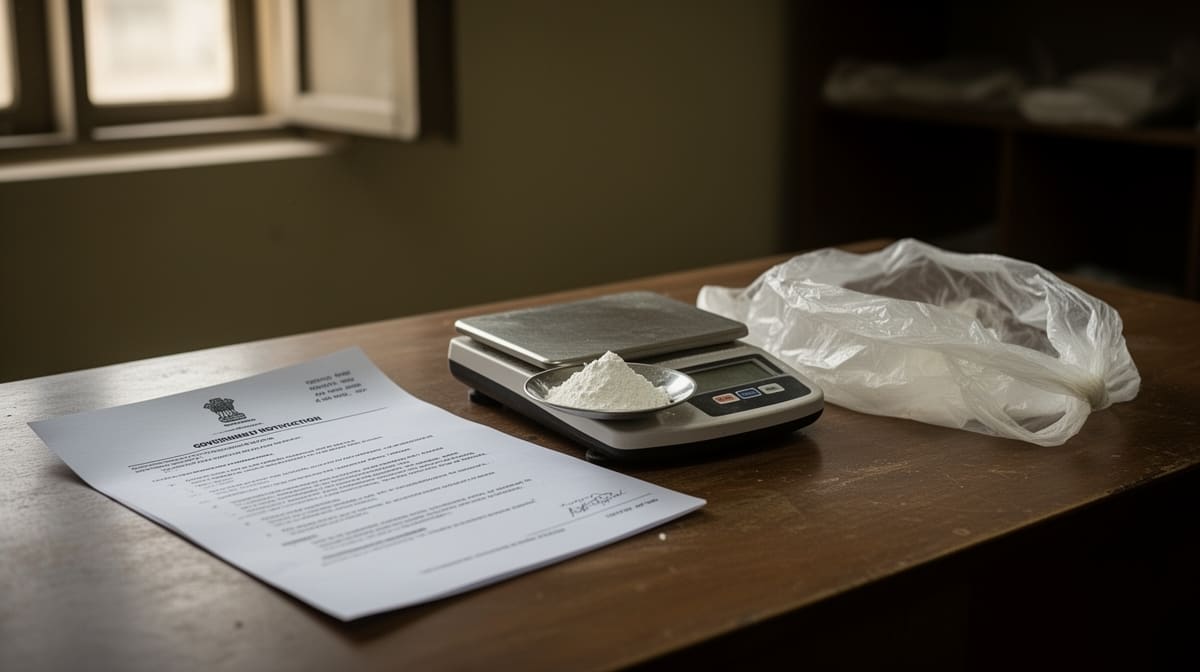
The Kerala High Court has reaffirmed that bail cannot be denied in narcotics cases solely on the basis of the quantity of contraband seized, emphasizing procedural fairness, investigation status, and absence of flight risk over punitive presumption.
Background & Facts
The Dispute
The applicant, Johan Joymon, a 22-year-old resident of Ernakulam, was arrested on 23 December 2025 for possession of 2.296 kilograms of ganja, an offence under Section 20(b)(ii)(B) of the Narcotic Drugs and Psychotropic Substances Act, 1985. The prosecution alleges he was in unlawful possession with intent to distribute, a non-bailable offence under the NDPS Act.
Procedural History
- 23 December 2025: Arrest and remand to judicial custody following recovery of ganja from the applicant’s possession.
- 31 January 2026: Sessions Court rejected the applicant’s earlier bail application, citing the large quantity of contraband.
- 17 February 2026: Bail application filed before the Kerala High Court under Section 483 of the Bharatiya Nagarik Suraksha Sanhita, 2023.
Relief Sought
The applicant seeks regular bail, arguing that the investigation is nearly complete, no incriminating material links him to trafficking, and his prior criminal record does not involve narcotics offences.
The Legal Issue
The central question was whether the mere possession of a large quantity of ganja under the NDPS Act justifies automatic denial of bail, or whether courts must evaluate the accused’s flight risk, investigation status, and likelihood of tampering with evidence.
Arguments Presented
For the Petitioner
The applicant’s counsel argued that the investigation was substantially complete, with recovery already effected and no further forensic or custodial needs. He emphasized that the applicant had no prior involvement in narcotics offences and that the prosecution had not adduced any evidence connecting him to a larger network. Reliance was placed on Arnesh Kumar v. State of Bihar to argue against presumption of guilt based on quantity alone.
For the Respondent
The State contended that possession of over two kilograms of ganja falls squarely within the ambit of serious trafficking offences under the NDPS Act, warranting strict bail denial. It cited State of Punjab v. Baldev Singh to assert that large-scale drug possession inherently poses a threat to public order and justifies continued detention.
The Court's Analysis
The Court examined the balance between the seriousness of the offence and the rights of the accused under Article 21 of the Constitution. It held that while the quantity of contraband is a relevant factor, it cannot be the sole or decisive criterion for denying bail. The Court noted that the investigation was nearly concluded, the recovery was complete, and there was no indication the applicant would obstruct justice.
"It is true that the applicant has criminal antecedents. However, he is not involved in any offence of similar nature. For these reasons, I do not find any reason to hold that the continued detention of the applicant is required for any purpose."
The Court distinguished Baldev Singh by noting that it involved active trafficking networks and ongoing investigations, whereas here, the evidence was static and no further custodial interrogation was necessary. The Court also emphasized that bail is the rule, jail is the exception, even in serious offences, unless compelling reasons exist to the contrary.
The Verdict
The applicant won. The Court held that bail cannot be denied merely because of the quantity of narcotics seized, and granted regular bail subject to strict conditions ensuring cooperation with investigation and non-interference with witnesses.
What This Means For Similar Cases
Bail Is Not Automatically Denied for Large Quantities
- Practitioners must now argue that quantity alone is insufficient to justify denial of bail under the NDPS Act.
- Courts must assess the stage of investigation, likelihood of evidence tampering, and prior criminal history - not just the weight of contraband.
- In cases where recovery is complete and no further custodial interrogation is needed, bail becomes a viable option even for large quantities.
Procedural Completion Tilts the Balance in Favor of Bail
- If the investigation is substantially complete, the prosecution’s burden to justify continued detention increases significantly.
- Courts are expected to consider whether detention serves any investigative purpose beyond mere punishment.
- This aligns with the spirit of Arnesh Kumar and reinforces that presumption of innocence persists even in serious drug cases.
Conditions Must Be Tailored, Not Standardized
- Bail conditions must be specific, reasonable, and proportionate to the risk.
- The Court’s requirement for weekly reporting and travel restriction sets a precedent for targeted, non-punitive conditions in NDPS bail orders.
- Blanket prohibitions on leaving the state or contacting witnesses are permissible, but must be clearly articulated and not overly broad.