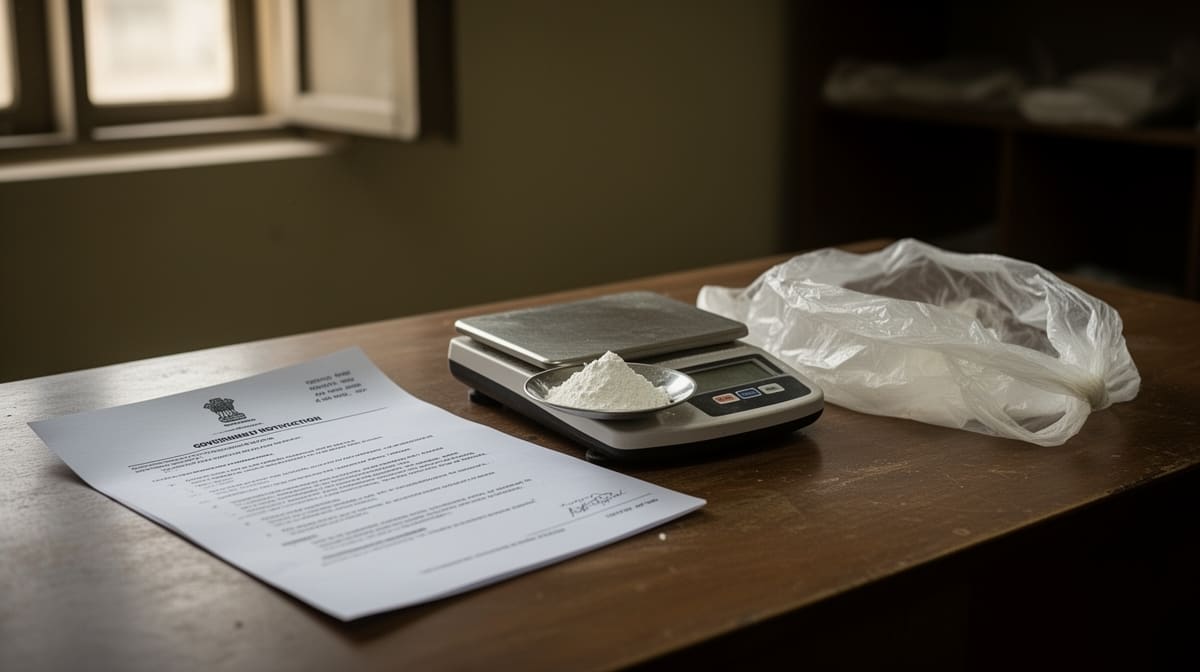
The Karnataka High Court has clarified a critical aspect of bail jurisprudence under the Narcotic Drugs and Psychotropic Substances Act, 1985, holding that Section 37(1)(b) - which imposes stringent conditions for bail - does not apply to cases involving intermediate quantities of contraband. This judgment underscores the distinction between commercial and intermediate quantities in bail considerations, offering relief to accused persons facing non-commercial drug seizures.
Background & Facts
The Dispute
The petitioner, Mohammed Bilal, was accused in Crime No. 107/2025 registered by Davanagere CEN Crime Police Station for offences under Sections 8(c), 21(b), 22(b), and 29 of the NDPS Act, 1985, and Sections 3, 21, and 22 of the Foreigners Act, 2025. The case arose from the interception of a car on 24.07.2025, in which the petitioner and three other accused were traveling from Bengaluru to Davanagere. The police seized 13 grams of methamphetamine from the vehicle, and later, on 29.07.2025, recovered an additional 5.61 grams of methamphetamine from the residence of two co-accused in Bengaluru.
Key Facts
- The petitioner was arrested on 25.07.2025 and remanded to judicial custody
- The seized methamphetamine (13 grams) was classified as an intermediate quantity (up to 50 grams under the NDPS Act)
- The petitioner had no criminal antecedents
- The second seizure (5.61 grams) was from the residence of co-accused, with no material connecting the petitioner to this recovery
- Charge sheet was filed, and the case was pending as Special Case No. 491/2025 before the Principal District and Sessions Judge, Davanagere
Procedural History
- 25.07.2025: Petitioner arrested and remanded to judicial custody
- 25.10.2025: First bail petition (Crl.P No. 13163/2025) dismissed by the High Court
- 20.11.2025: Second bail application dismissed by the trial court (Spl.C.No. 491/2025)
- 03.06.2026: Present bail petition (Crl.P No. 877/2026) filed under Section 483 of the Bharatiya Nagarik Suraksha Sanhita (BNSS), 2023 (corresponding to Section 439 CrPC)
Relief Sought
The petitioner sought regular bail in Crime No. 107/2025, arguing that the seized contraband was of intermediate quantity and that Section 37(1)(b) of the NDPS Act - which imposes strict bail conditions - was inapplicable.
The Legal Issue
The central question was whether Section 37(1)(b) of the NDPS Act applies to cases involving intermediate quantities of contraband, or whether its stringent bail conditions are limited to commercial quantities.
Arguments Presented
For the Petitioner
- The seized contraband (13 grams of methamphetamine) was an intermediate quantity, not a commercial quantity, and thus Section 37(1)(b) of the NDPS Act was inapplicable
- The petitioner had no criminal antecedents and was not connected to the second seizure (5.61 grams) from the co-accused’s residence
- Co-accused Nos. 1 and 4 had already been granted bail by the trial court, indicating disparate treatment
- Investigation was complete, and the charge sheet had been filed, reducing the risk of tampering with evidence
For the Respondent
- The petitioner was found in conscious possession of contraband, warranting denial of bail under Section 37(1)(b) of the NDPS Act
- The gravity of the offence and the potential for recidivism justified continued custody
- The second seizure, though from co-accused, was part of the same conspiracy, implicating the petitioner
The Court's Analysis
The Court examined the scope of Section 37(1)(b) of the NDPS Act, which imposes stringent bail conditions for offences involving commercial quantities of contraband. The provision states:
"No person accused of an offence punishable for offences under Section 19 or Section 24 or Section 27A and also for offences involving commercial quantity shall be released on bail or on his own bond unless the Court is satisfied that there are reasonable grounds for believing that he is not guilty of such offence and that he is not likely to commit any offence while on bail."
The Court observed that the seized contraband (13 grams) was below the commercial quantity threshold and fell within the intermediate quantity category. Relying on precedents, the Court held that Section 37(1)(b) is inapplicable to intermediate quantities, as its stringent conditions are reserved for commercial quantities.
The Court further noted:
"The second seizure of contraband article is from the house of accused Nos.1 and 2 and there is no material to connect the present petitioner to the said seizure."
Given the lack of criminal antecedents, the completion of investigation, and the filing of the charge sheet, the Court concluded that the petitioner’s continued custody was not justified under the NDPS Act.
The Verdict
The petition was allowed, and the petitioner was enlarged on bail subject to the following conditions:
- Execution of a personal bond of Rs. 1,00,000 with two sureties for the like sum
- Regular appearance before the trial court on all hearing dates, unless exempted for valid reasons
- No tampering with prosecution witnesses or evidence
- No involvement in similar offences in the future
What This Means For Similar Cases
Section 37(1)(b) NDPS Act Applies Only to Commercial Quantities
- Practitioners must distinguish between intermediate and commercial quantities when arguing bail under the NDPS Act
- Intermediate quantities (e.g., 13 grams of methamphetamine) do not trigger Section 37(1)(b), allowing for less stringent bail conditions
- Courts are likely to grant bail where the accused has no criminal antecedents and the investigation is complete
Conscious Possession Must Be Proven for Conviction
- The Court distinguished the petitioner’s role in the first seizure (from the car) from the second seizure (from co-accused’s residence)
- Lack of material connection to the second seizure weakened the prosecution’s case, reinforcing the need for direct evidence of conscious possession
- Accused persons can argue lack of involvement in seizures where they were not physically present
Bail Conditions Reflect the Seriousness of the Offence
- The bond amount (Rs. 1,00,000) and surety requirements reflect the Court’s balancing of personal liberty and risk of recidivism
- Conditions such as regular appearance and non-tampering with witnesses are standard but strictly enforced
- Accused persons must comply with bail conditions to avoid revocation, particularly in drug-related offences