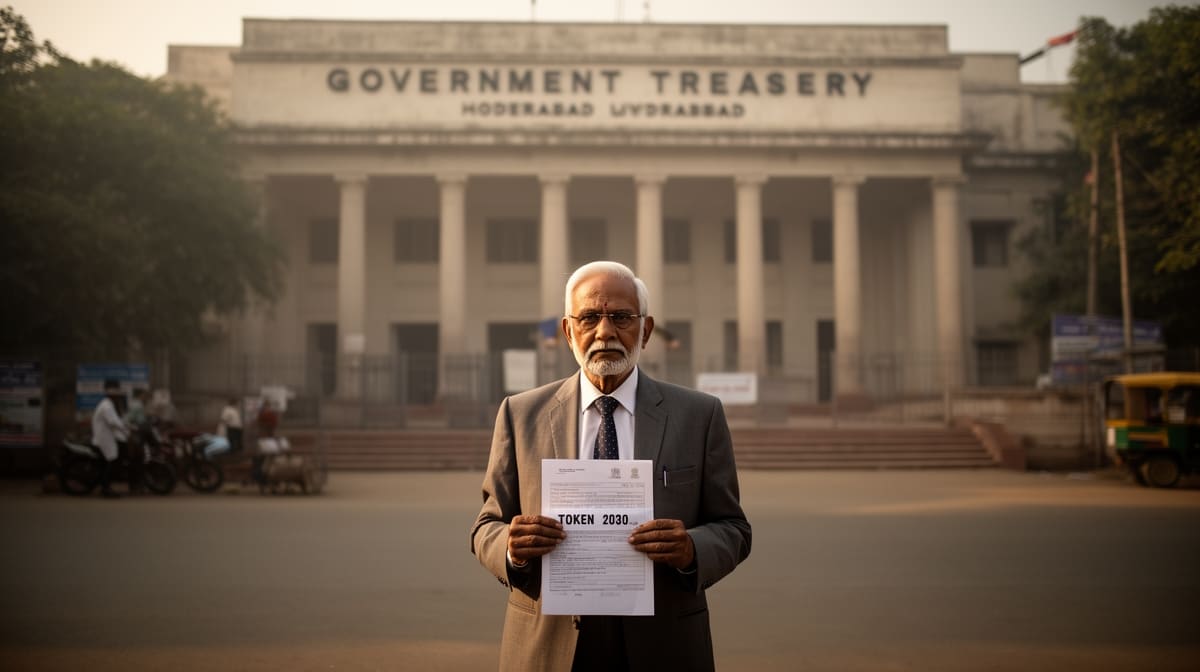
The Telangana High Court has reaffirmed the state’s constitutional obligation to promptly release admitted retiral benefits, holding that undue delay in disbursing commutation and gratuity amounts violates fundamental rights. This judgment provides clear procedural clarity for retired government employees facing administrative inertia in payment processing.
Background & Facts
The Dispute
The petitioner, P. Ravinder, a retired Administrative Officer (Rtd) under the Transport Department of Telangana, sought the release of admitted but unpaid retiral benefits, including a commutation amount and gratuity, despite the amounts having been formally finalized and token numbers generated in the Comprehensive Financial Management System (CFMS). The respondents, comprising various state finance and accounting authorities, failed to effect payment despite repeated requests.
Key Facts
- The petitioner retired on superannuation on 31.03.2025.
- The Commutation Bill Amount of Rs. 15,51,655/- (Token No. 2603659734) was finalized and generated in CFMS on 11.08.2025.
- The Gratuity Amount of Rs. 2,624,411/- (Token No. 2601036232) was finalized and generated in CFMS on 11.08.2025.
- The Gratuity Amount of Rs. 6,08,230/- (Token No. 2601036227) was finalized and generated in CFMS on 11.08.2025.
- The Commutation Bill Amount of Rs. 3,04,448/- (Token No. 2603659743) was finalized and generated in CFMS on 11.08.2025.
- The petitioner submitted multiple representations to the respondents between August 2025 and February 2026, all of which remained unaddressed.
- The amounts were not released despite being fully sanctioned, verified, and digitally recorded in the official financial system.
Procedural History
- 11.08.2025: All four payment tokens generated in CFMS for commutation and gratuity amounts.
- September 2025 to February 2026: Repeated representations made by petitioner to finance, treasury, and pay & accounts departments.
- 03.09.2025: Division Bench of the Telangana High Court, in W.P. No. 23138 of 2025, directed release of similar admitted retiral benefits with a six-week timeline.
- 20.02.2026: Writ Petition No. 8282 of 2026 filed under Article 226 of the Constitution.
- 18.03.2026: Writ Petition taken up for admission hearing with consent of both parties.
Relief Sought
The petitioner sought a writ of mandamus directing the respondents to:
- Immediately release the admitted amounts: Rs. 15,51,655/-, Rs. 3,04,448/-, Rs. 2,624,411/-, and Rs. 6,08,230/-.
- Pay interest at 24% per annum from the date the amounts fell due.
- Declare the delay as arbitrary and violative of Articles 14, 16, and 21 of the Constitution.
The Legal Issue
The central question was whether the state’s failure to release admitted and digitally finalized retiral benefits, despite statutory and constitutional obligations, constitutes an arbitrary and unconstitutional violation of a retired public servant’s right to property and dignity under Articles 14, 16, and 21.
Arguments Presented
For the Petitioner
Learned counsel submitted that the amounts were not merely claimed but formally admitted and recorded in the CFMS, making them due and payable. He relied on the precedent set by the Division Bench in W.P. No. 23138 of 2025, where a similar delay was held unconstitutional. He argued that the state cannot retain public funds indefinitely after finalization, especially when the employee has already retired and is dependent on these payments for livelihood. He emphasized that the delay amounted to a violation of the right to life under Article 21, as it deprived the petitioner of means to meet basic needs.
For the Respondent
The Assistant Government Pleader for Services-III did not dispute the factual position that the amounts were finalized and tokenized. He conceded that the delay was inadvertent and not intentional, and assured the Court that the payments would be processed on priority. He requested the Court to direct release within a reasonable time without imposing interest, citing administrative bottlenecks.
The Court's Analysis
The Court observed that the petitioner’s entitlements were not in dispute. The amounts had been computed, sanctioned, and digitally recorded in the official financial system. The state’s obligation to pay such dues arises not merely from service rules but from the constitutional guarantee of dignity and economic security under Article 21. The Court noted that the same issue had been adjudicated in W.P. No. 23138 of 2025, where a six-week timeline was imposed for release of similar amounts.
"The state cannot hold back funds that have been duly computed, sanctioned, and tokenized in the official financial system. Such delay, even if administrative, amounts to a violation of the retired employee’s right to economic dignity under Article 21."
The Court rejected the notion that administrative delays justify constitutional violations. It held that the precedent in W.P. No. 23138 of 2025 was directly applicable and binding. The Court emphasized that the state, as a model employer, must adhere to the highest standards of accountability. The failure to pay even after digital finalization reflects systemic negligence, not mere procedural delay.
The Verdict
The writ petition was disposed of with directions. The respondents are directed to release the entire admitted retiral benefits - Rs. 15,51,655/-, Rs. 3,04,448/-, Rs. 2,624,411/-, and Rs. 6,08,230/- - within six weeks from the date of the order. If the amounts are not paid within this period, they shall carry interest at the rate of 10% per annum from the date they fell due (11.08.2025) until actual payment. No costs are awarded.
What This Means For Similar Cases
Administrative Finalization Creates Absolute Liability
- Once retiral benefits are computed, sanctioned, and tokenized in CFMS, the state’s liability becomes absolute and non-discretionary.
- Practitioners must now treat such tokenized amounts as legally due and payable, irrespective of pending internal clearances.
- Delay beyond 6 weeks triggers automatic interest liability at 10% per annum, as per this judgment.
Precedent Binding Across Departments
- The ruling in W.P. No. 23138 of 2025 is now binding precedent for all state departments handling retiral payments.
- Any department refusing to release tokenized amounts must now justify the delay before a court, not merely cite internal procedures.
- This judgment effectively closes the loophole where departments delay payment citing "pending approvals" after digital finalization.
Constitutional Duty Overrides Bureaucratic Inertia
- The Court has elevated the payment of retiral dues from an administrative matter to a constitutional imperative under Article 21.
- Retired employees can now invoke this judgment to seek immediate relief in writ petitions without waiting for prolonged departmental redressal.
- Future petitions may cite this order to demand interest at 10% per annum even if the delay is not malicious, merely negligent.