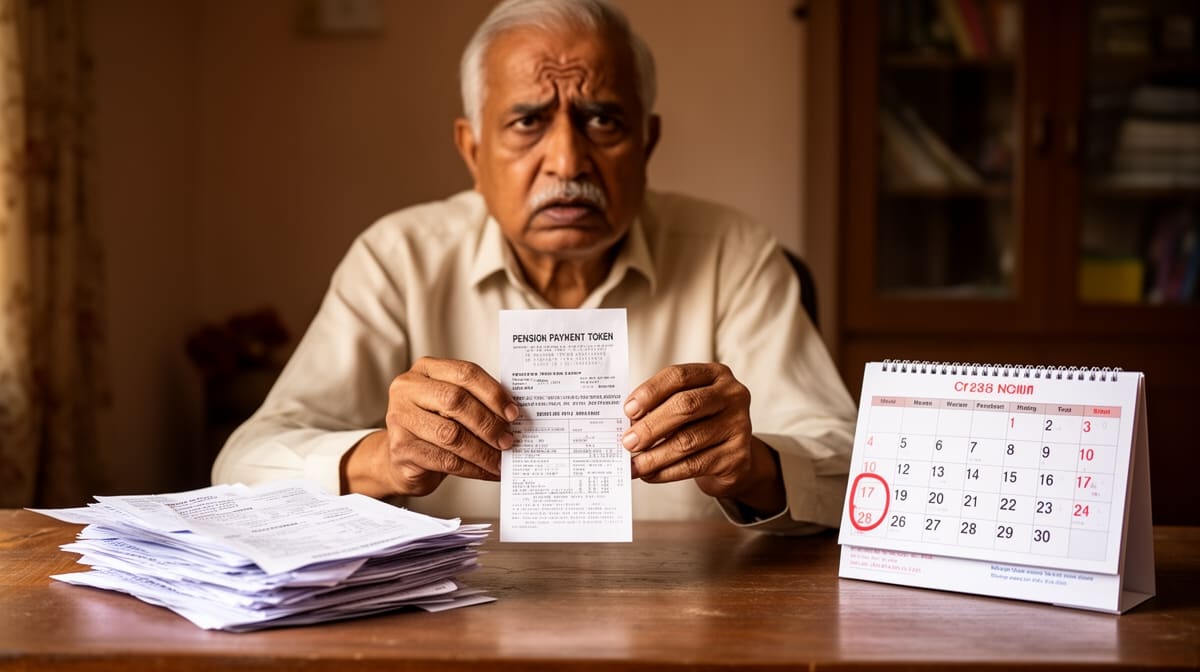
The Telangana High Court has reaffirmed the state’s constitutional obligation to promptly release admitted retiral benefits to retired government employees, emphasizing that administrative delay in disbursing quantified dues constitutes a violation of Article 21. The Court’s directive sets a clear timeline for compliance and imposes a financial consequence for non-adherence, reinforcing the principle that financial entitlements earned through service cannot be held hostage to bureaucratic inertia.
Background & Facts
The Dispute
The petitioner, B.R. Arjuna, a retired Deputy Executive Engineer (R&B), sought the release of multiple admitted retiral benefits that had been formally calculated and tokenized in the Comprehensive Financial Management System (CFMS) but remained unpaid despite repeated requests. The amounts in question were not in dispute; the issue was solely one of delayed disbursement by the state authorities.
Key Facts
- The petitioner retired from service on superannuation.
- The following amounts were duly calculated, verified, and tokenized in CFMS:
- Commutation Bill Amount: Rs. 23,72,287/- (Token No. 2600239801)
- Commutation Bill Amount: Rs. 8,47,303/- (Token No. 2600239806)
- Gratuity Amount: Rs. 11,78,926/- (Token No. 2600239788)
- Gratuity Amount: Rs. 4,21,074/- (Token No. 2600239796)
- Final Earned Leave (E.L.) encashment (300 days): Rs. 25,06,460/- (Token No. 2524176169)
- GPF Arrears: Rs. 31,77,030/- (Token No. 2524132905)
- Pension Arrears: Rs. 1,61,339/- (Token No. 2600239778)
- Pension Arrears: Rs. 57,639/- (Token No. 2600239782)
- The petitioner submitted multiple representations seeking release of these amounts.
- All amounts were confirmed as payable by the concerned departments and were generated as valid payment tokens in CFMS.
- Despite this, no payment was made.
Procedural History
- The petitioner filed Writ Petition No. 9905 of 2026 on 02.04.2026 under Article 226 of the Constitution.
- Simultaneously, an Application No. 1 of 2026 under Section 151 CPC was filed seeking interim relief.
- The matter was taken up for disposal at the admission stage with the consent of both parties.
- Learned counsel for the petitioner relied on the precedent set in W.P. No. 23138 of 2025, decided on 03.09.2025, where a similar issue was resolved in favor of the petitioner.
- The respondents did not contest the factual position or the applicability of the earlier order.
The Parties' Positions
For the Petitioner
The petitioner contended that the state’s failure to release amounts already tokenized and admitted in the financial system amounted to arbitrary, unreasonable, and violative conduct under Articles 14, 16, and 21 of the Constitution. He emphasized that the amounts were not claimed as new entitlements but were admitted dues, the non-payment of which caused financial hardship and violated his right to life with dignity.
For the Respondent
The Assistant Government Pleader for Services-III did not dispute the petitioner’s submissions. He acknowledged that the amounts were duly tokenized and admitted, and confirmed that the respondents would release the amounts on the basis of the tokens. He requested the Court to pass an appropriate order to ensure compliance.
Relief Sought
The petitioner sought a writ of mandamus directing the respondents to immediately release the following admitted amounts:
- Commutation Bill: Rs. 23,72,287/- and Rs. 8,47,303/-
- Gratuity: Rs. 11,78,926/- and Rs. 4,21,074/-
- Final E.L. encashment: Rs. 25,06,460/-
- GPF arrears: Rs. 31,77,030/-
- Pension arrears: Rs. 1,61,339/- and Rs. 57,639/-
Additionally, he sought interest at 24% per annum from the date each amount became due.
The Legal Issue
Whether the state’s failure to release admitted retiral benefits, already tokenized and verified in the financial system, constitutes a violation of Articles 14, 16, and 21 of the Constitution, and whether the Court can direct release within a stipulated time with interest for delay.
Arguments Presented
For the Petitioner
The petitioner relied on the principle that once a government servant’s retiral dues are calculated, verified, and tokenized in the official financial system, they become a legally enforceable right. Delay in payment, especially when no legitimate dispute exists, amounts to arbitrary action under Article 14 and violates the right to life under Article 21, as recognized in K.S. Puttaswamy v. Union of India. He cited W.P. No. 23138 of 2025 as binding precedent where the same Court had directed release of similar amounts within six weeks with interest.
For the Respondent
The respondents did not contest the petitioner’s factual assertions. The Assistant Government Pleader conceded that the amounts were admitted and tokenized, and undertook to release them. He sought no time for internal review or further verification, effectively acknowledging the petitioner’s entitlement.
The Court's Analysis
The Court observed that the matter was not one of disputed entitlement but of administrative delay in releasing admitted dues. The fact that the amounts had been tokenized in the CFMS system indicated that all procedural and substantive checks had been completed. The state’s continued non-payment, despite this, could not be justified on any legal or administrative ground.
"The state cannot hold back funds that have been formally recognized and system-generated as payable. Such delay, especially in the case of retired personnel who depend on these dues for survival, strikes at the heart of Article 21."
The Court noted that its earlier order in W.P. No. 23138 of 2025 had laid down a clear precedent on identical facts and that the respondents had not sought to distinguish the present case. The Court found no reason to depart from its own reasoning.
The Court further held that while the petitioner had prayed for 24% interest, the prevailing judicial practice in such cases, particularly where the state is the defaulting party, supports a reasonable rate of 10% per annum. The Court also rejected the request for costs, noting that the respondents had cooperated at the hearing and had not resisted the claim in bad faith.
The Verdict
The writ petition was disposed of with the direction that the respondents shall release the entire admitted retiral benefits within six weeks from the date of the order. The amounts include:
- Commutation Bill: Rs. 23,72,287/- and Rs. 8,47,303/-
- Gratuity: Rs. 11,78,926/- and Rs. 4,21,074/-
- Final E.L. encashment: Rs. 25,06,460/-
- GPF arrears: Rs. 31,77,030/-
- Pension arrears: Rs. 1,61,339/- and Rs. 57,639/-
If the amounts are not paid within six weeks, the entire outstanding balance shall carry interest at the rate of 10% per annum from the date each amount became due until actual payment. All pending applications in the writ petition are closed. There shall be no order as to costs.
What This Means For Similar Cases
Admitted Dues Cannot Be Delayed Without Consequence
- Practitioners representing retired government employees must now insist on immediate release of tokenized dues, citing this judgment as binding precedent.
- Any delay beyond six weeks triggers automatic liability for 10% interest from the due date, eliminating the need for separate claims for interest.
Tokenization in CFMS = Legal Entitlement
- The generation of a payment token in CFMS is now legally recognized as conclusive proof of the state’s acknowledgment of liability.
- No further internal clearance or approval can be invoked to justify delay once a token is issued.
Judicial Enforcement of Article 21 in Financial Matters
- Courts will treat non-payment of retiral dues as a violation of the right to life and dignity under Article 21, even in the absence of physical harm.
- This judgment elevates financial security in retirement from a policy matter to a constitutional right.
Procedural Compliance Is Non-Negotiable
- Government departments must ensure that all retiral benefit calculations are completed and tokenized within 30 days of retirement.
- Failure to do so may expose the department to interest liability and contempt proceedings.
No Need to Prove Bad Faith
- The Court did not require proof of mala fide or malice. The mere fact of delay after admission sufficed to trigger relief.
- This lowers the threshold for petitioners in similar cases.
Relief Is Automatic on Non-Compliance
- The 10% interest is not discretionary - it is triggered automatically upon expiry of the six-week window.
- Practitioners need not file a separate application for interest; it accrues by operation of the order.