The Rajasthan High Court has affirmed that government employees in Class-IV posts are entitled to study leave for nursing training if the course serves the interest of the department, rejecting the notion that such benefits are restricted to higher cadres. This ruling reinforces the principle that service eligibility under Rule 112 of the Rajasthan Service Rules, 1951, must be interpreted functionally, not hierarchically.
Background & Facts
The Dispute
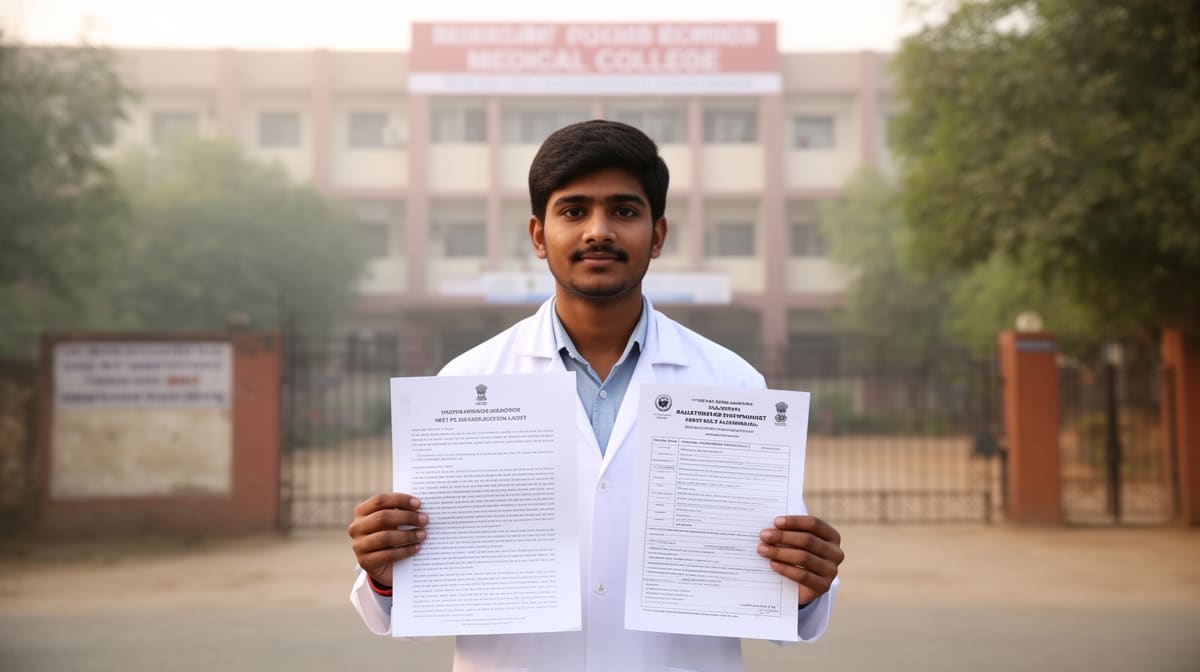
The petitioner, Vineet Diwakar, a government employee in the Health Department of Rajasthan, sought study leave for the General Nursing and Midwifery (GNM) course undertaken during 2021-2022. His application was denied by the respondents on the ground that he belonged to a Class-IV cadre and that study leave under Rule 112 of the Rajasthan Service Rules, 1951, was intended only for employees whose training would directly enhance higher-level administrative or technical functions.
Key Facts
- The petitioner was employed in a non-gazetted position in the Health Department, Jodhpur
- He enrolled in the GNM course for the academic year 2021-2022, which is a recognized qualification for nursing staff in government hospitals
- The GNM course duration was 3.5 years, completed on a part-time basis while in service
- The petitioner applied for study leave on 15.07.2021, which was rejected by the Chief Medical and Health Officer (CMHO), Jodhpur, on 06.08.2025
- The rejection cited that study leave under Rule 112 was not applicable to Class-IV employees engaged in non-clinical or support roles
- The petitioner had no prior history of study leave and had served continuously since his appointment
- The GNM qualification directly enhances the capacity of government hospitals to deliver nursing care, a critical public health function
Procedural History
- 15.07.2021: Petitioner applied for study leave for GNM course
- 06.08.2025: Impugned order issued rejecting the application
- 12.02.2026: Writ Petition No. 3489/2026 filed before the Rajasthan High Court, Jodhpur Bench
- 13.05.2026: Hearing conducted before Justice Kuldeep Mathur
Relief Sought
The petitioner sought: (1) quashing of the order dated 06.08.2025; (2) direction to grant study leave for the GNM course; and (3) consequential benefits including payment of half salary during leave, seniority protection, and inclusion of the period in qualifying service for promotion and pension.
The Legal Issue
The central question was whether Rule 112 of the Rajasthan Service Rules, 1951 permits the grant of study leave to a Class-IV government servant pursuing a professional course like GNM, if such training is demonstrably in the interest of the department’s functioning.
Arguments Presented
For the Petitioner
Counsel for the petitioner relied on the binding precedent set by the Jaipur Bench of the same High Court in Himmat Singh & Anr. v. State of Rajasthan & Ors. (S.B. Civil Writ Petition No. 17843/2015, decided on 30.11.2022). It was argued that Rule 112 does not distinguish between cadres; it only requires that the study leave be in the interest of the department’s working. The GNM qualification directly strengthens the public health infrastructure, making it a clear departmental interest. The petitioner’s role, though Class-IV, was integral to hospital operations, and his upskilling would improve service delivery.
For the Respondent
Counsel for the respondents did not dispute the factual similarity to Himmat Singh. However, he submitted that he lacked instructions to concede the benefit, implying administrative reluctance rather than legal opposition. No substantive counter-legal argument was advanced to distinguish the precedent or challenge the interpretation of Rule 112.
The Court's Analysis
The Court conducted a textual and purposive interpretation of Rule 112 of the Rajasthan Service Rules, 1951, which states that study leave may be granted if it is "in the interest of the working of the department or the service to which the Government servant belongs." The Court emphasized that the rule does not impose any restriction based on cadre classification. The phrase "interest of the working of the department" was held to be broad and functional, not hierarchical.
"This Court finds that if the study leave is in the interest of the working of the Department, then it cannot be said that the person, who is in Class-IV cadre and acquires qualification of GNM, the same would not be in the interest of working of the Department."
The Court further noted that the rulemaking authority had deliberately used two complementary phrases - "interest of the working of the department" and "interest of the service" - to ensure inclusivity. The Court rejected the argument that only higher-level training (e.g., medical degrees) qualifies, holding that nursing education directly enhances frontline service delivery in public hospitals. The precedent in Himmat Singh was applied directly, as the facts were indistinguishable: a Class-IV employee acquiring a professional qualification that benefits the department’s core function.
The Court also dismissed the notion that past administrative errors or inconsistent grants of study leave could justify denial in the present case, citing the principle that unlawful acts cannot create a legitimate expectation to deny lawful rights.
The Verdict
The petitioner succeeded. The Court quashed the order dated 06.08.2025 and directed the respondents to grant study leave for the GNM course undertaken in 2021-2022, with all consequential benefits including half-pay salary during the leave period, protection of seniority, and inclusion of the leave period in qualifying service for promotion and pension. Compliance was mandated within six weeks from the date of receipt of the certified copy of the order.
What This Means For Similar Cases
Study Leave Is Not Cadre-Dependent
- Practitioners may now argue that any government servant, regardless of cadre, is eligible for study leave if the course enhances departmental efficiency
- GNM, paramedical, IT, and other vocational certifications must be assessed on functional merit, not hierarchical status
- Denial based solely on "Class-IV" or "non-gazetted" status is legally unsustainable under Rule 112
Departmental Interest Must Be Functionally Interpreted
- The "interest of the department" includes improved service delivery, reduced dependency on external hires, and enhanced public health outcomes
- Training that strengthens frontline services - even in support roles - qualifies as departmental interest
- Administrative convenience or past inconsistencies cannot override statutory entitlement
Precedent Binding Across Benches
- Judgments from one bench of the Rajasthan HC (e.g., Jaipur) are binding on other benches (e.g., Jodhpur) unless overruled by a larger bench
- Counsel must cite relevant precedents early and insist on their application when facts align
- Failure to distinguish a precedent on material grounds renders opposition legally untenable