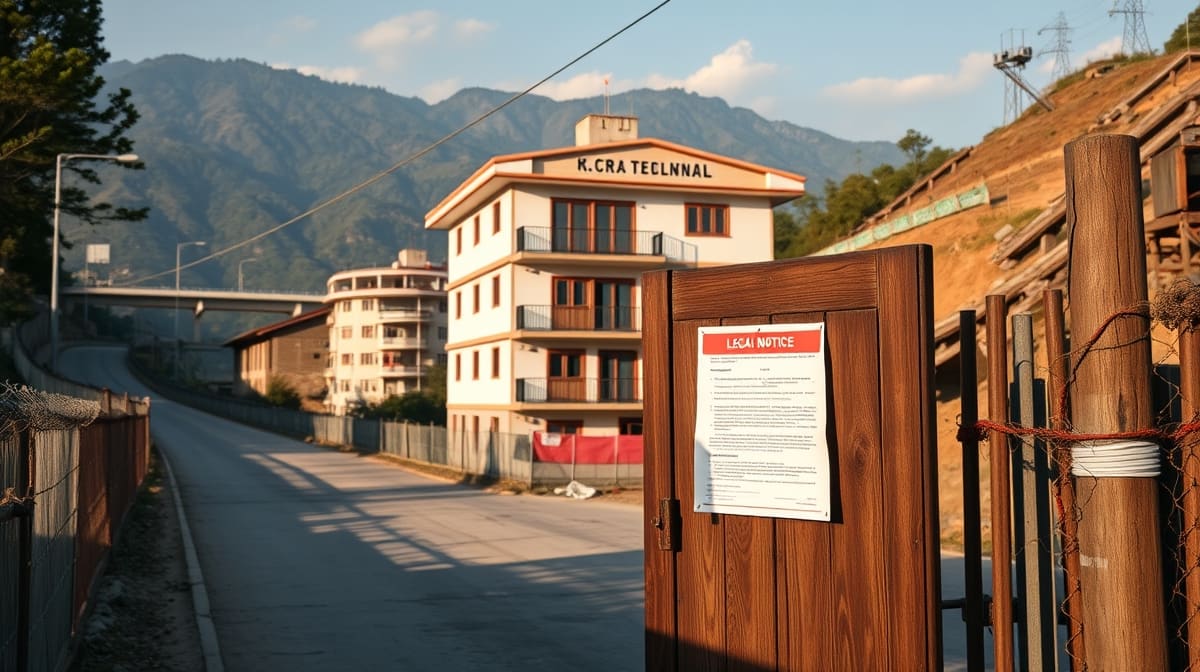
The Sikkim High Court has reaffirmed that the state cannot deprive a citizen of property without legal authority under Article 300A of the Constitution, even in the context of infrastructure projects. In a decisive ruling, the Court set aside the rejection of an injunction application by the District Judge, holding that where possession is lawful and acquisition is unproven, the balance of convenience and irreparable harm tilt decisively in favor of the property owner.
Background & Facts
The Dispute
The appellants, Mrs. Srijana Gurung and Mr. Praveen Pradhan, are the lawful owners of a four-storied RCC residential building constructed on land bearing Plot No. 290/2244, measuring 0.0140 hectares (1507 square feet), located at Pachey Samsing, Pakyong, Sikkim. The property was acquired through a registered sale deed dated 13.02.2007 (Annexure-P3), which was submitted with the plaint in the underlying Title Suit No. 10 of 2024. The appellants assert that this is their only dwelling house and that they have been in continuous, unencumbered physical possession since the date of purchase.
Key Facts
- The appellants purchased the land on 13.02.2007 and constructed the residential building thereafter.
- The property is situated along the alignment of a proposed National Highway project being executed by NHIDCL (Respondent No. 2).
- On 17.12.2021, the District Collector / CALA, East Sikkim, issued a notice asserting that the appellants’ property had been "acquired" and directed them to vacate.
- A subsequent notice dated 08.09.2022, issued by the Sub-Divisional Magistrate, Pakyong, reiterated the claim of acquisition and gave the appellants ten days to vacate and hand over possession.
- The appellants filed an application under Order XXXIX Rules 1 and 2 of the CPC seeking an injunction to restrain the respondents from proceeding with any construction on or disturbing their possession of the suit land.
- The respondents did not produce any document evidencing acquisition under the National Highways Act, 1956 or any other law.
- The Government Advocate conceded before the High Court that no acquisition proceedings had been initiated and no documents supported the claim of acquisition.
- The appellants also denied any encroachment; the Government Advocate confirmed no proceedings had been initiated against them for encroachment.
Procedural History
- 13.02.2007: Registered sale deed executed in favor of appellants for Plot No. 290/2244.
- 17.12.2021: Notice issued by District Collector / CALA, East Sikkim, claiming acquisition and demanding vacating.
- 08.09.2022: Sub-Divisional Magistrate issued second notice repeating acquisition claim and demanding possession within ten days.
- 2024: Title Suit No. 10 of 2024 filed by appellants seeking declaration of title and permanent injunction.
- 01.08.2024: District Judge, Pakyong, dismissed the application for interim injunction under Order XXXIX Rules 1 and 2 CPC, holding that irreparable harm was not established and balance of convenience favored respondents.
- 06.04.2026: Appeal filed under Section 104 read with Order XLIII Rule 1 CPC heard and decided by the Sikkim High Court.
The Parties' Positions
Appellants: Argued that they are lawful owners with registered title and physical possession. The state’s claim of acquisition is baseless and unsupported by any legal document. Denial of injunction would result in irreversible loss of their only residence, violating Article 300A and Article 21 of the Constitution.
Respondents: Contended that the highway project is a national infrastructure priority and that the appellants’ property lies within the alignment. However, no documents were produced to substantiate acquisition. The Government Advocate admitted no acquisition proceedings existed.
Relief Sought
The appellants sought an interim injunction restraining the respondents from proceeding with any construction on or disturbing their possession of the suit land and dwelling house until the final disposal of the title suit.
The Legal Issue
The central question was whether a court may grant an interim injunction under Order XXXIX Rules 1 and 2 CPC to protect the possession of a property when the state claims acquisition without producing any legal document, and the property is the only dwelling of the owners.
Arguments Presented
For the Appellant
The appellants’ counsel relied on the registered sale deed to establish prima facie title and possession. They emphasized that Article 300A prohibits deprivation of property except by authority of law, and since no acquisition proceedings existed, the state’s notice was legally void. The denial of injunction would cause irreparable harm by threatening the loss of their only home, a violation of the right to life under Article 21. The balance of convenience clearly favored the appellants, as the respondents’ construction could be rerouted without prejudice.
For the Respondent
The respondents’ counsel acknowledged that no acquisition proceedings had been initiated under the National Highways Act, 1956 or any other statute. They conceded that no documents supported the claim of acquisition or encroachment. However, they argued that the highway project was critical for national infrastructure and that granting injunction would cause delay and financial loss.
The Court's Analysis
The Court observed that the District Judge erred in rejecting the injunction application despite the appellants establishing a prima facie case of ownership and possession. The Court noted that the state’s assertion of acquisition was not only unsubstantiated but also factually incorrect, as confirmed by the Government Advocate’s admission.
"Therefore, there was nothing on record before the learned District Judge to conclude that the appellants would not suffer irreparable loss or injury and balance of convenience/inconvenience was tilted in favour of the respondent nos. 1 and 2."
The Court emphasized that Article 300A is a constitutional safeguard against arbitrary deprivation of property. The state’s reliance on notices without legal basis cannot override the rights of a lawful owner. The appellants’ assertion that the property is their only dwelling house was unchallenged and credible. The Court held that directing the eviction of a family from their sole residence on a patently false claim of acquisition raises serious human rights concerns.
The Court further clarified that the appellants did not seek to restrain the highway project itself, but only to prevent construction on their specific property. The respondents’ interest in expediting infrastructure could not override the constitutional right to property and home.
The Verdict
The appeal is allowed. The impugned order dated 01.08.2024 of the District Judge, Pakyong, is set aside. A stay is granted restraining the respondents from demolishing the dwelling house or disturbing the appellants’ possession of the suit land described in the sale deed dated 13.02.2007 until the final disposal of Title Suit No. 10 of 2024 or until due process is initiated to establish any claim of encroachment. A copy of this judgment is to be forwarded to the District Judge, Pakyong, and the record is remitted to the lower court.
What This Means For Similar Cases
Property Possession Trumps Administrative Notices
- Practitioners must challenge any state notice claiming acquisition without production of a valid acquisition order, notification, or award under the relevant statute.
- Courts must treat possession backed by registered title as prima facie lawful, especially where the property is a dwelling.
Article 300A Is a Substantive Right, Not a Formality
- The mere assertion of acquisition by a government official without legal documentation does not extinguish property rights.
- Courts must apply Article 300A as a substantive shield against arbitrary state action, not merely as a procedural formality.
Injunctions Are Warranted in Home Protection Cases
- Where a family’s only residence is threatened based on unsubstantiated claims, courts must prioritize irreparable harm over convenience to the state.
- Infrastructure projects cannot override constitutional rights without due process; injunctions are not an obstacle but a safeguard.
No Encroachment Proceedings? No Basis for Eviction
- If no proceedings for encroachment have been initiated, the state cannot use the threat of demolition to force surrender of property.
- Courts must require concrete evidence before permitting any action that displaces lawful occupants.