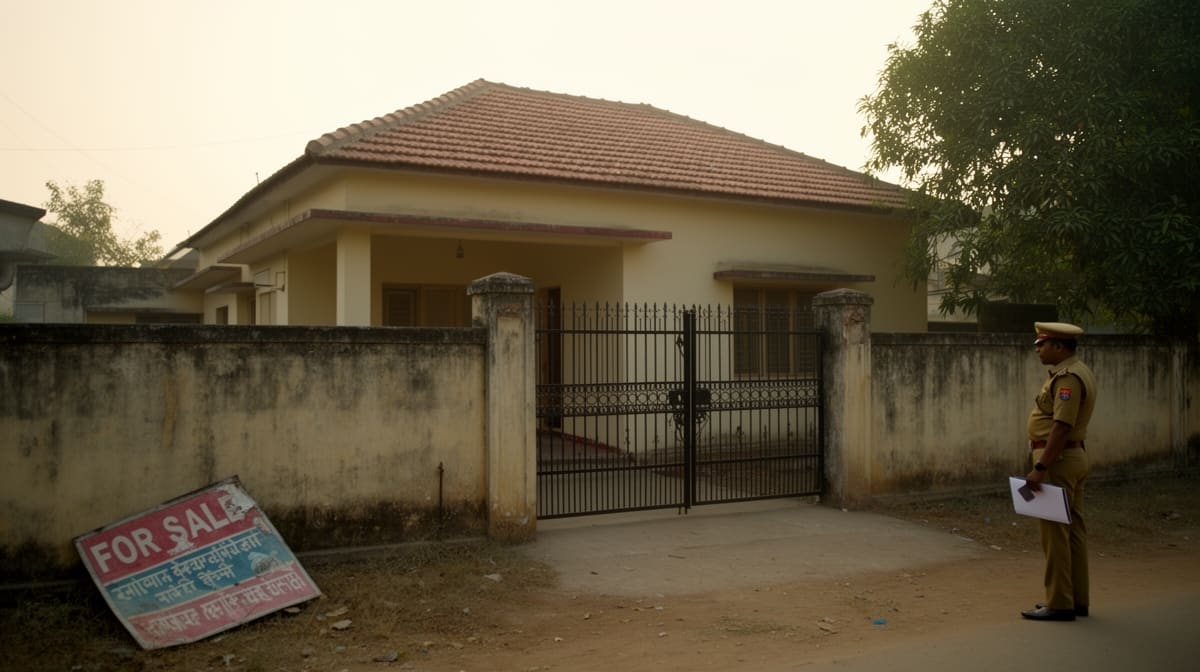
The Andhra Pradesh High Court has reaffirmed that no person may be deprived of property without due process of law, even if their possession is technically unlawful. This judgment underscores the constitutional safeguard under Article 300-A and the procedural fairness mandated by Articles 14 and 21, setting a critical precedent for land disputes involving long-standing occupants.
Background & Facts
The Dispute
The petitioner, C. Athiyanathan, an 84-year-old ex-serviceman, has been in continuous possession of a plot of land measuring 0.05 acres (24 x 26 feet) in Sy. No. 302, Shanthi Nagar, MR Palle, Tirupati Urban, since approximately 1986. Over four decades, he constructed a compound wall, planted trees including banana, coconut, tamarind, and neem, and erected a small shed. The property was assigned a door number by local authorities, indicating official recognition of his occupancy.
Key Facts
- The petitioner has been in uninterrupted possession since around 1986 (approximately 40 years)
- The land is located in Sy. No. 302, Shanthi Nagar, MR Palle, Tirupati Urban, Tirupati District
- The compound wall and structures were erected by the petitioner himself over 40 years ago
- The property was assigned a door number by municipal or revenue authorities
- The 8th respondent, Pangaluri Seethammagari Satram Pvt Ltd, initiated action to demolish the structures
Procedural History
- 22.03.2026: Representatives of the 8th respondent arrived at the petitioner’s property and took measurements despite his objection
- 09.04.2026: The respondents demolished a portion of the petitioner’s compound wall using men and machinery
- 09.04.2026: The petitioner protested, asserting his 40-year possession and requesting cessation of demolition
- 09.04.2026: Respondents threatened coercive action if the petitioner obstructed further demolition
- 16.04.2026: Writ Petition No. 10165/2026 filed before the Andhra Pradesh High Court
The Parties' Positions
Petitioner’s Position: The petitioner claims settled, long-standing possession of the property for over four decades. He asserts that the demolition was arbitrary, high-handed, and conducted without notice or hearing. He contends that the assignment of a door number by authorities implies tacit recognition of his occupancy.
Respondents’ Position: The respondents, including the State of Andhra Pradesh and the 8th private respondent, did not contest the factual assertion of possession. The Assistant Government Pleader admitted that the petitioner was in possession and agreed that due process must be followed.
Relief Sought
The petitioner sought a writ of mandamus to restrain the respondents from demolishing or dispossessing him without due process of law, and to declare the demolition as violative of Articles 14, 21, and 300-A of the Constitution.
The Legal Issue
The central question was whether a person in settled possession of property for over four decades can be dispossessed without following due process of law, even if their possession is not legally recognized or documented.
Arguments Presented
For the Petitioner
The petitioner’s counsel relied on the settled principle that possession, even if not legally perfected, attracts constitutional protection under Article 300-A. He cited Rame Gowda (dead) by L.Rs. v. M. Varadappa Naidu (dead) by L.Rs. (2004) to argue that no person may be dispossessed without a fair opportunity to be heard. He emphasized that the demolition was carried out with machinery and threats, violating natural justice and Article 14.
For the Respondent
The Assistant Government Pleader for the respondents did not dispute the petitioner’s long possession. He conceded that the respondents would follow due process of law and requested the Court to pass appropriate directions. No substantive legal opposition was raised to the petitioner’s claim of entitlement to procedural safeguards.
The Court's Analysis
The Court examined the nature of possession and its constitutional implications. It held that settled possession, regardless of its legal origin, triggers protection under Article 300-A, which guarantees that no person shall be deprived of property except by authority of law. The Court emphasized that even if the possession were deemed illegal, the petitioner must be afforded an opportunity to be heard before any dispossession.
"When the petitioner is in settled possession and enjoyment of the property, he cannot be dispossessed, without following due process of law."
The Court relied on the precedent in Rame Gowda (dead) by L.Rs. v. M. Varadappa Naidu (dead) by L.Rs. (2004) to reinforce that the state or private parties cannot take the law into their own hands. The demolition of the compound wall, which had stood for four decades, was characterized as a high-handed act that amounted to a violation of Article 14 (equality) and Article 300-A (right to property). The Court further noted that the assignment of a door number by authorities, though not conclusive of title, indicates recognition of occupancy and cannot be ignored.
The Court rejected the notion that mere lack of title negates the right to procedural fairness. It held that due process is not a privilege but a constitutional imperative, especially when the individual has lived on the land for generations.
The Verdict
The writ petition was disposed of with the consent of both parties. The Court directed the respondents not to dispossess the petitioner from the property in Sy. No. 302, Shanthi Nagar, Tirupati, except by due process of law. No costs were awarded. All pending interlocutory applications were closed.
What This Means For Similar Cases
Possession Triggers Due Process, Not Title
- Practitioners must now argue that settled possession for over 10 - 15 years creates a prima facie right to procedural fairness under Article 300-A, irrespective of title defects
- In eviction or demolition cases, the burden shifts to the state or private entity to prove that due process was followed
- Courts will not permit self-help remedies - demolition without notice or hearing is per se illegal
Door Numbers and Municipal Recognition Matter
- Assignment of a door number by revenue or municipal authorities constitutes tacit acknowledgment of occupancy and must be factored into legal arguments
- Such recognition strengthens the claim of settled possession and undermines claims of trespass or encroachment
- Legal notices and demolition orders must address this recognition explicitly
Enforcement Against Private Parties
- The judgment applies equally to private entities (like Respondent No. 8) acting in collusion with state authorities
- Private parties cannot act as de facto enforcement agents without judicial or statutory authority
- Writ jurisdiction under Article 226 is available against private actors when they act in concert with the state or exercise public functions