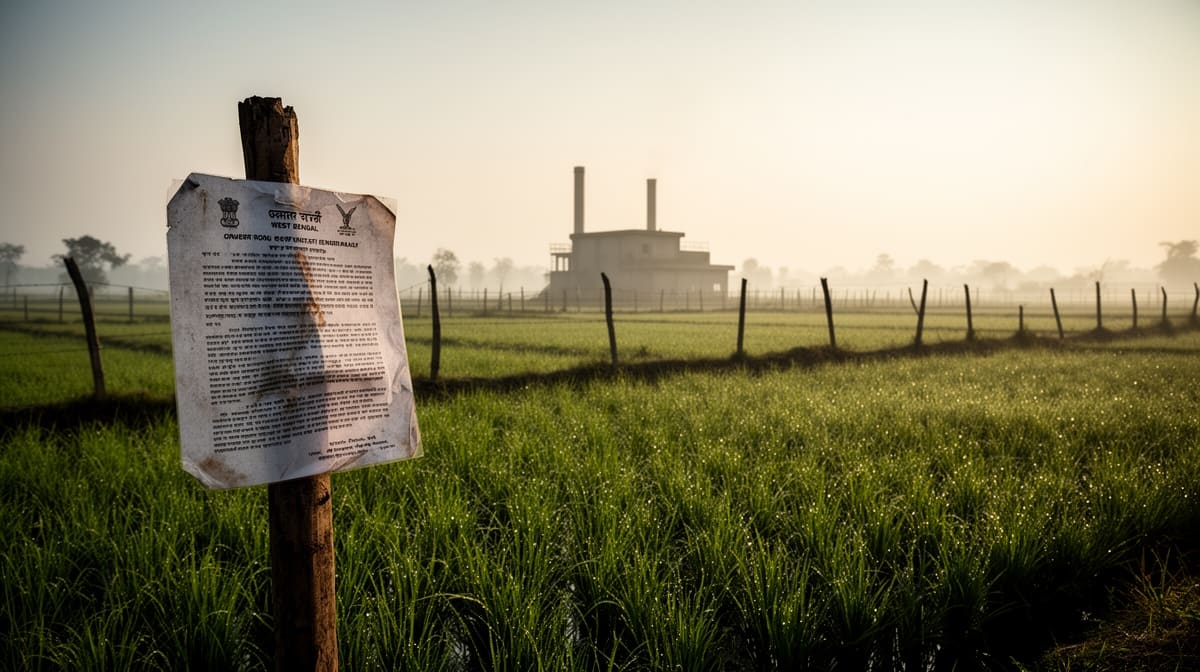
The Calcutta High Court has affirmed that the State cannot deprive a person of property through vesting under the West Bengal Land Reforms Act, 1955, without a legally enforceable mechanism for compensation. This ruling anchors the right to property under Article 300-A of the Constitution in a substantive framework that demands more than procedural legality - it requires just and fair redressal.
Background & Facts
The Dispute
The petitioner, Alpine Distilleries Pvt. Ltd., owned land in West Bengal that the State sought to vest under Section 14T(3) of the West Bengal Land Reforms Act, 1955. The vesting was challenged on the ground that the statutory provision for compensation, Section 14V, had been declared ultra vires by a Division Bench of this Court in Paschimbanga Bhumijibi Krishak Samiti & Ors. v. State of West Bengal (1996). Despite this, the State proceeded with vesting, relying on the continued validity of Section 14T(3).
Procedural History
The case progressed through multiple forums:
- 2022: Vesting order issued under Section 14T(3)
- 2022: Appellate authority affirmed vesting, citing a purported concession by the petitioner to retain part of the land under Section 14Y
- 2025: West Bengal Land Reforms and Tenancy Tribunal upheld the appellate order, again relying on the alleged concession
- 2026: Writ petition filed before the Calcutta High Court challenging the legality of vesting in absence of compensation
Relief Sought
The petitioner sought to quash the vesting order and restrain further proceedings under Section 14T(3), arguing that vesting without compensation violates Article 300-A of the Constitution. Alternatively, the petitioner sought recognition of its right to retain the factory portion under Section 14Y.
The Legal Issue
The central question was whether Section 14T(3) of the West Bengal Land Reforms Act, 1955, can lawfully authorize the State to vest private property when the statutory provision for compensation (Section 14V) has been declared ultra vires, and no alternative compensation mechanism exists.
Arguments Presented
For the Petitioner
The petitioner relied on Paschimbanga Bhumijibi Krishak Samiti (1996), which held Section 14V ultra vires, and on Pijush Kanti Chowdhury v. State of West Bengal (2007), which held that vesting cannot proceed without lawful compensation. It further invoked Bimal Kumar Shah v. Kolkata Municipal Corporation (2024), where the Supreme Court held that compensation is a necessary concomitant of any deprivation under Article 300-A, regardless of whether the action is termed acquisition or vesting. The petitioner emphasized that Article 300-A requires not merely a law, but a constitutionally valid law - one that provides for compensation.
For the Respondent
The State contended that Section 14T(3) remains intra vires and that vesting is distinct from acquisition under the Land Acquisition Act. It argued that Bimal Kumar Shah was confined to acquisition proceedings and did not apply to land reforms under Article 39(b) and (c). The State also cited interim orders from the Supreme Court in Paschimbanga Bhumijibi, which permitted mutation and possession changes pending final adjudication, as tacit approval to proceed. It further relied on WPLRT 66 of 2013, where the Court held that injunction cannot be granted merely because compensation is uncertain.
The Court's Analysis
The Court undertook a rigorous constitutional analysis of Article 300-A, which states: "No person shall be deprived of his property save by authority of law." The Court rejected the State’s narrow reading of this provision, holding that "authority of law" must mean a law that satisfies constitutional norms - not merely one that exists on paper.
"To assume that constitutional protection gets constricted to the mandate of a fair compensation would be a disingenuous reading of the text and, shall we say, offensive to the egalitarian spirit of the Constitution."
The Court emphasized that Bimal Kumar Shah was not confined to the Land Acquisition Act but articulated a universal principle: compensation is a sine qua non for any state-induced deprivation of property, whether through acquisition, vesting, or eminent domain. The Court noted that Article 39, which underpins the 1955 Act, is itself rooted in public purpose - a principle that cannot justify uncompensated deprivation.
The Court distinguished the State’s cited precedents. In WPLRT 66 of 2013, the issue was whether an injunction could be granted due to uncertainty of compensation. The Court held that this was an error of legal reasoning: the availability of damages as a remedy under the Specific Relief Act cannot override a constitutional mandate. The Court further clarified that the Supreme Court’s interim order in Paschimbanga Bhumijibi was merely a status quo directive, not a validation of uncompensated vesting.
The Court also rejected the appellate authority’s reliance on a "concession" by the petitioner regarding retention under Section 14Y. The petitioner’s written submissions clearly stated that the retention claim was advanced without prejudice to the primary challenge to the vesting’s legality. To treat this as consent to deprivation was a fundamental misreading of legal procedure.
The Verdict
The petitioner succeeded. The Calcutta High Court held that vesting under Section 14T(3) cannot proceed in the absence of a constitutionally valid compensation mechanism, and that Article 300-A renders such vesting unlawful. The Court set aside the vesting order and restrained further proceedings until the Supreme Court decides the fate of Section 14V.
What This Means For Similar Cases
Compensation Is Non-Negotiable Under Article 300-A
- Practitioners must now argue that any state action depriving property - whether under land reform, acquisition, or tenancy laws - must include a legally enforceable compensation provision
- Vesting orders issued without compensation are void ab initio, regardless of whether the underlying statute remains intra vires
- Courts must scrutinize whether "authority of law" includes substantive fairness, not just procedural compliance
Concessions Cannot Substitute Legal Rights
- Any statement made "without prejudice" to a legal challenge cannot be construed as waiver or consent
- Tribunals and appellate authorities must distinguish between alternative remedies and surrender of fundamental rights
- Practitioners should explicitly document the non-waiver nature of alternative claims in written submissions
Stay Orders Are Not Validation
- Interim orders from higher courts permitting mutation or possession changes do not validate the legality of the underlying action
- Such orders are procedural safeguards, not substantive approvals
- Practitioners should not rely on interim orders to justify proceeding with uncompensated deprivation