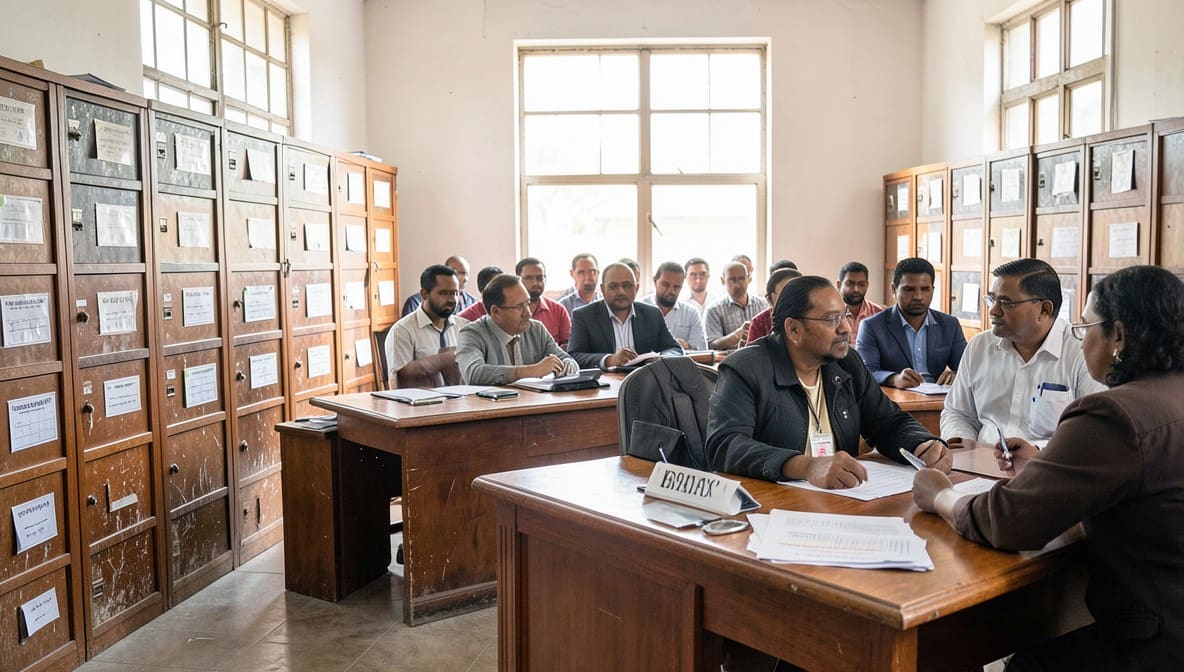
The Allahabad High Court has issued a strong directive to expedite the adjudication of a land partition case pending for nearly two decades, reinforcing the principle that undue delay in quasi-judicial proceedings violates the right to effective remedy under Article 227 of the Constitution. This order underscores the judiciary’s role in ensuring administrative accountability, particularly in land disputes where prolonged pendency causes irreparable hardship to litigants.
Background & Facts
The Dispute
The petition under Article 227 of the Constitution seeks to compel the Sub Divisional Magistrate (SDM), Tahsil Lalganj, District Pratapgarh, to decide a long-pending case for partition of land holdings under Section 176 of the U.P. Zamindari Abolition and Land Reforms Act, 1950. The dispute involves a claim for division of agricultural land between co-heirs, originally filed as Case No. T200602570200005 (Sukkhu vs. Bhola Nath and Others).
Key Facts
- The land partition case was filed before the SDM on or before 12.06.2006
- The matter has remained pending for over 20 years without any substantive hearing or final order
- The petitioners are parties to the original land dispute seeking resolution of their proprietary rights
- No final order has been passed despite multiple opportunities for hearing and filing of evidence
- The petitioners allege persistent adjournments and procedural inaction by the SDM’s office
Procedural History
- 12.06.2006: Original land partition case filed before SDM, Tahsil Lalganj under Section 176 of U.P. Zamindari Abolition and Land Reforms Act, 1950
- No hearing or order issued between 2006 and 2026
- 2026: Petition filed under Article 227 before the Allahabad High Court, Lucknow Bench
- 12.06.2026: Hearing conducted before Hon’ble Justice Brij Raj Singh
The Parties' Positions
- Petitioners: Argued that the prolonged pendency of the case for nearly 20 years constitutes a denial of justice and violates their fundamental right to timely adjudication under Article 21. They sought a direction to dispose of the matter within a fixed timeframe.
- Respondents: The SDM and State did not oppose the petition. The Standing Counsel for the State and learned counsel for respondent no. 10 conceded the delay and did not contest the need for expeditious disposal.
Relief Sought
The petitioners sought a writ of mandamus directing the SDM to decide Case No. T200602570200005 within a stipulated period, with no further adjournments, and to afford full opportunity of hearing to all parties.
The Legal Issue
Whether the High Court, exercising its supervisory jurisdiction under Article 227 of the Constitution, can direct a quasi-judicial authority to decide a long-pending case within a fixed timeframe, even in the absence of a demonstrated legal error or mala fide conduct.
Arguments Presented
For the Petitioner
Learned counsel for the petitioners relied on the principle that Article 227 empowers the High Court to supervise all subordinate courts and tribunals to ensure they function within the bounds of law and in a timely manner. He cited L. Chandra Kumar v. Union of India to emphasize that delay in adjudication by quasi-judicial authorities amounts to a violation of the right to access justice. He argued that a case pending for over two decades without any progress is a manifest failure of the administrative justice system and warrants judicial intervention.
For the Respondent
The Standing Counsel for the State and counsel for respondent no. 10 did not contest the petition. They acknowledged the delay and conceded that the matter required urgent disposal. No legal counter-arguments were advanced.
The Court's Analysis
The Court observed that while it does not possess the power to adjudicate the merits of the land partition dispute, it retains the inherent supervisory authority under Article 227 to ensure that subordinate authorities do not permit cases to languish indefinitely. The Court noted that the case has been pending since 12.06.2006, with no discernible progress over two decades. Such delay, the Court held, is not merely procedural inefficiency but a systemic failure that undermines public confidence in the rule of law.
"In view of above, the present petition is disposed of with a direction to Sub Divisional Magistrate Tahsil Lalganj Distt. Pratpagarh to consider and decide case, detailed above, most expeditiously, after affording full opportunity of hearing to the parties to the litigation and without granting unnecessary adjournment to either party..."
The Court clarified that its direction does not pre-determine the outcome of the case. The SDM remains free to decide the matter strictly in accordance with law, based on evidence and submissions. However, the Court emphasized that the authority must act with urgency and without further procrastination. The one-year timeline was imposed as a reasonable benchmark to balance the need for due process with the imperative of timely justice.
The Verdict
The petition was disposed of with a direction to the Sub Divisional Magistrate, Tahsil Lalganj, to decide Case No. T200602570200005 within one year from the date of receipt of the certified copy of this order, provided there is no legal impediment. The SDM is directed to afford full opportunity of hearing to all parties and to refrain from granting unnecessary adjournments. The Court explicitly stated that it has not examined the merits of the case and the authority shall decide strictly in accordance with law.
What This Means For Similar Cases
Judicial Supervision Overrides Procedural Inertia
- Practitioners may now invoke Article 227 proactively in cases where quasi-judicial authorities fail to decide matters within a reasonable time, even without proof of bias or illegality
- A delay exceeding 10 - 15 years in land or revenue cases is now a strong ground for High Court intervention
- Courts may impose fixed timelines for disposal, especially where the matter involves property rights and prolonged uncertainty
Fixed Timelines Are Enforceable, Not Advisory
- The one-year deadline set by the Court is not a suggestion but a binding directive
- Failure to comply may invite contempt proceedings or further writ relief
- Practitioners should file follow-up applications if the authority fails to meet the deadline, citing this judgment as binding precedent
Merits Are Not Prejudged - But Process Must Be Fair and Fast
- The Court’s refusal to examine the merits reinforces that Article 227 is not a substitute for appellate review
- However, procedural fairness must be coupled with speed - delay itself can be a denial of justice
- This judgment provides a template for litigants in other pending land, revenue, or tenancy cases across Uttar Pradesh and similar jurisdictions