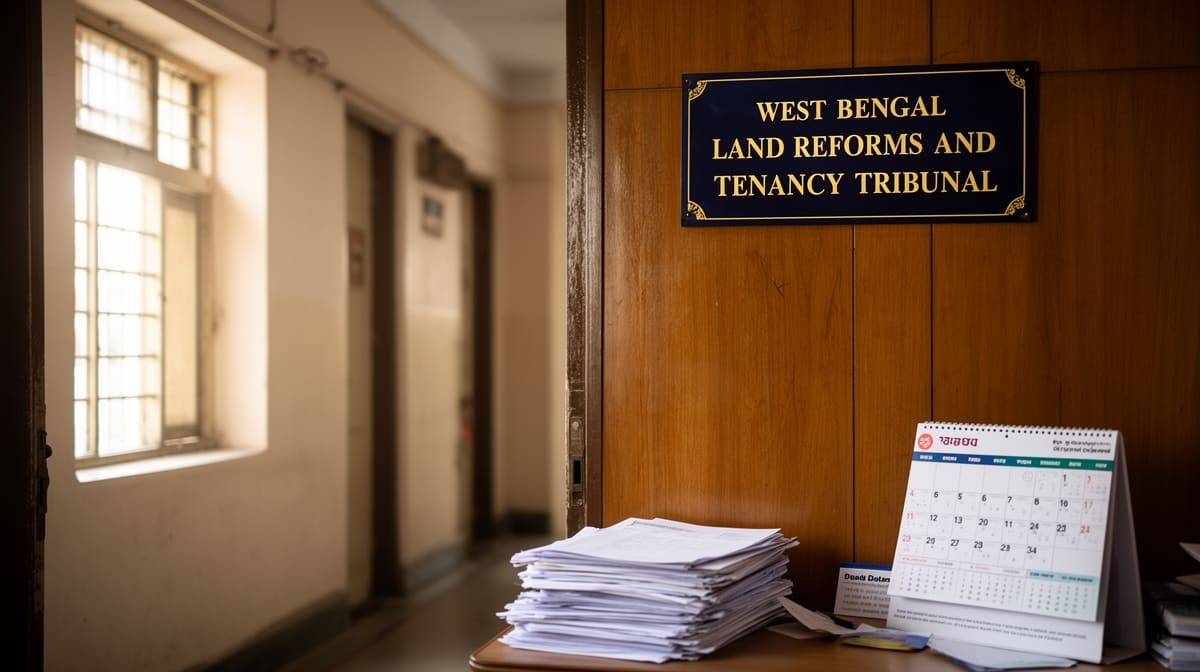
The Calcutta High Court has underscored the constitutional imperative of speedy justice by directing a land reforms tribunal to decide a long-pending case within six months, emphasizing that undue delay in adjudication disproportionately harms elderly litigants. This order reinforces the principle that procedural delays, especially when parties are advanced in age, cannot be tolerated under Article 21.
Background & Facts
The Dispute
The petitioners, Sankar Prasad Roy and another, are septuagenarians challenging an order of the West Bengal Land Reforms and Tenancy Tribunal in Original Application No. 2545 of 2023 (LRTT). The dispute pertains to land rights and tenancy status under the West Bengal Land Reforms Act, 1955. The petitioners have been awaiting final adjudication since 2023, with no resolution in sight despite the completion of pleadings and submission of records.
Key Facts
- Both petitioners are over 70 years of age as of March 2026
- Original Application No. 2545 of 2023 was filed before the West Bengal Land Reforms and Tenancy Tribunal
- The matter was listed for hearing on August 31, 2026, as per an order dated December 15, 2025
- The records have been fully transferred to the Tribunal and all pleadings are complete
- No interim relief has been granted during the pendency
- The petitioners have not received any substantive hearing since filing
Procedural History
- 2023: Original Application No. 2545 of 2023 filed before the West Bengal Land Reforms and Tenancy Tribunal
- December 15, 2025: Tribunal fixed next hearing date as August 31, 2026
- March 30, 2026: Writ Petition No. 36 of 2026 filed before the Calcutta High Court seeking expeditious disposal
- March 30, 2026: Hearing concluded before the Division Bench
The Parties' Positions
For the Petitioners: Counsel submitted that the petitioners, being septuagenarians, face grave hardship due to the prolonged pendency. The delay of over three years, with the next hearing fixed more than 17 months ahead, constitutes a violation of their right to speedy justice under Article 21 of the Constitution. They emphasized that the records are complete and no further evidence is required.
For the State: The Senior Government Advocate acknowledged that private respondents have not been appearing before the Tribunal, contributing to the delay. However, no substantive objection was raised to the petitioners’ prayer for expeditious disposal.
Relief Sought
The petitioners sought a direction to the Tribunal to dispose of O.A. 2545 of 2023 within a reasonable time, preferably within six months, and to advance the next hearing date.
The Legal Issue
The central question was whether prolonged and unreasonable delay in adjudication by a statutory tribunal, particularly when the parties are elderly and the pleadings are complete, violates the right to speedy justice under Article 21 of the Constitution, and whether a writ court may intervene to mandate a timeline for disposal.
Arguments Presented
For the Petitioner
Counsel relied on the constitutional guarantee of speedy justice under Article 21, citing Hussainara Khatoon v. Home Secretary, State of Bihar and Kartar Singh v. State of Punjab, to argue that delay in adjudication is not merely procedural but a substantive denial of justice. They emphasized that the petitioners’ advanced age renders them vulnerable to irreversible harm if the matter is not decided promptly. The completeness of records and absence of any pending evidentiary requirement were highlighted as grounds for immediate adjudication.
For the Respondent
The State did not contest the core contention that delay was excessive. The Senior Government Advocate attributed the delay to non-appearance by private respondents but did not oppose the request for a timeline. No legal objection was raised to the invocation of the High Court’s writ jurisdiction under Article 226 to direct expeditious disposal.
The Court's Analysis
The Court observed that while tribunals are statutorily mandated to dispose of matters expeditiously, the reality of prolonged delays undermines the very purpose of establishing specialized forums. The Court noted that the petitioners, being in their seventies, have already endured over three years of uncertainty. The next hearing date of August 31, 2026, would extend the pendency to over four years - a duration incompatible with the constitutional guarantee of justice.
"The right to speedy justice is not a mere procedural formality but a substantive component of the right to life and personal liberty under Article 21. When the pleadings are complete and the records are before the Tribunal, further delay serves no legitimate purpose and inflicts irreparable hardship on elderly litigants."
The Court rejected the notion that non-appearance by private respondents justifies indefinite postponement. It held that the Tribunal has the inherent power and duty to proceed ex parte or on admitted facts where respondents remain absent. The Court further noted that the nature of the dispute - concerning land rights and tenancy - is inherently time-sensitive for elderly claimants who may not survive prolonged litigation.
The Court also emphasized that the High Court’s supervisory jurisdiction under Article 226 permits intervention where statutory bodies fail to discharge their duty in a reasonable time. The Court found no reason to require service on private respondents, given the innocuous nature of the direction and the overwhelming equity in favor of the petitioners.
The Verdict
The writ petition was disposed of with the direction that the Second Bench, West Bengal Land Reforms and Tenancy Tribunal, shall dispose of Original Application No. 2545 of 2023 (LRTT) within six months from the date of communication of this order. The Tribunal is permitted to advance the next hearing date upon notice to both sides. For compliance, the Tribunal and concerned officers may act on a server copy of this judgment without awaiting a certified copy. There will be no order as to costs.
What This Means For Similar Cases
Delay Cannot Be Justified by Absent Parties
- Practitioners must now argue that non-appearance by respondents does not absolve tribunals of their duty to decide on merits
- Tribunals must proceed ex parte or on admitted records where parties remain absent
- A delay of more than 18 months in tribunal proceedings, absent exceptional circumstances, may attract writ intervention
Age as a Factor in Speedy Justice Claims
- Advanced age of litigants is now a recognized aggravating factor in assessing undue delay
- Courts will treat elderly petitioners as a vulnerable class entitled to prioritized adjudication
- Applications for expeditious disposal must explicitly state the petitioner’s age and health condition
Writ Jurisdiction as a Remedial Tool
- High Courts may issue mandatory directions to tribunals to fix timelines for disposal
- The completeness of pleadings and availability of records are decisive factors in granting such relief
- Certified copies are not mandatory for compliance - server copies are sufficient for operational purposes