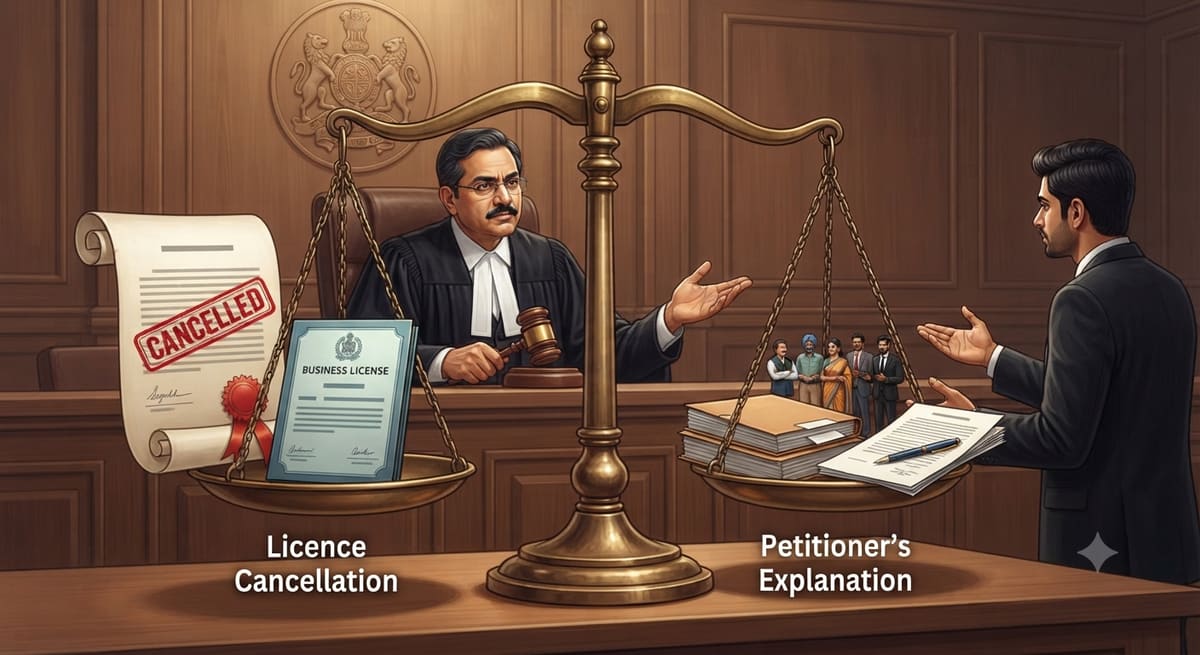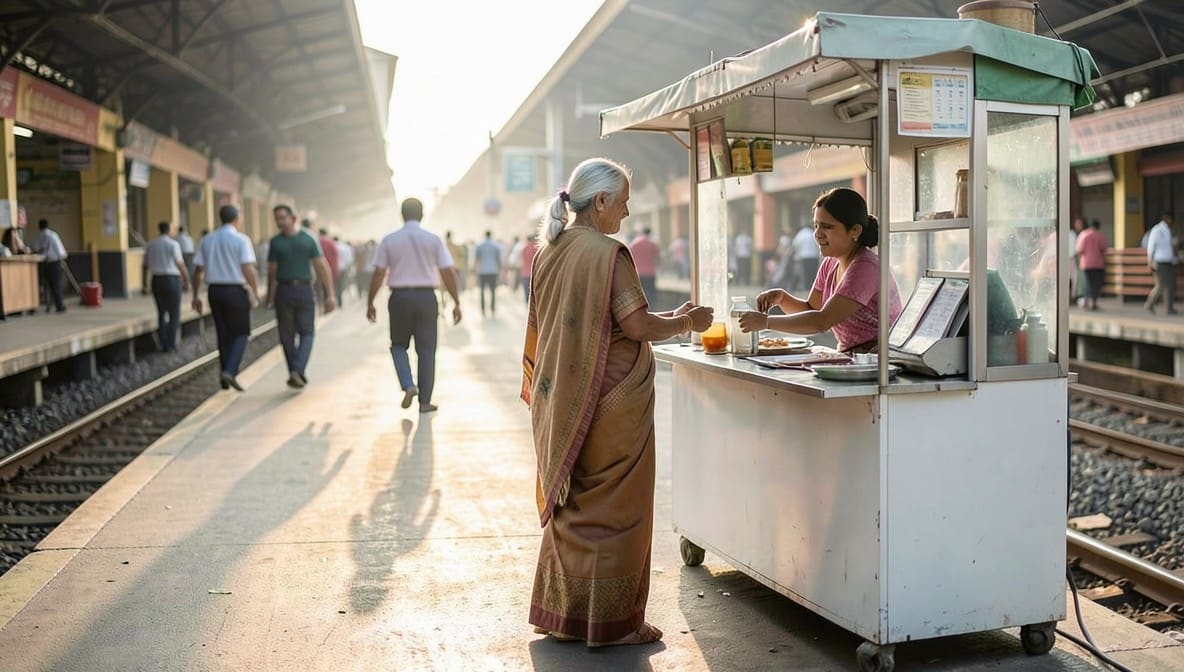
The Jharkhand High Court has reaffirmed that the right to livelihood of vulnerable individuals, particularly widows dependent on petty railway stall businesses, cannot be extinguished on vague or retrospective grounds. In a significant ruling, the Court quashed the termination of a 76-year-old widow’s license, emphasizing constitutional protections under Articles 14, 19(1)(g), and 21, and aligning with the Supreme Court’s precedent in S.C.R. Caterers.
Background & Facts
The Dispute
The petitioner, Smt. Kalawati Devi, widow of Late Dipti Singh, sought quashing of the termination order dated 11.06.2025 of her license to operate a small food stall on the Ranchi Railway Station platform. She claimed the termination violated principles of natural justice, was arbitrary, and contravened the Railway Catering Policy, 2010, and the binding precedent of the Supreme Court in Senior Divisional Commercial Manager & Others v. S.C.R. Caterers (2016) 3 SCC 582.
Key Facts
- The petitioner’s husband operated the food stall under a valid license from 1994 until his death in 2000.
- Upon his demise, the license was transferred to the petitioner as his widow, in accordance with railway catering policy.
- The license was renewed periodically: in 2002, 2007, and 2012.
- On 17.07.2015, the petitioner was abruptly directed to vacate the stall and was physically removed on 21.07.2015 without any notice or hearing.
- No record existed justifying the 2015 removal under principles of natural justice.
- The petitioner filed two writ petitions before the High Court seeking redress.
- On 14.10.2024, following a Court order, the Railway authorities renewed her license for three years, subject to payment of dues.
- On 11.06.2025, the renewed license was terminated on four grounds: (a) unsatisfactory services, (b) non-adherence to performance levels, (c) non-payment of railway dues, and (d) non-payment of penalties.
- The demand for dues dated 20.05.2025 (Annexure-24) amounted to Rs. 1,35,359/-, including Rs. 8,570.40 for water charges and Rs. 58,563/- for electricity charges for the period 2015 - 2024, during which the petitioner was forcibly removed.
- The petitioner’s license fees for the period 14.10.2024 to 11.06.2025 were nil, as acknowledged in the demand notice.
- The petitioner, aged 76, runs the stall with the assistance of her daughter.
Procedural History
- 17.07.2015: Petitioner directed to vacate stall.
- 21.07.2015: Physical removal from platform.
- 2015 - 2024: Petitioner filed multiple representations and two writ petitions.
- 12.06.2024: First representation rejected by Railway authorities.
- 2024: Writ Petition No. 3905 of 2024 filed.
- 14.10.2024: License renewed by Railway authorities pursuant to Court order.
- 11.06.2025: Termination of renewed license issued under Article 15 of Master License Agreement.
- 2025: Writ Petition No. 5674 of 2025 filed challenging termination.
- 27.04.2026: Final hearing before Division Bench of Jharkhand High Court.
- 27.04.2026: Contempt Petition No. 11 of 2026 filed alleging violation of status quo order; disposed of concurrently.
Relief Sought
The petitioner sought:
- Quashing of the termination order dated 11.06.2025.
- Restoration of the license granted on 14.10.2024.
- Direction to include her daughter’s name in the license.
- Refund of Rs. 1,35,359/- paid under protest.
- Compliance with the 2010 Policy and S.C.R. Caterers judgment.
The Legal Issue
The central question was whether the termination of a widow’s railway stall license, after a decade-long legal battle and a recent court-ordered renewal, could be justified on vague allegations of poor service and retrospective demands for dues accrued during her unlawful ouster, without compliance with natural justice or adherence to the Supreme Court’s directive in S.C.R. Caterers.
Arguments Presented
For the Petitioner
Dr. A.K. Singh, Advocate, argued that:
- The termination order dated 11.06.2025 was ex facie arbitrary, violative of natural justice, and contrary to the Supreme Court’s ruling in S.C.R. Caterers.
- The allegations of unsatisfactory services and non-adherence to performance levels were vague, unsubstantiated, and lacked specific evidence.
- The demand for Rs. 1,35,359/- for water, electricity, and dues was for the period (2015 - 2024) when the petitioner was illegally barred from the platform, making the demand unjust and retaliatory.
- The 2010 Policy permits inclusion of family members, including daughters, in license renewals, especially where the licensee is elderly and dependent.
- The petitioner had paid all dues for the current license period and had offered to pay the disputed amount under protest without prejudice.
For the Respondent
Mr. Prashant Pallav, Additional Solicitor General of India, contended that:
- The termination was in strict compliance with Article 15 of the Master License Agreement.
- The petitioner had been given three opportunities to improve her services, with fines imposed progressively: Rs. 500, Rs. 1,000, Rs. 5,000, and Rs. 50,000.
- The petitioner failed to pay fines or rectify deficiencies, justifying termination.
- The counter-affidavit and inspection reports were unchallenged in the rejoinder, rendering the petitioner’s allegations as evasive.
- The 2010 Policy does not permit inclusion of a daughter’s name if the original licensee is deceased but the license is still active.
The Court's Analysis
The Court undertook a rigorous examination of the termination order, the procedural history, and the binding precedent of the Supreme Court in S.C.R. Caterers. It found that the termination was not merely procedurally flawed but substantively unjust.
"The petitioner was a widow, who, along with her daughter, was struggling to make a living. Therefore, it is merely alleged that the services provided by her were unsatisfactory or that she had not attained the prescribed performance level, reasons which cannot be very easily accepted."
The Court emphasized that vague allegations of poor service, without specific instances, inspection reports, or prior notice of performance benchmarks, cannot sustain termination. The absence of any documented evidence showing the petitioner was apprised of measurable standards rendered the grounds legally unsustainable.
Regarding the dues, the Court noted the glaring inconsistency: the petitioner was forcibly removed in 2015 and barred from the platform for nearly a decade. To demand payment for utilities and charges during that period was not only unreasonable but also punitive. The Court observed that the Railway authorities had not even attempted to recover these amounts during the intervening years, making the demand appear retaliatory.
The Court then turned to the Supreme Court’s judgment in S.C.R. Caterers, which held that denying renewal of licenses to those wholly dependent on such petty businesses for livelihood is arbitrary, discriminatory, and violative of Articles 14, 19(1)(g), and 21. The Court reiterated:
"The chances of such persons being deprived of their right to livelihood is also an important factor which has to be taken into consideration by the Court to interpret the policy framed by the railways."
The Court found that the Railway authorities, having been directed by the Court to renew the license in 2024, acted in bad faith by terminating it within a year. This conduct undermined judicial authority and the constitutional obligation to protect the livelihood of the economically vulnerable.
The Court also rejected the respondent’s argument against including the daughter’s name, noting that the petitioner, aged 76, naturally requires familial assistance. Such assistance does not constitute a benami transfer or sub-licensing.
The Verdict
The writ petition was allowed. The termination order dated 11.06.2025 was quashed and set aside. The license granted on 14.10.2024 was restored for its full term of three years. The petitioner was directed to file an affidavit within two weeks declaring that the license is personal to her, she has no other stall, and her daughter’s assistance is for familial support, not benami operation. The petitioner shall pay Rs. 1,35,359/- under protest and without prejudice within two weeks. She is granted liberty to seek refund of this amount and to renew her request for inclusion of her daughter’s name in the license. The respondents must consider her representation within three months. Restoration to the platform must occur immediately upon payment and affidavit submission, without imposing any new conditions.
What This Means For Similar Cases
Natural Justice Cannot Be Ignored in Licensing Decisions
- Practitioners must insist on specific, documented evidence of breach before termination of licenses.
- Vague allegations of "unsatisfactory service" without defined benchmarks or prior notice are legally insufficient.
- Any penalty or fine must be preceded by clear communication of expectations and opportunity to cure.
Retrospective Demands for Dues Are Unlawful
- Demands for charges incurred during periods of unlawful ouster are void and retaliatory.
- Authorities cannot withhold renewal or impose penalties based on dues accrued while the licensee was barred from the premises.
- Any demand for past dues must be time-bound, justified, and linked to actual usage during the license period.
Welfare Jurisprudence Overrides Administrative Rigidity
-
The S.C.R. Caterers precedent mandates that railway catering policies be interpreted in favor of livelihood protection.
-
Elderly, widowed, or economically vulnerable licensees are entitled to greater judicial protection under Articles 14, 19(1)(g), and 21.
-
Family assistance in running a stall does not equate to benami transfer; courts must distinguish between subsistence and commercial exploitation.
-
Practitioners should cite S.C.R. Caterers in all pending cases involving railway stall licenses.
-
Applications for renewal must be framed with explicit reference to constitutional rights to livelihood and dignity.
-
Courts must scrutinize administrative actions that disproportionately impact marginalized groups.