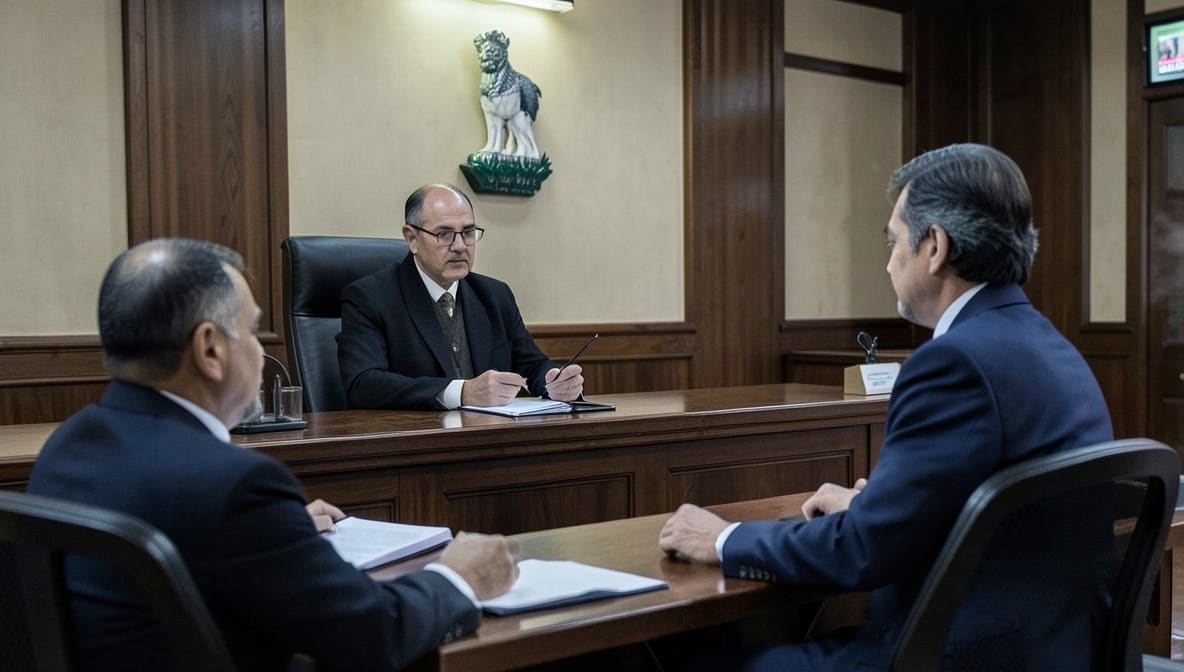
The Punjab and Haryana High Court has clarified that an accused cannot be compelled to assist investigative agencies in recovering evidence that may incriminate them, reinforcing the constitutional right to remain silent and the presumption of innocence. This ruling, delivered under the newly enacted Bharatiya Nagarik Suraksha Sanhita, 2023, sets a critical precedent for the scope of anticipatory bail conditions.
Background & Facts
The Dispute
The petitioner, Rajiv Kumar alias Mikki, sought anticipatory bail in connection with FIR No. 56 dated 09.02.2026, registered at Police Station Mandi Gobindgarh, District Fatehgarh Sahib, Punjab. The FIR alleged commission of offences under Section 316(2) and Section 61(2) of the Bharatiya Nyaya Sanhita, 2023, which pertain to causing death by act endangering life or personal safety, and criminal breach of trust respectively. The case involves allegations of financial misconduct and concealment of proceeds.
Key Facts
- FIR was registered on 09.02.2026 based on a complaint alleging misappropriation of funds
- The petitioner was named as a primary accused
- On 25.03.2026, the Court granted interim anticipatory bail subject to two conditions: (i) furnishing bonds to the satisfaction of the arresting officer, and (ii) joining the investigation
- The petitioner complied with both conditions by appearing before the investigating officer on 26.03.2026
- The petitioner did not possess any physical evidence or documents allegedly linked to the offence
- The prosecution claimed that the petitioner failed to facilitate recovery of money, which they contended was material evidence
- No incriminating material was recovered from the petitioner’s possession
Procedural History
- 09.02.2026: FIR No. 56 registered at Police Station Mandi Gobindgarh
- 25.03.2026: Interim anticipatory bail granted by the Court
- 26.03.2026: Petitioner appeared before investigating officer and submitted to questioning
- 05.04.2026: State filed compliance report alleging lack of cooperation
- 09.04.2026: Hearing held on petition to make interim bail absolute
The Parties' Positions
For the Petitioner: The petitioner had fully complied with the interim bail conditions by appearing before the investigating agency. He had no control over the alleged proceeds of the offence and could not be compelled to assist in their recovery without violating his right to defence.
For the Respondent (State): The State contended that the petitioner’s failure to facilitate recovery of money amounted to non-cooperation, necessitating custodial interrogation to extract information.
Relief Sought
The petitioner sought to make the interim anticipatory bail order dated 25.03.2026 absolute, arguing that no further conditions were warranted.
The Legal Issue
Can an accused person be compelled to assist the prosecution in recovering incriminating material as a condition for continuing anticipatory bail, and does refusal to do so justify denial of bail or custodial interrogation?
Arguments Presented
For the Petitioner
The petitioner’s counsel relied on the principle that the right to remain silent and the right to a fair defence are fundamental under Section 482 of the Bharatiya Nagarik Suraksha Sanhita, 2023, and protected by Article 20(3) of the Constitution. He argued that the petitioner had fully complied with the Court’s order by appearing for questioning. The prosecution’s demand for recovery assistance was tantamount to forcing self-incrimination. The money in question, if not in the petitioner’s possession, could not be treated as tangible evidence linking him to the offence.
For the Respondent
The State contended that the petitioner’s failure to disclose the location of proceeds constituted non-cooperation, which undermined the integrity of the investigation. It argued that custodial interrogation was necessary to trace the money, which was central to proving the offence under Section 61(2). The State cited general principles of investigative necessity but did not cite any statutory provision authorizing compulsion of an accused to assist in recovery.
The Court's Analysis
The Court undertook a careful review of the petitioner’s compliance and the nature of the alleged offence. It emphasized that anticipatory bail is not a privilege contingent on assisting the prosecution, but a safeguard against arbitrary arrest.
"The petitioner cannot be forced to assist the prosecuting agency for the recovery of incriminating material which may harm his interests or may amount to defeating his right of defence."
The Court observed that the money, even if allegedly proceeds of crime, was not a physical piece of evidence in the petitioner’s custody. Its recovery, if at all possible, depended on third-party records or financial trails, not the petitioner’s cooperation. The Court further noted that the State had not demonstrated any specific, credible reason why custodial interrogation was indispensable, especially after the petitioner had already submitted to questioning.
The Court distinguished between cooperation and compulsion. While voluntary cooperation is commendable, it cannot be mandated without violating the accused’s constitutional rights. The Court held that the State’s reliance on non-cooperation was legally unsustainable.
The Verdict
The petition was allowed. The interim anticipatory bail order dated 25.03.2026 was made absolute. The petitioner is granted anticipatory bail in the event of arrest in connection with FIR No. 56 of 2026, subject to the conditions already imposed: furnishing a personal bond to the satisfaction of the arresting officer and continuing to cooperate with the investigation by appearing when summoned. No further conditions, including recovery assistance, shall be imposed.
What This Means For Similar Cases
Right to Silence Trumps Investigative Demands
- Practitioners can now confidently argue that demanding recovery assistance as a bail condition is legally invalid
- Courts must reject State arguments that equate non-cooperation with non-compliance when the accused has appeared and answered questions
- The burden remains on the State to independently trace evidence, not to extract it from the accused
No Custodial Interrogation Without Justification
- Custodial interrogation cannot be justified merely on the ground that money or property is unaccounted for
- The Court must assess whether the accused possesses the evidence or has control over it
- Absent such possession, the State’s claim of necessity for custody lacks legal foundation
Clarification Under BNSS
- This judgment is among the first under the Bharatiya Nagarik Suraksha Sanhita, 2023 to interpret Section 482 in the context of anticipatory bail
- It reinforces that the new Code does not erode constitutional protections, even in serious offences
- Defence counsel should cite this judgment when opposing bail conditions that require self-incrimination