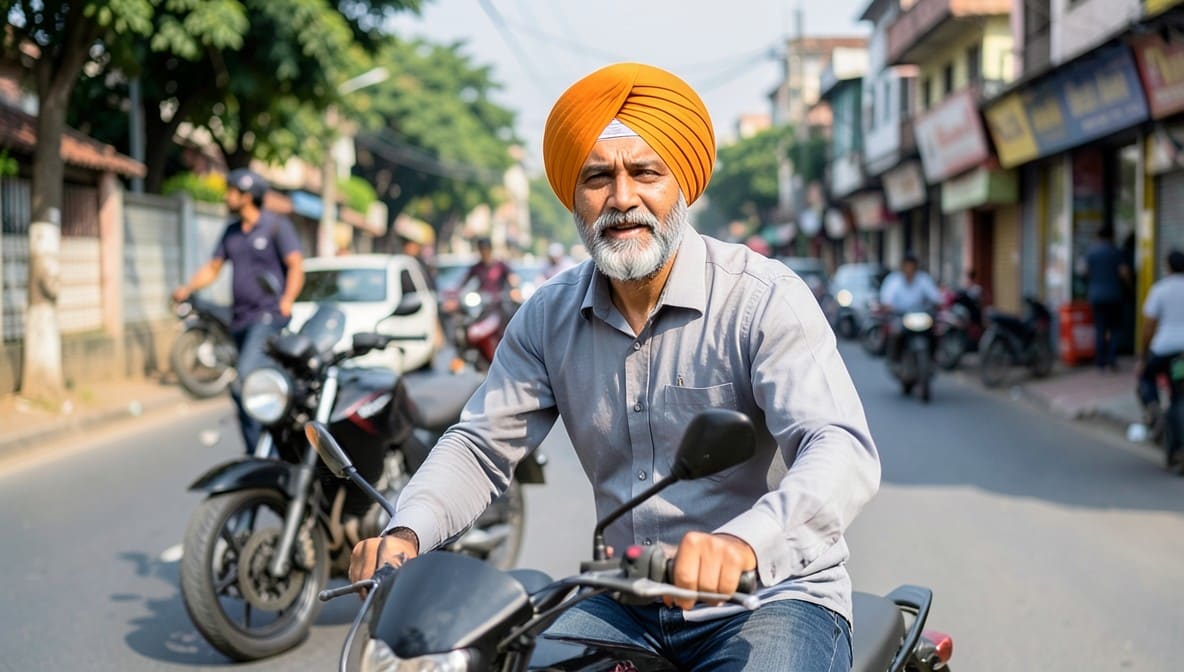
The Bombay High Court has affirmed that the exemption granted to Sikh riders wearing turbans from the mandatory helmet requirement under the Motor Vehicles Act does not violate the constitutional guarantee of equality. The judgment clarifies that such an exemption constitutes a reasonable classification, grounded in religious practice and public safety, and is consistent with Article 14 of the Constitution.
Background & Facts
The Dispute
The petitioner, Kirtesh s/o Vikas Chaudhari, a 23-year-old student from Nagpur, challenged the validity of the Proviso to Section 129 of the Motor Vehicles Act, 1988, which exempts persons who are Sikhs from the obligation to wear protective headgear while riding motorcycles, provided they are wearing a turban. The petitioner contended that this exemption creates an arbitrary and unconstitutional classification based on religion, violating the principle of equal protection under Article 14.
Key Facts
- Section 129 of the Motor Vehicles Act mandates that every person above four years of age driving or riding a motorcycle in a public place must wear protective headgear conforming to Bureau of Indian Standards.
- The Proviso to Section 129 states: "Provided that the provisions of this section shall not apply to a person who is a Sikh, if, while driving or riding on the motorcycle, in a public place, he is wearing a turban."
- The petitioner does not belong to the Sikh community and argues that the exemption grants a privileged status to one religious group, thereby discriminating against others.
- The exemption is not based on caste, creed, or general religious identity, but specifically on the religious practice of wearing a turban, which serves the same protective function as a helmet.
- The Central Government has not extended similar exemptions to any other religious group.
Procedural History
- 15.04.2026: Criminal Writ Petition No. 416 of 2026 filed before the Bombay High Court, Nagpur Bench.
- 29.06.2026: Hearing concluded by consent of parties.
- 30.06.2026: Judgment delivered.
The Parties' Positions
For the Petitioner
- Argued that the Proviso creates an irrational classification by exempting only Sikhs, while requiring all others to wear helmets.
- Contended that Article 14 prohibits any form of class legislation and that religion cannot be a basis for differential treatment in public safety laws.
- Asserted that the exemption undermines the objective of the law - reducing head injuries - by allowing one group to opt out without equivalent protection.
- Cited the principle of secularism under the Constitution to argue that no religious group should receive special privileges in regulatory statutes.
For the Respondent
- Submitted that the exemption is not based on religion per se, but on the practical reality that Sikhs, as a matter of religious obligation, wear turbans which provide substantial head protection.
- Emphasized that the turban, by virtue of its layered structure and material, fulfills the functional purpose of a helmet.
- Relied on precedents from the Delhi High Court and the Supreme Court to establish that reasonable classification based on religious practice is constitutionally permissible.
- Highlighted that the exemption is narrowly tailored and does not negate the overall safety objective of Section 129.
Relief Sought
The petitioner sought a declaration that the Proviso to Section 129 of the Motor Vehicles Act, 1988, and Section 194(d) (which prescribes penalties for non-compliance) are unconstitutional and void for being violative of Article 14 of the Constitution.
The Legal Issue
Whether the Proviso to Section 129 of the Motor Vehicles Act, 1988, which exempts Sikhs wearing turbans from the mandatory helmet rule, constitutes an arbitrary and unreasonable classification in violation of Article 14 of the Constitution.
Arguments Presented
For the Petitioner
The petitioner contended that the exemption is based solely on religious identity, which is impermissible under Article 14. He argued that the State cannot grant privileges to one religious community while imposing obligations on others, especially in a secular state. He cited State of West Bengal v. Anwar Ali Sarkar to assert that any classification must be non-arbitrary and must not result in unequal treatment of similarly situated persons. He further argued that the turban does not meet the BIS standards for protective headgear and therefore cannot be equated with a helmet, rendering the exemption irrational.
For the Respondent
The Union of India countered that the exemption is not based on religion as such, but on the objective function of the turban as a protective head covering. It relied on Ajay Canu v. Union of India and Jamshed Ansari v. State (NCT of Delhi) to demonstrate that courts have consistently upheld such exemptions as reasonable classifications. The State emphasized that the exemption is rooted in the practical reality of Sikh religious practice and that the turban, by its very design, provides a degree of head protection consistent with the statute’s purpose. It also invoked Article 25(2), which permits the State to make laws for social welfare and reform, including accommodation of religious practices.
The Court's Analysis
The Court undertook a structured analysis of Article 14 and the doctrine of reasonable classification. It reaffirmed that Article 14 does not prohibit classification but forbids class legislation - i.e., arbitrary or hostile discrimination. The Court held that permissible classification requires two conditions: (1) an intelligible differentia distinguishing the group from others, and (2) a rational nexus between the differentia and the object of the statute.
"The exemption granted to Sikhs is not on the basis of caste or creed or religion. The statistical data in respect of accidents involving two-wheelers and deaths caused due to head injuries is rising day by day. The provisions are implemented in the interests of the society and to protect lives of people."
The Court observed that the turban, as worn by Sikhs, is not merely a religious symbol but a functional head covering with substantial thickness and structural integrity. It noted that the exemption does not permit Sikhs to ride without any head protection, but rather recognizes an alternative form of protection that is integral to their religious identity. The Court distinguished this from arbitrary exemptions based on social or economic status, emphasizing that the differentia - wearing a turban - is objectively verifiable and directly related to the statute’s objective of reducing head injuries.
The Court further relied on Moti Das v. S.P. Sahi and Gogireddy Sambireddy v. Gogireddy Jayamma to affirm that the State may recognize and accommodate distinct religious practices under Article 25(2), even if such accommodation results in differential treatment. It held that the legislature is entitled to determine which religious communities are ripe for social reform and which practices may be accommodated without compromising public safety.
The Court rejected the petitioner’s argument that the exemption undermines the law’s purpose, noting that the Proviso does not negate the requirement of head protection - it merely substitutes one form of protection for another. The Court also noted that similar exemptions exist in other jurisdictions and have been consistently upheld.
The Verdict
The petition was dismissed. The Court held that the Proviso to Section 129 of the Motor Vehicles Act, 1988, does not violate Article 14 of the Constitution. The exemption for Sikhs wearing turbans constitutes a reasonable classification with an intelligible differentia and a rational nexus to the objective of road safety. The Court discharged the rule and upheld the constitutional validity of the Proviso.
What This Means For Similar Cases
Religious Practices May Qualify as Reasonable Differentia
- Practitioners may now invoke this judgment to argue that religious practices fulfilling a statutory objective (e.g., head protection, dietary accommodation, or dress codes) can form a valid basis for exemption under Article 14.
- The key is demonstrating that the practice provides a functionally equivalent or materially comparable benefit to the regulated requirement.
Statutory Exemptions Must Be Functionally Grounded, Not Symbolic
- Exemptions based purely on religious identity without a demonstrable functional equivalence (e.g., exempting all Hindus from seatbelt laws) will likely fail.
- This judgment establishes that the State may accommodate religious practices when they serve the same safety or regulatory purpose as the rule they exempt.
Precedent Strengthens Legal Certainty for Minority Religious Practices
- The ruling reinforces that secularism under the Constitution does not require uniformity of treatment, but rather equitable accommodation of diversity.
- Future challenges to exemptions for religious minorities (e.g., Sikh kirpans, Muslim headscarves in safety gear contexts) may now cite this judgment as authoritative.
Limitation on Judicial Intervention in Legislative Accommodation
- Courts will defer to legislative judgment when the classification is rationally connected to a public purpose, even if it involves religion.
- This curtails the scope for challenges based on perceived inequality where functional equivalence exists.