
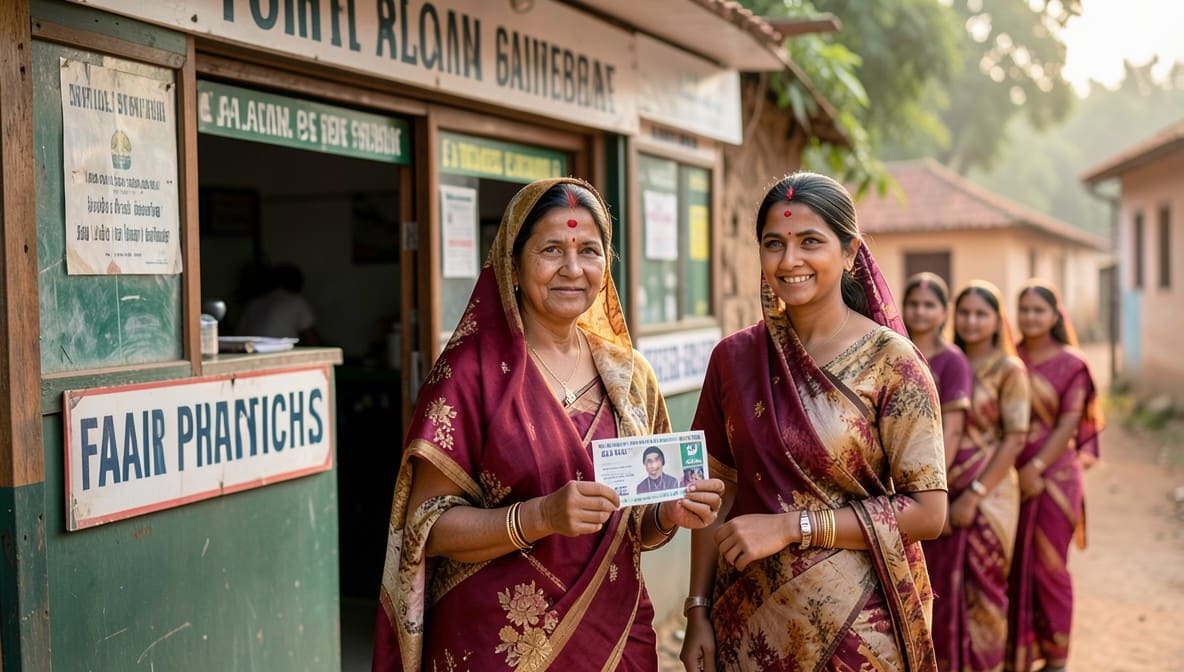
The Supreme Court has decisively affirmed that marital status cannot be a ground to exclude a daughter from welfare schemes designed to provide financial relief to the family of a deceased dealer. In a landmark ruling, the Court struck down a state regulation that barred married daughters from being considered for compassionate allotment of fair price shops, holding that such exclusion violates the constitutional guarantees of equality and non-discrimination.
Background & Facts
The Dispute
The appellant, Kulsum Nisha, sought appointment as a fair price shop dealer on compassionate grounds following the death of her mother, Smt. Badrun Nisha, who was the original allottee of a fair price shop located in village Panchayat Aariyawan, Tehsil Tiloi, District Amethi, Uttar Pradesh. The shop was allotted to her mother on 27.10.2012 under the Uttar Pradesh Essential Commodities (Regulation of Sale and Distribution Control) Order, 2016 (2016 Order). Upon her mother’s death on 04.03.2024, the appellant applied for allotment of the shop as a dependent family member. Her application was rejected solely on the ground that she was a married daughter, as the State’s Government Order No. 6 of 2019 (G.O.) excluded married daughters from the definition of ‘family’ under Paragraph IV(10).
Key Facts
- The fair price shop was originally allotted to Smt. Badrun Nisha on 27.10.2012.
- The Uttar Pradesh Government issued the 2016 Order on 10.08.2016, which defined ‘family’ to include ‘unmarried, legally separated, and widowed daughters’ but did not explicitly exclude married daughters.
- The State issued G.O. No. 6 of 2019 on 05.08.2019, which in Paragraph IV(10) defined ‘family’ as excluding married daughters.
- The appellant’s mother passed away on 04.03.2024.
- The appellant, though married, continued to reside with her mother and sisters in the same village.
- She actively assisted her mother in running the fair price shop.
- She is the sole earning member of the household, responsible for four sisters, one of whom is visually impaired.
- The Sub-Divisional Magistrate (SDM), Tiloi, issued an order on 05.03.2024 attaching the shop upon the dealer’s death.
- The appellant filed her application for allotment on 19.03.2024.
- The SDM rejected her application on 16.07.2024, citing her marital status.
- The Deputy Commissioner affirmed the rejection on 07.01.2025.
- The appellant filed a writ petition before the Allahabad High Court.
- The High Court dismissed the petition on 05.03.2025, relying on its own prior decisions in Smt. Kusumlata and Saida Begum.
Procedural History
- 27.10.2012: Fair price shop allotted to Smt. Badrun Nisha.
- 10.08.2016: 2016 Order notified by the State Government.
- 05.08.2019: G.O. No. 6 of 2019 issued, excluding married daughters from ‘family’.
- 04.03.2024: Death of the original dealer.
- 05.03.2024: SDM ordered attachment of the shop.
- 19.03.2024: Appellant filed application for compassionate allotment.
- 16.07.2024: SDM rejected application on ground of marital status.
- 07.01.2025: Deputy Commissioner affirmed rejection.
- 05.03.2025: High Court dismissed writ petition, upholding G.O. exclusion.
- 02.06.2026: Supreme Court delivered judgment allowing the appeal.
The Parties' Positions
The appellant contended that the exclusion of married daughters is arbitrary, gender-based, and violates Articles 14, 15(1), 19(1)(g), and 21 of the Constitution. She argued that dependency, not marital status, is the only relevant criterion. She highlighted her continuous residence in the village, her role in running the shop, and her responsibility for her siblings.
The State defended the exclusion, asserting that a married daughter is presumed to have shifted residence to her in-laws’ home and thus fails the local residence requirement under Paragraph IV(5) of the G.O. It argued that the classification between unmarried and married daughters is reasonable and based on social realities.
Relief Sought
The appellant sought quashing of the orders dated 16.07.2024, 07.01.2025, and 05.03.2025, and a direction to the competent authority to allot the fair price shop to her, subject to fulfillment of all other eligibility conditions.
The Legal Issue
The central question was whether excluding a married daughter from the definition of ‘family’ under the Uttar Pradesh G.O. for compassionate allotment of a fair price shop violates Articles 14 and 15(1) of the Constitution, and whether the term ‘daughters’ in the 2016 Order can be interpreted purposively to include married daughters who are dependent and reside locally.
Arguments Presented
For the Appellant
The appellant’s counsel argued that marital status is an impermissible basis for classification under Article 14, as it bears no rational nexus to the objective of the scheme - providing immediate financial relief to dependents. Reliance was placed on Shayara Bano v. Union of India and K.S. Puttuswamy v. Union of India to show that gender-based stereotypes are constitutionally invalid. The appellant’s continuous residence, financial dependency, and active role in the shop were emphasized as factual indicators of eligibility. The counsel urged the Court to adopt a purposive interpretation of the 2016 Order to align it with constitutional values.
For the Respondent
The State contended that the classification between unmarried and married daughters is reasonable because a married daughter is presumed to have ceased to be a resident of the parental household, thereby failing the local residence requirement under Paragraph IV(5). It cited Agnigundala Venkata Ranga Rao and State of U.P. v. Maqbool Ahmad to argue that the State has discretion to define eligibility criteria for welfare schemes. It maintained that the exclusion was not discriminatory but based on practical administrative considerations.
The Court's Analysis
The Court began by reaffirming the twin tests of Article 14: intelligible differentia and rational nexus. It held that the exclusion of married daughters fails both tests. The assumption that marriage severs familial ties is a gendered stereotype, incompatible with constitutional morality. The Court observed:
"Marriage neither extinguishes the bond between a daughter and her parental family nor furnishes a valid basis to presume absence of dependency. Contemporary social realities demonstrate that many married daughters continue to reside with, support, or remain dependent upon their parents."
The Court rejected the State’s argument that married daughters cannot satisfy the local residence requirement, noting that residence is an independent criterion under Paragraph IV(5) and must be assessed factually, not presumptively. It emphasized that the scheme’s purpose is welfare-oriented - to ensure continuity of the public distribution system and provide succour to dependents - not to confer inheritance rights.
The Court then turned to the doctrine of purposive construction. It noted that Clause 2(p) of the 2016 Order defines ‘family’ to include ‘adult children who are fully dependent on the head of the family’ without any marital qualification. The enumeration of ‘unmarried, legally separated, and widowed daughters’ was held to be illustrative, not exhaustive. The Court held:
"The absence of exclusionary language in respect of married daughters reflects an illustrative and not exhaustive character of enumeration."
It further reasoned that excluding a dependent married daughter who resides in the village and supports her family would defeat the very purpose of the scheme. The Court overruled the contrary decisions of the Allahabad High Court in Smt. Kusumlata and Saida Begum, and affirmed the views of the Bombay, Karnataka, and Calcutta High Courts.
The Verdict
The appellant succeeded. The Supreme Court quashed the orders dated 16.07.2024, 07.01.2025, and 05.03.2025. The competent authority is directed to allot the fair price shop to the appellant within four weeks, provided she satisfies all other eligibility conditions under the G.O., including local residence and dependency. There shall be no order as to costs.
What This Means For Similar Cases
Marital Status Cannot Be a Proxy for Dependency
- Practitioners must challenge any welfare scheme that uses marital status as a proxy for dependency, especially in public distribution, pension, or housing schemes.
- Dependency must be proven through factual evidence - residence, financial support, cohabitation - not marital status.
- Any blanket exclusion of married women from benefits must now be justified by concrete, non-gendered criteria.
Purposive Interpretation as a Tool for Constitutional Compliance
- Courts will increasingly interpret ambiguous statutory language to align with constitutional values, even if the literal text appears restrictive.
- Where a provision’s purpose is welfare-oriented, courts will read inclusive meanings into exclusionary terms if doing so avoids arbitrariness.
- This judgment provides a strong precedent for challenging gender-based exclusions in state schemes across India.
State Policies Must Reflect Lived Realities
- Administrative rules based on outdated social assumptions (e.g., that married women automatically leave their natal homes) are constitutionally untenable.
- Government orders must be reviewed for compliance with Article 15(1) and Article 21 - particularly in schemes affecting women’s livelihoods.
- State authorities must conduct individualized assessments of dependency and residence, not apply categorical exclusions.





