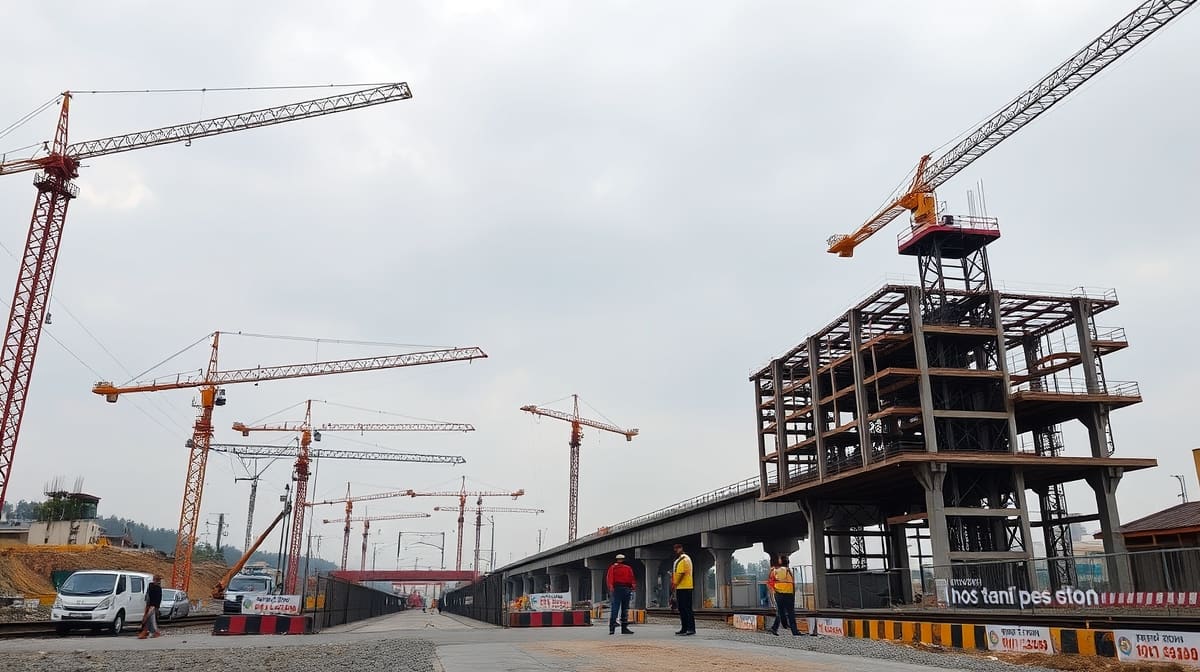
The Bombay High Court has reaffirmed that writ jurisdiction under Article 226 of the Constitution cannot be invoked to adjudicate pure contractual disputes where an arbitration clause exists, unless a public law issue - such as arbitrariness or violation of statutory rights - is demonstrably present. This judgment clarifies the boundary between private law remedies and extraordinary constitutional remedies in infrastructure contracts.
Background & Facts
The Dispute
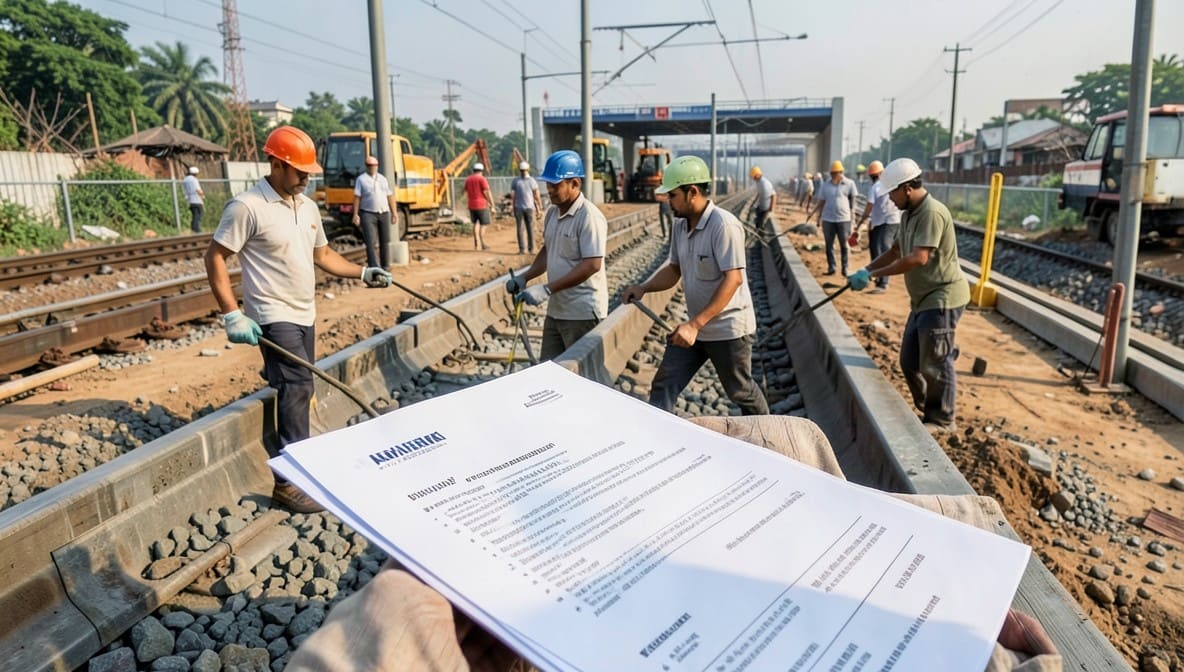
The petitioner, M/s. MVV Satyanarayan, a registered partnership firm engaged in civil construction for Indian Railways since 1984, entered into a contract with the Central Railway authorities for the construction of minor and major bridges, Road Under Bridges (RUBs), and drain works under the Ahmednagar - Beed - Parli Vaidyanath New Broad Gauge Line Project. The contract was awarded following a tender process initiated on 19.01.2024, with a Letter of Acceptance issued on 30.04.2024 and a formal agreement executed on 17.08.2024.
Key Facts
- Original contract value: Rs. 37,46,57,193/-
- Initial completion deadline: 29.04.2025 (12 months from Letter of Acceptance)
- Two supplemental agreements increased contract value to Rs. 54,85,03,233.53/- (approx. 46% increase)
- Completion deadline extended twice: first to 30.09.2025, then to 31.03.2026
- Earnest Money Deposit (EMD) of Rs. 20,66,500/- retained as security
- Security deposit mechanism: 6% deduction from each running bill until 5% of contract value (approx. Rs. 2.66 crores held)
- Performance Guarantee: Bank Guarantee of Rs. 1,87,32,859.67 issued by Bank of Maharashtra, extended to 25.06.2026
- Petitioner claims Rs. 46 crores of work executed; Rs. 38,95,69,185/- paid; Rs. 7.5 crores pending measurement and payment
- Respondents allege failure to deploy adequate manpower and machinery, with no activity observed for casting of deck slab
- Certain works were offloaded to third agencies by respondents, allegedly without petitioner’s consent
- Petitioner’s managing partner was abroad between 15.11.2025 and 29.11.2025
Procedural History
- 19.01.2024: Tender notice issued by Respondent No.2
- 30.04.2024: Letter of Acceptance issued by Respondent No.3
- 17.08.2024: Contract agreement executed
- 28.04.2025: Petitioner requests first extension of time
- 06.01.2025: Meeting minutes record slow progress and missed targets
- 13.06.2025: Meeting minutes again highlight non-compliance
- 30.09.2025: First extension granted
- 01.12.2025: Petitioner requests second extension
- 31.03.2026: Second extension granted as final deadline
- 13.11.2025: Respondent No.3 issues communication to 'part terminate' contract citing poor progress and delay in CRS inspection
- 19.11.2025: Seven Days’ Notice issued
- 27.11.2025: 48-Hours’ Notice issued
- 02.12.2025: Final Termination Notice issued
- 06.12.2025: Petitioner writes to respondents seeking permission to complete balance work
- 13.03.2026: Writ Petition reserved for judgment
- 27.03.2026: Judgment pronounced
Relief Sought
The petitioner sought:
- Quashing of termination notices dated 13.11.2025 and 02.12.2025
- Direction to permit completion of balance work
- Direction to release payments for work executed (approx. Rs. 7.5 crores)
- Protection of security deposits and bank guarantee
The Legal Issue
Can a writ petition under Article 226 of the Constitution be maintained to challenge the termination of a works contract where the agreement contains a mandatory arbitration clause, and the dispute primarily involves contested questions of fact regarding performance, delay, and payment?
Arguments Presented
For the Petitioner
The petitioner argued that the termination was arbitrary and violated principles of natural justice, as it was done without adequate opportunity to be heard. It contended that the delay was due to site conditions and offloading of critical works to third parties without consent, which were beyond its control. It relied on Union of India & Ors. v. Tantia Construction Pvt. Ltd. (2011) 5 SCC 697 to assert that the existence of an arbitration clause does not absolutely bar writ jurisdiction, especially where public interest and irreparable harm are involved. It further argued that the dispute involved a violation of contractual fairness and procedural due process, which are public law concerns.
For the Respondent
The respondents contended that the contract was governed by the General Conditions of Contract (GCC), which contained mandatory arbitration clauses under Clauses 63 and 64. They submitted that the petitioner had been given multiple notices, meetings, and extensions over a period of more than a year, and that the termination followed a documented process of non-compliance. They relied on State of U.P. v. Bridge & Roof Co. (India) Ltd. (1996) 6 SCC 22, Kerala State Electricity Board v. Kurien E. Kalathil (2000) 6 SCC 293, and Joshi Technologies International Inc. v. Union of India (2015) 7 SCC 728 to argue that disputes over contract performance, measurement, and termination are purely private law matters and must be resolved through arbitration. They further stated that the petitioner’s claim of irreparable harm could be addressed through interim relief under Section 9 of the Arbitration and Conciliation Act, 1996.
The Court's Analysis
The Court undertook a comprehensive review of the jurisprudence governing the interface between writ jurisdiction and contractual disputes. It emphasized that while Article 226 is plenary, its exercise is discretionary and must be tempered by the existence of an efficacious alternative remedy.
"The power of this Court under Article 226 of the Constitution is undoubtedly plenary and wide. It is also well settled that the existence of an alternative remedy, including an arbitration clause in a contract, does not absolutely and invariably foreclose the exercise of writ jurisdiction by a High Court. At the same time, however, it is equally well settled that writ jurisdiction under Article 226 is discretionary in nature, and the exercise of such extraordinary jurisdiction has to be calibrated with care and caution..."
The Court distinguished Tantia Construction on factual grounds. In that case, the dispute involved the Railway compelling a contractor to execute a qualitatively altered project at original rates - a clear case of arbitrary exercise of contractual power amounting to a public law issue. In contrast, the present case involved allegations of slow progress, non-deployment of resources, and failure to meet milestones - all factual disputes requiring evidence recording.
The Court found that the petitioner had been afforded multiple opportunities to respond: five Seven Days’ Notices, two 48-Hours’ Notices, and two formal extensions of time. The minutes of meetings dated 06.01.2025 and 13.06.2025 documented the respondents’ concerns and the petitioner’s acknowledgments. The absence of the managing partner abroad was held to be an insufficient ground to negate procedural compliance, as the firm could act through any authorized representative.
The Court further held that the petitioner’s claims regarding offloaded works, unpaid amounts, and measurement disputes were all fact-intensive and required examination of technical site registers, measurement books, and expert opinions - matters beyond the scope of writ jurisdiction.
"A writ court does not record evidence, examine witnesses, or scrutinize technical specifications and site records. The determination of whether the work was progressing satisfactorily or not... are questions that can only be resolved through a detailed examination of evidence..."
The Court concluded that no public law element - such as violation of fundamental rights, statutory duties, or arbitrariness in exercise of power - was established. The dispute was squarely within the domain of private law governed by contract.
The Verdict
The writ petition was dismissed. The Court held that the petitioner must pursue its claims - including the legality of termination, payment for work executed, offloading of works, and recovery of security deposits - before the Arbitral Tribunal constituted under the General Conditions of Contract. The respondents are directed to maintain the Earnest Money Deposit, security deposit, and Bank Guarantee without forfeiture, encashment, or action for a period of twelve weeks from the date of judgment to enable the petitioner to initiate arbitration proceedings. There shall be no order as to costs.
What This Means For Similar Cases
Arbitration Clauses Are Binding Unless Public Law Violation Is Proven
- Practitioners must first assess whether a dispute involves a public law element (e.g., arbitrariness, violation of statutory duty, or fundamental right) before filing a writ petition
- Mere allegations of unfairness, delay, or breach of contract are insufficient to bypass arbitration
- The burden lies on the petitioner to demonstrate that the dispute transcends private law
Procedural Compliance Must Be Documented
- Public authorities must maintain clear records of notices, meetings, and extensions to rebut claims of natural justice violation
- Multiple notices and extensions over time establish adequate opportunity to be heard
- Absence of a key individual (e.g., managing partner) does not invalidate procedural compliance if the entity is legally capable of representation
Interim Relief Is Available Under Arbitration Act
- Parties seeking protection of assets or preservation of site material must invoke Section 9 of the Arbitration and Conciliation Act, 1996
- Courts will not entertain writ petitions merely to avoid arbitration, even where irreparable harm is claimed
- The availability of Section 9 remedies reinforces the exclusivity of arbitration for contractual disputes