The Bombay High Court has clarified the legal threshold for incorporating arbitration clauses from main contracts into subcontracts, holding that a general reference to another contract's terms is insufficient. This judgment underscores the necessity of specific incorporation of arbitration agreements, particularly in two-contract scenarios, and will guide practitioners in drafting enforceable dispute resolution clauses in commercial agreements.
Background & Facts
The Dispute
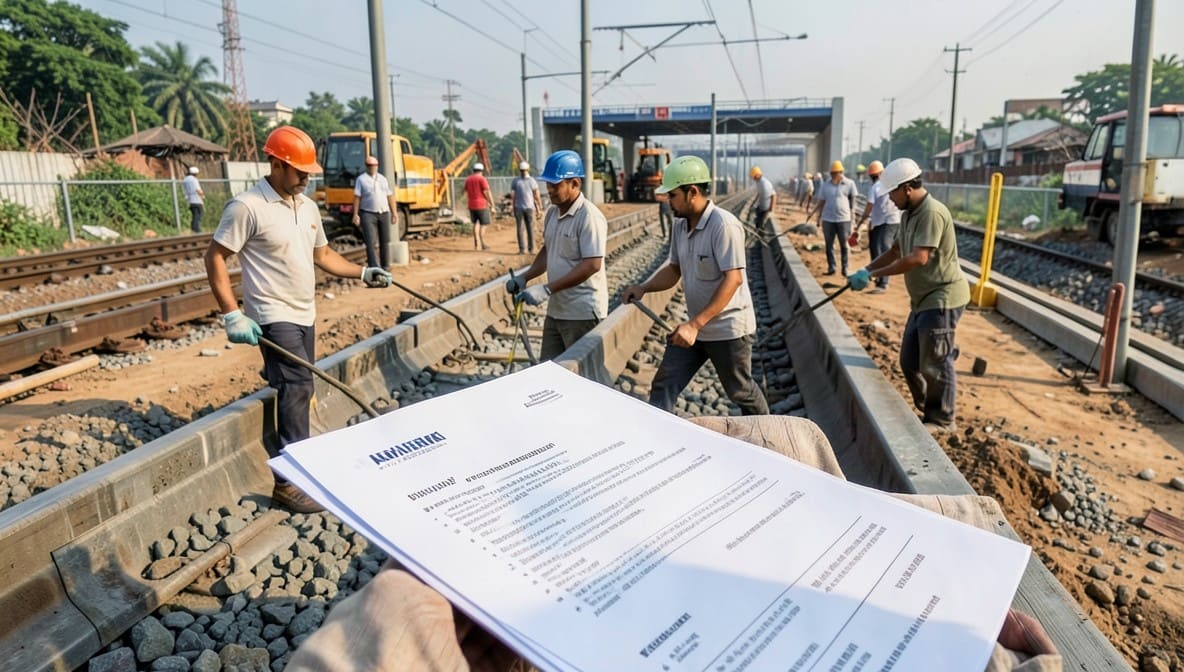
The applicant, Apurvakriti Infrastructure Private Limited, a subcontractor, entered into a Work Order dated 2 March 2015 with Tata Projects Limited (Respondent No. 1) for the construction of ballastless track work for the Navi Mumbai Metro Rail Project Line 1. The work was part of a larger contract between Tata Projects Limited and CIDCO (Respondent No. 2), under which the applicant was engaged as a subcontractor for a contract value of Rs. 58,27,00,000. Disputes arose regarding non-payment of outstanding amounts after the issuance of a Work Completion Certificate on 4 December 2023.
Key Facts
- 2 March 2015: Work Order issued by Respondent No. 1 to the applicant for ballastless track work.
- 4 December 2023: Work Completion Certificate issued by Respondent No. 1.
- 8 May 2025: Applicant sent a Demand Letter to Respondent No. 1 for outstanding payments.
- 6 August 2025: Respondent No. 1 replied stating that amicable settlement talks were ongoing.
- 26 September 2025: Applicant issued a second notice invoking arbitration under Section 21 of the Arbitration and Conciliation Act, 1996, relying on Clause 31.3 of the General Conditions of Contract (GCC) between Respondent No. 1 and CIDCO.
- The Work Order did not contain an independent arbitration clause but referenced the GCC between Respondent No. 1 and CIDCO.
Procedural History
- 26 September 2025: Applicant invoked arbitration under Section 21 of the Arbitration Act.
- Undated: Respondent No. 1 failed to respond to the second notice.
- Present Application: Filed under Section 11 of the Arbitration Act for appointment of an arbitrator.
The Parties' Positions
For the Applicant
- Argued that the GCC between Respondent No. 1 and CIDCO, including Clause 31.3 (arbitration clause), was incorporated by reference into the Work Order dated 2 March 2015.
- Relied on judgments:
- M. R. Engineers And Contractors Private Limited v. Som Datt Builders Limited (2009) 7 SCC 696
- Hirani Developers v. Nehru Nagar Samruddhi CHS Ltd. and Anr. 2026 SCC Online SC 854
- Ajay Madhusudan Patel & Ors. v. Jyotindra S. Patel & Ors. (2024) 9 S.C.R. 894
- ASF Buildtech Private Limited v. Shapoorji Pallonji And Company Private Limited 2025 INSC 616
- Contended that the referral court should prima facie rule on the existence of an arbitration agreement, while the arbitral tribunal should determine the applicability of the clause to non-signatories.
For the Respondent
- Argued that the GCC was signed between Respondent No. 1 and CIDCO, and the applicant was not a party to it.
- Submitted that there was no specific incorporation of the arbitration clause into the Work Order.
- Relied on judgments:
- Dascon Sourav Commercial Private Limited v. CLE Private Limited 2024 SCC OnLine Cal 3590
- NBCC (India) Limited v. Zillion Infra Projects Private Limited (2024) 7 SCC 174
- Inox Wind Limited v. Thermocables Limited (2018) 2 SCC 519
- Maharashtra State Electricity Distribution Company Limited (MSEDCL) v. R. Z. Malpani 2026 SCC OnLine SC 553
- Hindustan Petroleum Corporation Limited v. BCL Secure Premises Private Limited (2026) 3 SCC 711
- Elite Engineering And Construction (Hyderabad) Private Limited v. Techtrans Construction India Private Limited (2018) 4 SCC 281
Relief Sought
The applicant sought the appointment of an arbitrator to adjudicate disputes arising from the non-payment of outstanding amounts under the Work Order, relying on the arbitration clause in the GCC between Respondent No. 1 and CIDCO.
The Legal Issue
The central question was whether Clause 31.3 of the GCC, executed between Respondent No. 1 and CIDCO, could be incorporated by reference into the Work Order dated 2 March 2015 between the applicant and Respondent No. 1, thereby enabling the invocation of arbitration under Section 11 of the Arbitration and Conciliation Act, 1996.
Arguments Presented
For the Applicant
- The GCC between Respondent No. 1 and CIDCO, including Clause 31.3, was incorporated by reference into the Work Order.
- The referral court should prima facie determine the existence of an arbitration agreement, while the arbitral tribunal should decide on the applicability of the clause to non-signatories.
- Relied on M. R. Engineers and Hirani Developers to argue that general references to another contract can incorporate arbitration clauses if the intention is clear.
For the Respondent
- The GCC was not signed by the applicant, and there was no specific incorporation of the arbitration clause into the Work Order.
- A general reference to another contract’s terms is insufficient to incorporate an arbitration clause, particularly in two-contract scenarios (where the applicant and Respondent No. 1 are not parties to the GCC).
- Relied on NBCC (India) Limited and Inox Wind Limited to argue that specific incorporation is required for arbitration clauses.
The Court's Analysis
The Court examined Section 7(5) of the Arbitration and Conciliation Act, 1996, which governs the incorporation of arbitration clauses by reference. It relied on the Supreme Court’s judgment in M. R. Engineers And Contractors Private Limited v. Som Datt Builders Limited, which laid down the following principles:
24. The scope and intent of Section 7(5) of the Act may therefore be summarized thus: (i) An arbitration clause in another document would get incorporated into a contract by reference if: (1) The contract contains a clear reference to the document containing the arbitration clause; (2) The reference clearly indicates an intention to incorporate the arbitration clause; and (3) The arbitration clause is appropriate (capable of application) and not repugnant to the contract. (ii) A general reference to another contract does not incorporate its arbitration clause. (iii) Where a contract refers to another contract for execution/performance terms, the arbitration clause in the referred contract is not incorporated unless there is a specific reference to it. (iv) Standard form contracts (e.g., trade association terms) may incorporate arbitration clauses by general reference. (v) Where a contract stipulates that the General Conditions of Contract of one party (e.g., government contracts) shall apply, the arbitration clause is deemed incorporated.
The Court noted that the present case fell under Category 3 of the classification in Inox Wind Limited v. Thermocables Limited, which involves two-contract scenarios (where the applicant and Respondent No. 1 are not parties to the GCC). In such cases, a stricter rule applies, requiring specific reference to the arbitration clause.
The Court observed that while the Work Order incorporated the technical specifications and terms of the GCC, it did not specifically reference Clause 31.3 (arbitration clause). Thus, the arbitration clause was not incorporated into the Work Order.
The Court distinguished the judgments relied upon by the applicant:
- In Ajay Madhusudan Patel & Ors. v. Jyotindra S. Patel & Ors., the Supreme Court held that the referral court should prima facie rule on the existence of an arbitration agreement, while the arbitral tribunal could determine the applicability of the clause to non-signatories.
- In ASF Buildtech Private Limited v. Shapoorji Pallonji And Company Private Limited, the Supreme Court held that the referral court’s role is limited to determining the prima facie existence of an arbitration agreement, while the arbitral tribunal has the competence to decide on its applicability under Section 16 of the Act.
However, the Court held that these judgments were not applicable because there was no arbitration agreement between the parties to begin with. The absence of specific incorporation of the arbitration clause meant that the applicant’s reliance on the GCC’s arbitration clause was misplaced.
The Verdict
The Court dismissed the Commercial Arbitration Application, holding that:
- Clause 31.3 of the GCC between Respondent No. 1 and CIDCO was not incorporated into the Work Order dated 2 March 2015.
- There was no arbitration agreement between the applicant and Respondent No. 1, rendering the application under Section 11 of the Arbitration Act non-maintainable.
What This Means For Similar Cases
Specific Incorporation Is Mandatory for Two-Contract Scenarios
- Practitioners must ensure that arbitration clauses in main contracts are specifically incorporated into subcontracts, particularly in two-contract scenarios (where the subcontractor is not a party to the main contract).
- A general reference to another contract’s terms is insufficient to incorporate an arbitration clause. The contract must explicitly reference the arbitration clause to avoid disputes over jurisdiction.
Referral Courts Will Scrutinize Incorporation Strictly
- Courts will strictly interpret the incorporation of arbitration clauses, especially in Category 3 and 4 scenarios (as classified in Inox Wind Limited).
- Standard form contracts (e.g., trade association terms) may allow for general incorporation, but bespoke contracts (e.g., subcontracts) require specific references to arbitration clauses.
Arbitral Tribunals Cannot Assume Jurisdiction Without Clear Agreement
- The referral court will not refer disputes to arbitration unless there is prima facie evidence of an arbitration agreement.
- The arbitral tribunal’s jurisdiction under Section 16 is limited to disputes where an arbitration agreement exists. If the agreement is not incorporated, the tribunal cannot assume jurisdiction merely on the basis of general references to another contract’s terms.