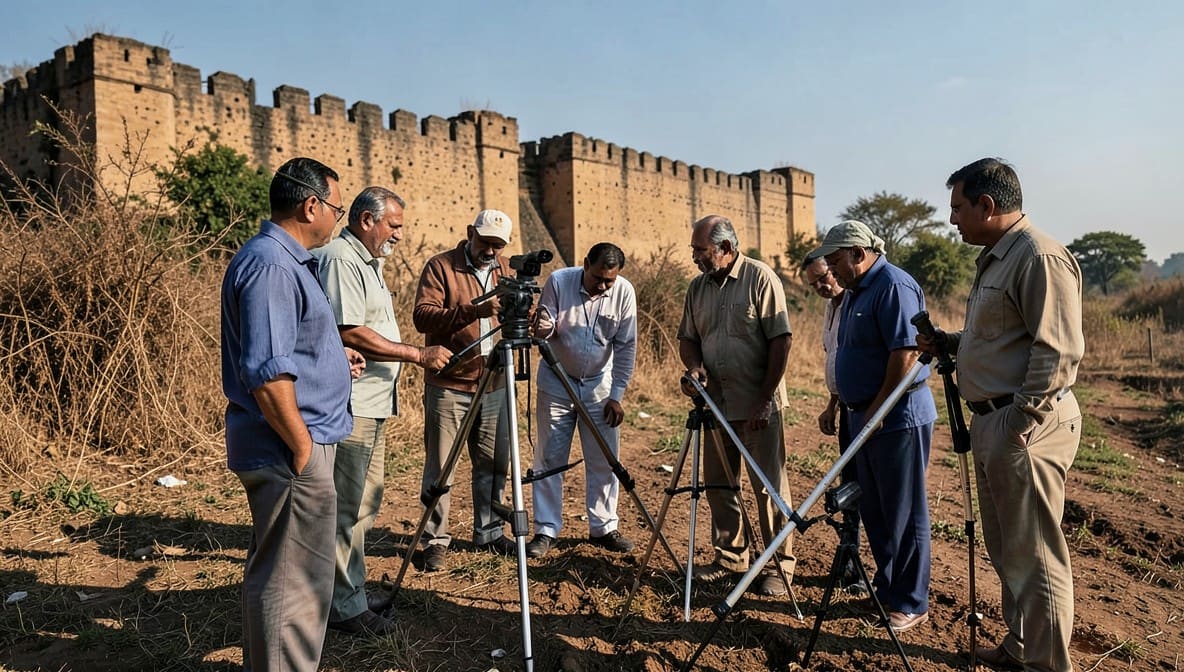
The Karnataka High Court has underscored the necessity of conducting a joint survey before denying land conversion applications under the Ancient Monuments and Archaeological Sites and Remains Act, 1958. The judgment reinforces that administrative authorities cannot rely on presumptive proximity to prohibited areas without on-ground verification, ensuring procedural fairness in land use conversions.
Background & Facts
The Dispute
The petitioner, Smt. Aasia Gudnal, sought conversion of her land bearing Survey No. 353/14 (measuring 1-20 guntas) in Toravi Village, Vijayapura District, from agricultural to non-agricultural purposes. She filed Application No. 821149 dated 24.12.2025 before the Deputy Commissioner (Respondent No. 1), who sought a report from the Urban Development Authority (Respondent No. 2). The Authority issued a recommendation report dated 13.01.2026 (Annexure-D), denying conversion on the ground that the land fell within 100 metres of the Vijayapura Fort wall, a prohibited area under the Ancient Monuments and Archaeological Sites and Remains Act, 1958.
Key Facts
- The petitioner owns Survey No. 353/14, measuring 1-20 guntas, in Toravi Village
- She applied for conversion on 24.12.2025 (Application No. 821149)
- The Urban Development Authority issued a denial report (Annexure-D) on 13.01.2026 without conducting a joint survey
- The denial was based on the presumption that the land fell within 100 metres of the Fort wall, a prohibited area under the Act of 1958
- The petitioner contended that no survey was conducted to verify the actual proximity
Procedural History
- 24.12.2025: Petitioner filed Application No. 821149 for land conversion
- 13.01.2026: Respondent No. 2 issued denial report (Annexure-D) without survey
- 2026: Petitioner filed WP No. 200875 of 2026 before the Karnataka High Court, Kalaburagi Bench
- The Court relied on its earlier judgment in WP No. 201060/2023 dated 27.11.2024, where a similar denial was quashed after a joint survey disproved proximity to prohibited areas
Relief Sought
The petitioner sought:
- Quashing of the recommendation report dated 13.01.2026 (Annexure-D)
- A mandamus directing Respondent No. 1 to grant conversion after considering her application
- Any other relief deemed fit by the Court
The Legal Issue
The central question was whether administrative authorities can deny land conversion under the Ancient Monuments Act without conducting a joint survey to ascertain the actual proximity of the land to prohibited areas.
Arguments Presented
For the Petitioner
- Cited the judgment in WP No. 201060/2023, where the Court quashed a similar denial after a joint survey disproved proximity to prohibited areas
- Argued that the impugned report (Annexure-D) was issued without verifying the ground reality, rendering it arbitrary and illegal
- Contended that the Act of 1958 mandates factual verification before denying conversion
For the Respondents
- The Additional Government Advocate (for Respondent No. 1) and counsel for Respondent No. 2 submitted that they would conduct a joint survey/inspection to ascertain the land’s proximity to the prohibited area and proceed accordingly
The Court's Analysis
The Court relied heavily on its earlier judgment in WP No. 201060/2023, where it had directed a joint survey to resolve a similar dispute. In that case, the Additional Director of Land Records (ADLR) conducted a survey on 28.10.2024 and submitted a report on 25.11.2024, confirming that the subject lands (Survey Nos. 354/2 and 354/1) did not fall within the prohibited, protected, or regulated areas under the Act of 1958. Consequently, the Court quashed the condition requiring a "Buffer Zone" and directed the approval of the layout plan.
Applying the same reasoning to the present case, the Court observed:
"It is an undisputed fact and a matter of record that the subject land has not been surveyed or inspected by the respondent No.2/authority before issuing the impugned communication at Annexure-D dated 13.01.2026."
The Court emphasized that administrative decisions under the Act of 1958 must be based on factual verification, not presumptions. The failure to conduct a joint survey rendered the impugned report arbitrary and contrary to law.
The Verdict
The Court allowed the writ petition and passed the following directions:
- Quashed the impugned recommendation report (Annexure-D dated 13.01.2026)
- Remitted the matter to Respondent No. 2 (Urban Development Authority) to conduct a joint survey/inspection of Survey No. 353/14 in the presence of the petitioner
- Directed Respondent No. 2 to submit a report to Respondent No. 1 (Deputy Commissioner) within 3 months from the date of receipt of the order
- Directed Respondent No. 1 to reconsider the petitioner’s application and pass appropriate orders within 1 month of receiving the report
What This Means For Similar Cases
Mandatory Joint Survey Before Denial
- Administrative authorities cannot deny land conversion applications under the Ancient Monuments Act based on presumptive proximity to prohibited areas
- A joint survey/inspection is mandatory to ascertain the actual ground reality
- Failure to conduct such a survey renders the denial arbitrary and liable to be quashed
Procedural Fairness in Land Use Decisions
- The judgment reinforces the principle of natural justice in administrative decision-making
- Authorities must verify facts on the ground before rejecting applications, especially when statutory rights are involved
- Courts are likely to intervene where decisions are based on assumptions rather than evidence
Precedential Value for Adjacent Lands
- The judgment has direct implications for landowners in Toravi Village and Vijayapura District, where similar disputes may arise
- Authorities must now adopt a uniform approach of conducting joint surveys before denying conversions near archaeological sites
- Landowners can challenge arbitrary denials by citing this judgment and demanding factual verification