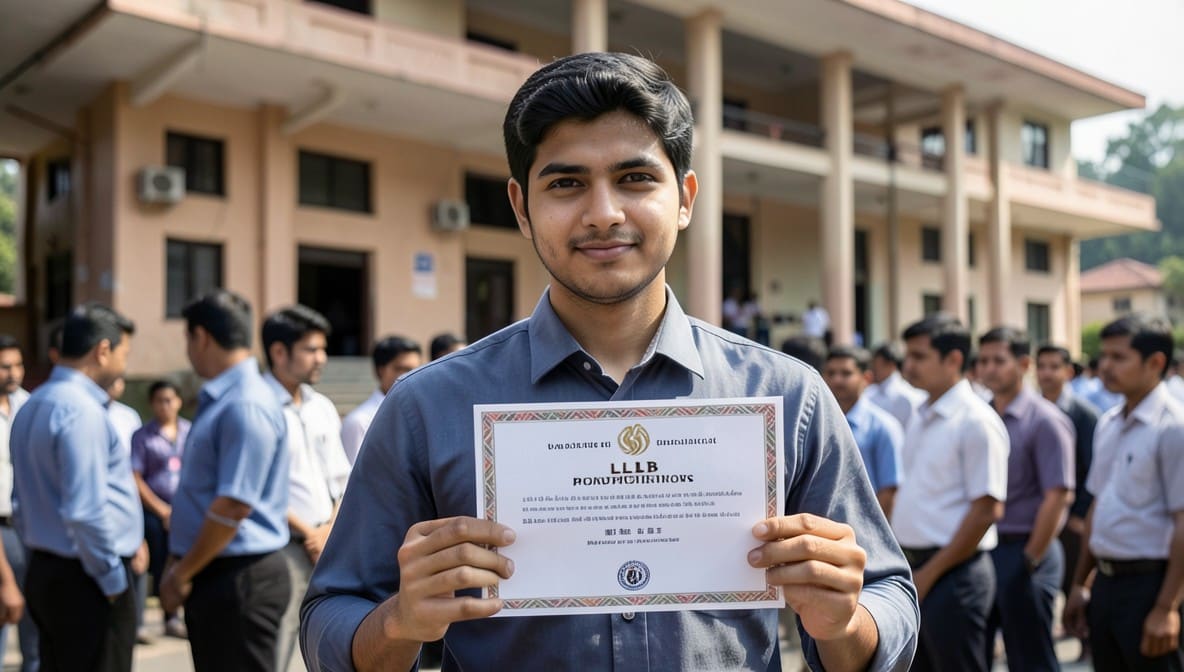
A student who has successfully completed an LLB course and been enrolled with the Bar Council of India cannot be denied his final degree due to administrative errors in university records. The Himachal Pradesh High Court has reaffirmed that such errors, attributable solely to the institution, cannot be visited upon the student, even where minor discrepancies exist in recorded marks.
Background & Facts
The Dispute
The petitioner, Tarun Goyal, enrolled in a three-year LLB program at the University of Himachal Pradesh (respondent No.3) in 2015. He appeared in and cleared all six semester examinations. Detailed Marks Cards for each semester were issued to him, and he was awarded a Provisional Degree on 17.09.2018. He subsequently enrolled with the Bar Council of Delhi upon submission of these documents and passed the All India Bar Examination. Despite this, the University refused to issue his final LLB Degree.
Key Facts
- The petitioner completed his LLB course in 2018 and was awarded a Provisional Degree on 17.09.2018
- He was enrolled with the Bar Council of Delhi on the basis of his Detailed Marks Cards and Provisional Degree
- He passed the All India Bar Examination conducted by the Bar Council of India
- On 30.04.2025, he formally requested the University to issue his final LLB Degree
- A verification report dated 08.05.2025 revealed two discrepancies:
- His name does not appear in the official admission disclosure list for 2015; instead, the name of Abhinaw Kumar is listed under his roll number
- His first semester marks are recorded as 303/500 in the official Gazette, but 311/500 on the University’s green sheet register
- The petitioner made repeated written and oral representations, all of which were ignored
Procedural History
- 30.04.2025: Petitioner first formally requested issuance of final LLB Degree
- 08.05.2025: University issued verification report identifying record discrepancies
- 12.03.2026: Writ petition filed before the High Court; counsel relied on Pratima Das v. State of H.P.
- 19.03.2026: Judgment delivered by Justice Jyotsna Rewal Dua
Relief Sought
The petitioner sought directions to:
- Correct the first semester marks from 311/500 to 303/500
- Issue a corrected Provisional Certificate
- Issue the final LLB Degree in accordance with law
The Legal Issue
The central question was whether a university may withhold a final degree from a bona fide student who has cleared all examinations, solely due to clerical errors in admission records or minor discrepancies in recorded marks, where the student bears no fault.
Arguments Presented
For the Petitioner
Counsel relied on Pratima Das v. State of H.P., where the Supreme Court held that a student who has cleared all examinations and been issued marksheets and provisional degree cannot be denied final documents due to administrative errors by the university. The petitioner argued that he had fulfilled all academic requirements, was recognized by the Bar Council, and the discrepancies were neither caused by him nor indicative of academic irregularity.
For the Respondent
The University conceded that the petitioner was a bona fide student and that the omission of his name from the admission disclosure list was an administrative oversight. However, it contended that the discrepancy in first semester marks - 303/500 in Gazette versus 311/500 on green sheet - required verification of original mark sheets, which are deposited with the Trial Court under Priya Thakur v. State of H.P.. It argued that the High Court could not direct correction without judicial scrutiny of the original records.
The Court's Analysis
The Court acknowledged the petitioner’s unchallenged academic record and the absence of any allegation of fraud or malpractice on his part. It noted that the University itself admitted the error in the admission disclosure list, which was attributable to its own administrative lapse.
The Court distinguished the present case from Priya Thakur, where the discrepancy in marks required verification of original mark sheets deposited with the Trial Court. In Pratima Das, the Supreme Court had held that such errors cannot be used to penalize students. The Court observed:
"It is evident that the exclusion of the name of the Appellant in the admission disclosure list has occurred due to no fault on part of the Appellant, rather the same is at the hands of the University for which the Appellant cannot be made to suffer."
The Court accepted that the petitioner’s case was squarely covered by Pratima Das, except for the mark discrepancy. However, it held that the existence of a minor variance in recorded marks - where the original documents are under the custody of the Trial Court - does not justify withholding the degree indefinitely. The Court emphasized that the petitioner’s right to a degree is not contingent on resolving administrative inconsistencies through litigation.
The Court concluded that the University’s refusal to issue the degree was arbitrary and violative of the petitioner’s right to education and professional advancement. It directed that the petitioner be permitted to seek correction of the mark discrepancy through the appropriate judicial forum, without prejudice to his right to obtain the degree.
The Verdict
The writ petition was disposed of with liberty to the petitioner to file an application before the concerned Trial Court where the original mark sheets are deposited, seeking correction of the first semester marks from 311/500 to 303/500. The University is directed to issue the final LLB Degree and corrected Provisional Certificate within four weeks of the petitioner filing such application, or within four weeks from today if no application is filed. Pending miscellaneous applications are dismissed.
What This Means For Similar Cases
Administrative Errors Cannot Defer Academic Rights
- Practitioners representing students denied degrees due to clerical errors in admission lists or record mismatches must invoke Pratima Das to argue that the student’s rights are not contingent on institutional rectification
- Universities cannot use internal record discrepancies as grounds to withhold degrees when the student has cleared all examinations and been recognized by professional bodies
Trial Court Route Is Procedural, Not Preventive
- The Court’s direction to approach the Trial Court is procedural, not a bar to degree issuance
- The degree must be issued within four weeks of application filing, regardless of whether the Trial Court has acted
- The correction process and degree issuance are independent; the latter cannot be held hostage to the former
Institutional Accountability Is Non-Negotiable
- Institutions must maintain accurate records and bear responsibility for their errors
- Students are not obligated to litigate to obtain documents they have earned through academic performance
- This judgment reinforces that academic recognition must precede administrative correction, not follow it