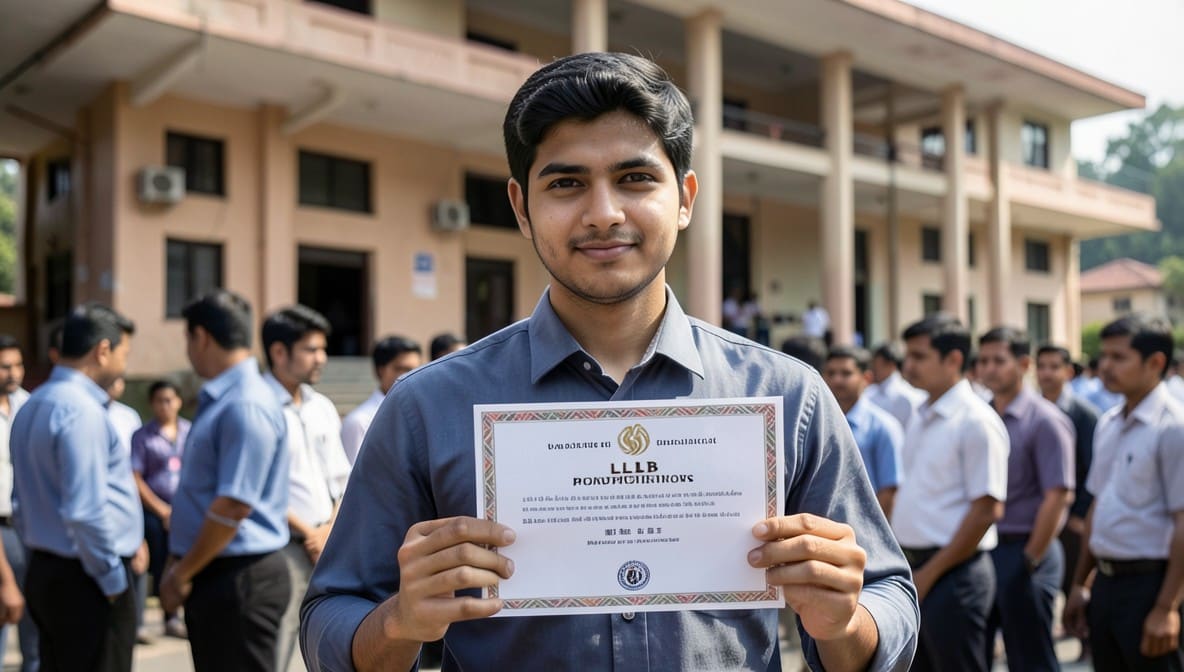
The High Court of Himachal Pradesh has reaffirmed that a bona fide student cannot be denied academic documents due to administrative errors beyond their control. In a decisive ruling, the Court directed the university to issue the LLB degree to a student who cleared all examinations but was deprived of his degree solely because of a mislisting in the admission disclosure record.
Background & Facts
The Dispute
The petitioner, Sushil Kumar, enrolled in the five-year LLB degree program at the University of Himachal Pradesh (respondent No.2) in 2015. He appeared in and cleared all ten semesters of the course, receiving Detailed Marks Cards (DMCs) for the first seven semesters. He completed the program in 2020 and subsequently applied for his final degree. Despite repeated written and oral requests, the university refused to issue the degree.
Key Facts
- The petitioner was admitted to the LLB program in the academic session 2015-16
- His name appears in the university’s green sheet register for the 2015-16 session
- His name is absent from the official admission disclosure list submitted to HPPERC
- Instead, the name of one Gulzar Singh appears under the petitioner’s roll number in the admission disclosure list
- The petitioner received DMCs for semesters 1 through 7, confirming his academic participation and performance
- The petitioner cleared all examinations and completed the course in 2020
- A verification report dated 07.06.2023 confirmed the discrepancy was due to an administrative error by the university
Procedural History
- 2020: Petitioner completed LLB course and applied for degree
- 2020 - 2023: Repeated representations made to the university, all unaddressed
- 07.06.2023: University issued verification report acknowledging clerical error
- 2023: Writ Petition (CWP No. 4495 of 2023) filed before the High Court of Himachal Pradesh
- 07.04.2026: Judgment delivered by the Division Bench
Relief Sought
The petitioner sought a writ of mandamus directing the university to issue his LLB degree, all DMCs for semesters 8 to 10, and any other relevant academic documents without further delay.
The Legal Issue
The central question was whether a university may withhold a degree from a student who has successfully completed all academic requirements, solely due to an administrative error in the admission disclosure list that was not attributable to the student.
Arguments Presented
For the Petitioner
The petitioner’s counsel, Mr. Sanjeev Bhushan, relied on the binding precedent in Pratima Das v. State of Himachal Pradesh and Ors., where the Supreme Court held that a bona fide student cannot be penalized for clerical errors committed by the university. He argued that the petitioner had fulfilled all academic obligations, was in possession of valid DMCs, and the mislisting was entirely the university’s fault. He emphasized that denial of the degree violated the right to education and the principle of natural justice.
For the Respondent
The Additional Advocate General for the State and the Advocate for respondent No.2 conceded that the petitioner’s case was squarely covered by Pratima Das. They acknowledged that the error in the admission disclosure list was administrative and not attributable to the petitioner. They submitted that the university had no legitimate ground to withhold the degree and accepted the petitioner’s entitlement to the documents.
The Court's Analysis
The Court examined the facts in light of the precedent in Pratima Das v. State of Himachal Pradesh and Ors., which had addressed an identical factual matrix involving an MBBS student whose name was omitted from the admission disclosure list due to a clerical error. The Court noted that in Pratima Das, the Supreme Court had unequivocally held that the student had not committed any fault, and the university’s failure to maintain accurate records could not be visited upon the student.
"It is undisputed that the Appellant has been a bona fide student of MB University and had cleared all her examinations. It is also evident that the exclusion of the name of the Appellant in the admission disclosure list has occurred due to no fault on part of the Appellant, rather the same is at the hands of the University for which the Appellant cannot be made to suffer."
The Court found that the petitioner in the present case was in an identical position: he had cleared all examinations, possessed valid DMCs, and the mislisting was a documented administrative oversight. The Court rejected any notion that the petitioner should be required to pursue alternative remedies, noting that no factual dispute remained and that the university had already admitted the error.
The Court emphasized that academic institutions bear a duty of care to ensure accurate record-keeping and that students must not be subjected to prolonged deprivation of their earned rights due to such errors. The Court held that the principles of equity, fairness, and the constitutional right to education under Article 21 compel the immediate issuance of the degree.
The Verdict
The writ petition was allowed. The Court directed respondent No.2, the University of Himachal Pradesh, to issue the petitioner’s LLB degree, Detailed Marks Cards for semesters 8 to 10, and all other relevant academic documents within four weeks from the date of judgment. The pending miscellaneous applications were disposed of as infructuous.
What This Means For Similar Cases
Administrative Errors Cannot Override Academic Achievement
- Practitioners representing students denied degrees due to clerical errors in admission lists or result records should cite Pratima Das as binding precedent
- Universities cannot invoke procedural irregularities to withhold degrees when the student has demonstrably completed all requirements
Burden of Proof Lies with the Institution
- Once a student produces valid DMCs and proof of course completion, the burden shifts to the university to prove the student’s non-eligibility
- Mere absence from an administrative list is insufficient to deny a degree if the student’s academic record is intact
Timely Relief Is Mandatory
- Courts will not permit students to be forced into prolonged litigation for documents they have rightfully earned
- Directives for issuance of documents within fixed timelines (e.g., four weeks) are now standard in such cases