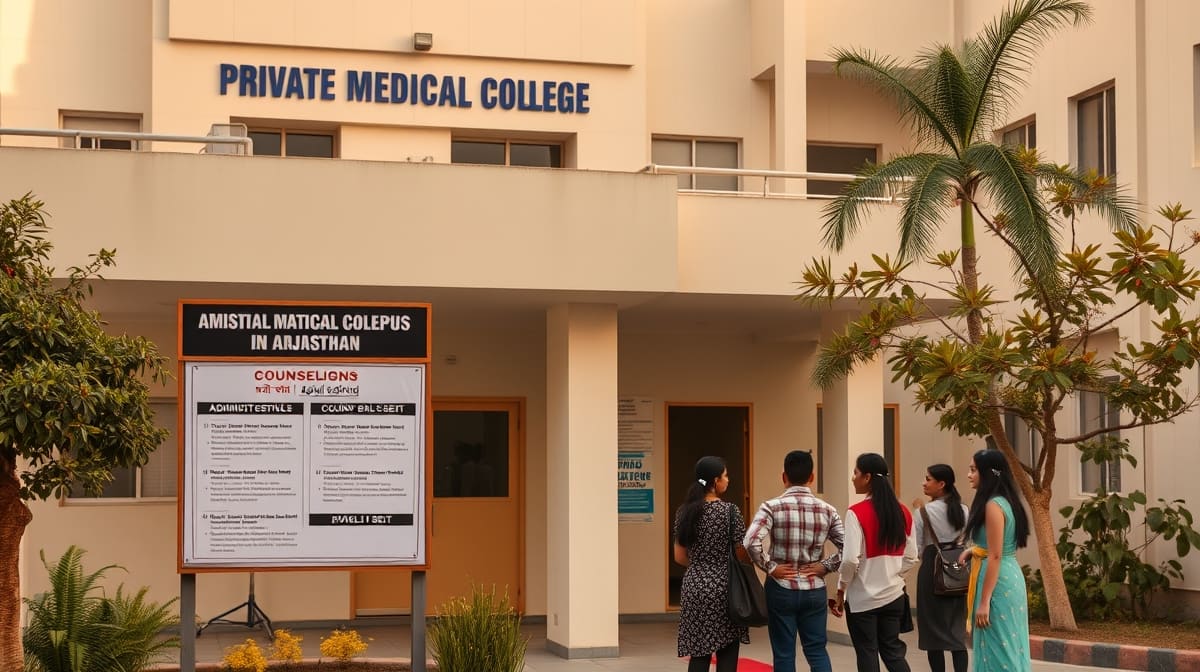
The Rajasthan High Court has directed the NEET PG Medical and Dental Admission/Counselling Board and the National Medical Commission to consider representations from private medical colleges seeking permission to conduct an institutional stray vacancy round for filling 248 vacant postgraduate medical seats for the 2025-26 academic session. The judgment underscores the settled legal principle that medical seats, particularly in postgraduate courses, must not remain unfilled and highlights directions issued by the Bombay and Madhya Pradesh High Courts in analogous cases.
Background & Facts
The Dispute
The petitioners, Pacific Medical College And Hospital and Pacific Institute Of Medical Sciences, are private medical institutions in Rajasthan offering undergraduate (MBBS) and postgraduate (PG) medical courses. Both institutions had secured requisite permissions from the Central Government under the regulatory framework governed by the National Medical Commission (NMC). For the academic session 2025-2026, admissions to PG courses were conducted through the NEET-PG 2025 examination, followed by centralized counselling by the State Counselling Board, Rajasthan, which concluded on 27.02.2026.
Despite the completion of all counselling rounds, a substantial number of PG seats remained vacant. In S.B. Civil Writ Petition No. 7083/2026, 79 out of the total sanctioned PG intake remained unfilled, while in S.B. Civil Writ Petition No. 7086/2026, 169 out of 225 sanctioned PG seats were vacant. The last date for admission as per the NEET-PG schedule was 28.02.2026.
Key Facts
- The petitioners are recognized private medical colleges with enhanced intake capacities for PG courses.
- Admissions for 2025-2026 were conducted through NEET-PG 2025 and subsequent counselling rounds.
- Total vacant PG seats: 79 (Petitioner 1) + 169 (Petitioner 2) = 248 seats.
- The last date for admission was 28.02.2026.
- The State Counselling Board failed to conduct any further rounds to fill the vacant seats.
- The petitioners relied on judgments from the Bombay High Court and Madhya Pradesh High Court, which permitted institutional-level stray vacancy rounds in similar circumstances.
Procedural History
- 25.03.2026: The Federation of Private Medical Colleges filed a Special Leave Petition (SLP) before the Supreme Court, which directed the Federation to submit a representation to the Central Government for expeditious consideration.
- 25.03.2026: The petitioners submitted a representation to the Central Government, emphasizing the national interest in filling vacant seats and the prejudice caused to meritorious candidates.
- 12.03.2026: The Bombay High Court, in W.P. No. 3058/2026, directed the conduct of a stray vacancy round at the institutional level under Rule 14 of the Maharashtra Unaided Private Professional Educational Institutions (Regulation of Admissions and Fees) Act, 2015.
- 26.03.2026: The Madhya Pradesh High Court issued similar directions in a writ petition, directing compliance with Rule 14(a)(2) of the Rules, 2018 for admission in PG subjects.
- 28.03.2026: The present writ petitions were filed before the Rajasthan High Court seeking directions for a special stray vacancy round.
Relief Sought
The petitioners sought the following reliefs:
- Directions to the respondent authorities to conduct a special stray vacancy round at the institutional level for filling the remaining vacant PG seats for the academic session 2025-2026.
- In the alternative, directions to conduct counselling for the vacant seats.
- Revision of the counselling schedule to include a special round.
- Any other orders deemed fit by the Court.
The Legal Issue
The central legal question was whether the respondent authorities could be directed to conduct an institutional stray vacancy round to fill the 248 vacant PG medical seats for the academic session 2025-2026, in light of the settled legal principle that medical seats ought not to remain unfilled and the precedents set by other High Courts.
Arguments Presented
For the Petitioners
- Settled Legal Principle: Relied on the well-established legal position that medical seats, particularly in PG courses, must not remain vacant and ought to be filled to avoid wastage of national resources.
- Precedents: Cited judgments from the Bombay High Court (12.03.2026) and Madhya Pradesh High Court (26.03.2026), which permitted institutional-level stray vacancy rounds under analogous circumstances.
- National Interest: Emphasized that non-filling of seats would prejudice meritorious candidates and result in the loss of an academic year.
- Statutory Framework: Argued that Rule 14(a)(2) of the Rules, 2018 permits institutional-level rounds for filling vacancies.
For the Respondents
The respondents, represented by the Advocate General, did not present substantive counter-arguments in the judgment. The focus was on compliance with the directions issued by the Court.
The Court's Analysis
The Court observed the following key principles and precedents:
-
Settled Legal Principle:
"It is a well-settled principle of law that seats in postgraduate medical courses ought not to remain unfilled and must not be allowed to go to waste."
The Court noted that the State Counselling Board failed to declare any counselling schedule for filling the remaining vacant seats, despite the conclusion of all rounds.
-
Supreme Court Directions: The Court referred to a Special Leave Petition filed by the Federation of Private Medical Colleges before the Supreme Court, wherein the Apex Court directed the Federation to submit a representation to the Central Government for expeditious consideration. The representation, submitted on 25.03.2026, highlighted the 248 vacant seats and the prejudice caused to candidates.
-
Precedents from Other High Courts: The Court placed significant reliance on the Bombay High Court judgment dated 12.03.2026, which directed the conduct of a stray vacancy round at the institutional level under Rule 14 of the Maharashtra Act. The Bombay High Court held that the circular dated 24.07.2023, which prohibited filling vacancies through institutional rounds, was an executive instruction and could not override the statutory rule permitting such rounds.
Similarly, the Madhya Pradesh High Court, in its order dated 26.03.2026, issued directions for compliance with Rule 14(a)(2) of the Rules, 2018 and permitted the conduct of a stray vacancy round. The Court reproduced the operative part of the Madhya Pradesh High Court’s order, which emphasized the prima facie view that institutional rounds were permissible under the statutory framework.
-
Application to Present Case: The Court held that the directions issued by the Bombay and Madhya Pradesh High Courts were mutatis mutandis applicable to the present case. It directed the respondents to consider the representation submitted by the petitioners while taking into account the orders passed by the other High Courts.
The Verdict
The Rajasthan High Court disposed of the writ petitions with the following directions:
- The respondents were directed to take a decision on the representation submitted by the petitioners for conducting a special stray vacancy round to fill the 248 vacant PG seats.
- The decision must be taken preferably before 31.03.2026, the cut-off date referred to in the Madhya Pradesh High Court’s order.
- The respondents were directed to consider the orders passed by the Bombay and Madhya Pradesh High Courts while deciding the representation.
- The pending applications, if any, were also disposed of.
What This Means For Similar Cases
Institutional Stray Vacancy Rounds Are Permissible Under Statute
The judgment reinforces the legal position that institutional stray vacancy rounds for filling vacant medical seats are permissible under statutory rules such as Rule 14 of the Maharashtra Act and Rule 14(a)(2) of the Rules, 2018. Executive instructions or circulars prohibiting such rounds cannot override statutory provisions.
- Practitioners should argue that any prohibition on institutional rounds must be grounded in statute, not merely executive policy.
- Medical colleges can rely on this judgment to seek directions for conducting stray vacancy rounds where seats remain unfilled after centralized counselling.
Precedential Value of High Court Directions
The Court’s reliance on Bombay and Madhya Pradesh High Court judgments underscores the precedential value of directions issued by coordinate benches. This creates a persuasive precedent for other High Courts to follow in similar cases.
- State counselling boards must consider analogous judgments from other jurisdictions when framing policies for seat allotment.
- Private medical institutions can cite this judgment to argue for uniform application of rules across states.
Timely Compliance with Directions Is Critical
The Court emphasized the urgency of filling vacant seats and directed the respondents to take a decision preferably before 31.03.2026. This highlights the importance of timely compliance with judicial directions in matters involving academic admissions.
- Petitioners should seek expeditious disposal of representations, especially where deadlines (e.g., academic cut-off dates) are involved.
- Respondent authorities must ensure proactive decision-making to avoid judicial intervention in future cases.