The High Court of Kerala has clarified a critical procedural right for accused persons: the ability to access documents listed in the final police report even before formal charge framing. This ruling reinforces the foundational principle that the right to prepare a defense is not contingent on the procedural milestone of charges being framed, but arises as soon as the investigation concludes and the final report is filed.
Background & Facts
The Dispute
The petitioner, Fr. Paul Thelakkat, was named as Accused No. 2 in Crime No. 342/2019 registered at Thrikkakara Police Station. The prosecution’s case relied heavily on a document listed as Document No. 14 in the final report, which was purportedly entrusted to CW20, Dr. Joseph Inchody, a key witness. The petitioner sought access to this document under Section 91 of the Code of Criminal Procedure to prepare his defense.
Procedural History
- 2019: Crime registered against multiple accused, including the petitioner
- 2020: Chargesheet filed; Document No. 14 listed in final report
- 2024: Petitioner filed CMP.2858/2024 before the Judicial First Class Magistrate seeking production of Document No. 14
- January 4, 2025: Magistrate dismissed the application, holding that an accused has no right to demand documents under Section 91 Cr.P.C. prior to charge framing
- February 2025: Petitioner filed this criminal miscellaneous case challenging the dismissal
Relief Sought
The petitioner sought production of Document No. 14 for use during trial. In the alternative, he sought preservation of the document in court custody to ensure its availability for cross-examination and defense preparation.
The Legal Issue
The central question was whether an accused person has the right to seek access to documents listed in the final police report under Section 91 of the Cr.P.C. before the framing of charges, and whether such access is essential to safeguard the right to a fair trial under the Indian Evidence Act, 1872 and the Bharatiya Sakshya Adhiniyam, 2023.
Arguments Presented
For the Petitioner
The petitioner’s counsel argued that Section 91 Cr.P.C. empowers any person, including an accused, to apply for the production of documents relevant to the case. They cited State of Maharashtra v. Dr. Praful B. Desai to assert that the right to access evidence is inherent in the right to defense under Article 21. They emphasized that the document in question was central to the prosecution’s case and its denial prejudiced the accused’s ability to challenge the credibility of CW20.
For the Respondent/State
The State and the additional respondent contended that Section 91 Cr.P.C. applies only to third parties and not to accused persons before charge framing. They relied on procedural formalities, arguing that the accused’s rights to documents crystallize only after charges are framed under Section 228 Cr.P.C., and that premature access could disrupt investigation integrity.
The Court's Analysis
The Court rejected the narrow interpretation advanced by the prosecution. It held that Section 91 Cr.P.C. does not restrict its application to persons other than the accused. The provision is designed to facilitate the ascertainment of truth, and its language is broad enough to encompass any person who may possess relevant documents.
"The document sought for by the petitioner herein has been produced and forms part of the final report, being listed as Document No.14. The petitioner is now satisfied with the preservation of the document in court custody. The said request need not be disallowed, as the law permits reliance on documents by the accused which form part of the final report during trial."
The Court emphasized that the right to prepare a defense is not a privilege granted after charges are framed, but a constitutional imperative that begins the moment the accused is aware of the evidence against them. It noted that the Bharatiya Sakshya Adhiniyam, 2023 explicitly recognizes the accused’s right to inspect documents forming part of the prosecution’s case, regardless of procedural stage.
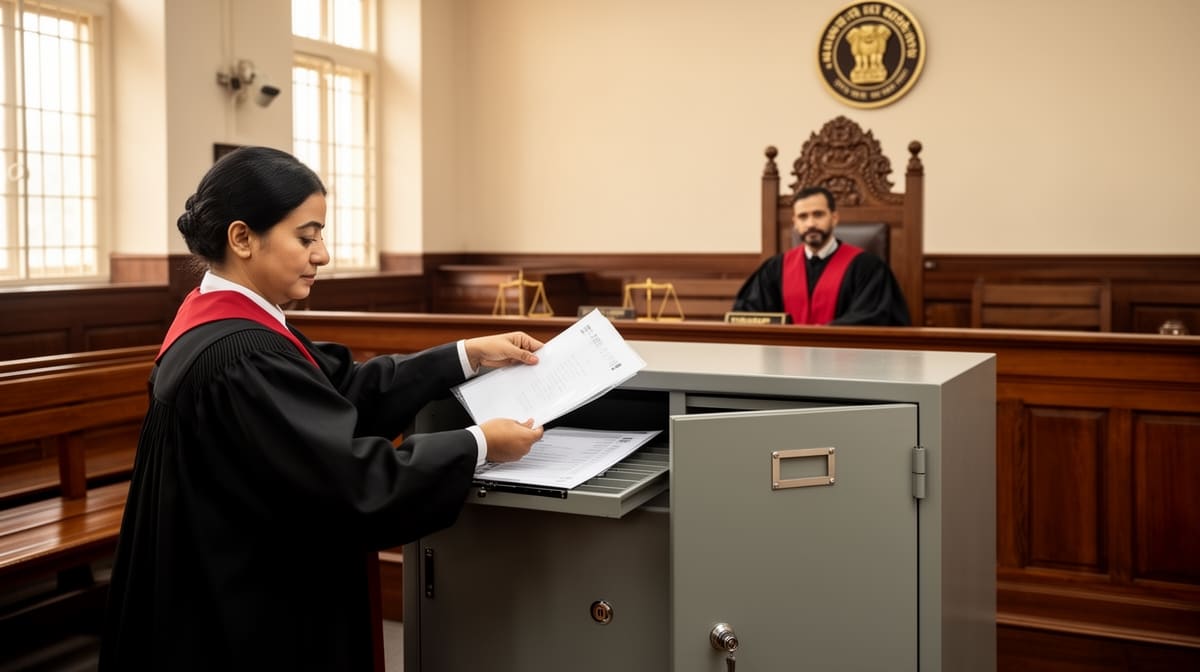
The Court further clarified that while the original document may remain in the custody of CW20, the court must ensure its preservation and availability. The accused’s right to use the document during trial is not contingent on physical possession but on judicial custody and controlled access.
The Verdict
The petitioner succeeded. The Court held that an accused has the right to access documents listed in the final report under Section 91 Cr.P.C. even before charge framing, and directed the Magistrate to secure Document No. 14 in court custody. The interim stay was vacated, and the Magistrate was ordered to comply with the directive.
What This Means For Similar Cases
Access to Final Report Documents Is Not Postponed Until Charge Framing
- Practitioners must now file applications under Section 91 Cr.P.C. immediately upon receipt of the final report, even if charges are not yet framed
- Courts cannot dismiss such applications on the ground that the accused is not yet a "charged person"
- Denial of access at this stage may constitute a violation of Article 21 and render trial unfair
Judicial Custody Is the Default for Critical Evidence
- Documents central to the prosecution’s case, especially those held by witnesses, must be secured in court custody upon request
- Original documents should not be returned without a certified copy being substituted
- Courts must impose conditions to prevent tampering, loss, or destruction
The Bharatiya Sakshya Adhiniyam, 2023, Reinforces Pre-Charge Rights
- The new Evidence Act does not alter the procedural rights under Cr.P.C. but affirms them
- Accused may now cite Section 59 and Section 60 of the Bharatiya Sakshya Adhiniyam to support applications for document access
- Defense counsel should routinely request preservation of all documents listed in the final report as part of pre-trial strategy