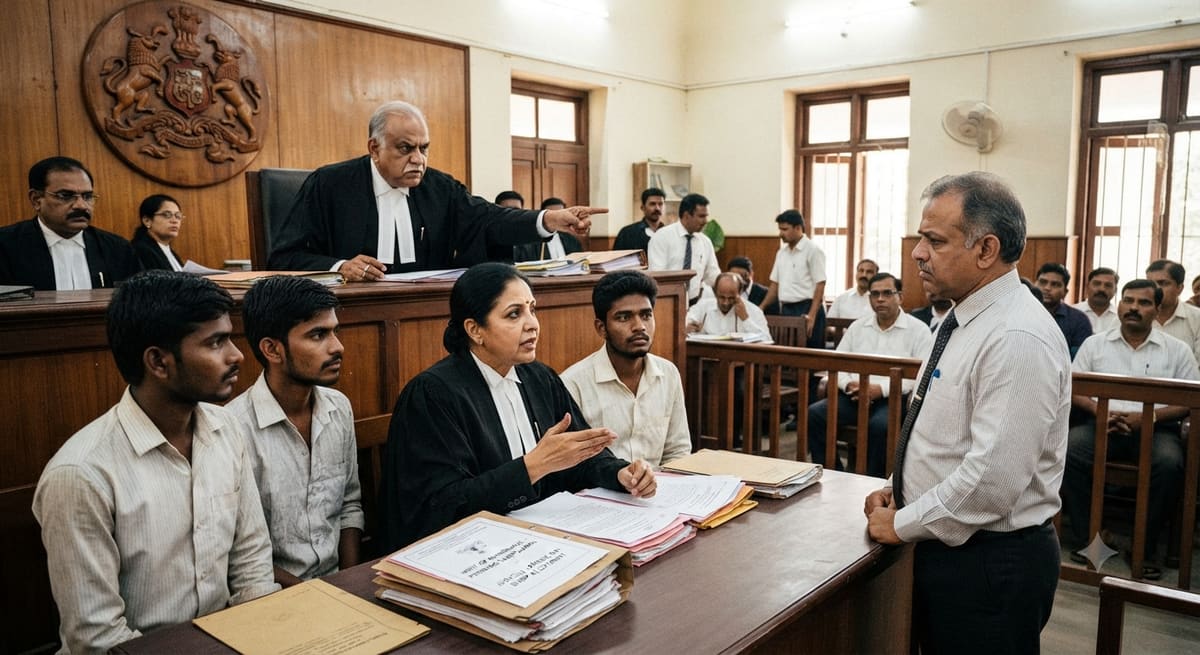
The Tripura High Court has reaffirmed that writ jurisdiction under Article 226 is not barred merely because a dispute has civil overtones, when statutory authorities have failed to implement binding orders issued under municipal legislation. This judgment clarifies that citizens with direct stake as neighbors may seek enforcement of statutory duties, and that prolonged inaction by municipal bodies cannot shield illegal construction from scrutiny.
Background & Facts
The Dispute
The appellant, a resident of Agartala, alleged that his neighbor, respondent No.4, constructed a three-storied building without municipal approval, violating the Tripura Municipal Act, 1994 and Tripura Building Rules, 2004. The construction included unauthorized extensions to the ground and first floors, and an illegal septic tank, posing structural and nuisance risks to the appellant’s property.
Procedural History
The case progressed through multiple administrative and judicial stages:
- 2015: Appellant filed multiple complaints with the Assistant Municipal Commissioner (Respondent No.3), leading to a notice under Section 135 of the Act and an order dated 13.08.2015 directing demolition of unauthorized portions.
- 2018: Respondent No.4 appealed under Section 133(3) to the Appellate Authority (Principal Secretary, Urban Development). The Appellate Authority set aside the 2015 demolition order, directing a technical inspection to resolve conflicting claims.
- 2018 - 2022: Despite repeated representations by the appellant and two formal orders (24.11.2020 and 11.12.2020) constituting a technical team, no inspection was conducted for over eight years.
- 2025: Appellant filed WP(C) No.67 of 2025 seeking mandamus to enforce the 2018 appellate order. The Single Judge dismissed it, citing alternative remedy and lack of locus.
Relief Sought
The appellant sought a writ of mandamus directing the Municipal Corporation to implement the 25.05.2018 appellate order by conducting a technical inspection, determining the legality of construction, and taking further action under the Act.
The Legal Issue
The central question was whether a writ of mandamus can be issued under Article 226 to enforce a statutory order issued by an appellate authority under the Tripura Municipal Act, 1994, when the implementing official has remained in persistent inaction for over eight years, despite multiple reminders.
Arguments Presented
For the Appellant
The appellant’s counsel argued that:
- The Appellate Authority’s order dated 25.05.2018 was final and binding, and its non-enforcement amounted to a violation of statutory duty.
- The appellant had exhausted all statutory remedies under Sections 130 and 133 of the Act, making the writ petition the only available recourse.
- As a neighboring property owner directly affected by structural violations and nuisance, he had locus standi under liberal writ jurisprudence.
- Delay in enforcement was attributable solely to the Municipal Corporation’s negligence or possible collusion, not to the appellant.
- Precedents like M.I. Builders v. Radhey Shyam Sahu and Consumer Action Group v. State of Tamil Nadu established that municipal authorities cannot evade accountability for illegal construction.
For the Respondent
The respondents conceded the inaction but argued:
- The dispute was essentially civil in nature, involving boundary and construction rights, and should be resolved in a civil court.
- The Single Judge correctly held that the appellant had an alternative remedy.
- The appellant’s delay in filing the writ petition (over five years after the 2018 order) amounted to laches.
- No constitutional right under Article 14 or 300-A was infringed, as the appellant’s property rights were not directly encroached upon.
The Court's Analysis
The Court rejected the Single Judge’s reasoning on multiple grounds. It emphasized that the Tripura Municipal Act, 1994, provides a comprehensive statutory framework for addressing unauthorized construction, and that the Appellate Authority’s order under Section 133(3) was not merely advisory but a binding directive.
"All that the appellant wants is implementation of the direction contained in the said order dt.25.5.2018. It is not denied that after the said order was passed, the petitioner/appellant had made multiple representations... and the respondent No.3 had even issued notice... and passed an order... but no inspection was done till date."
The Court held that the existence of a civil remedy does not oust writ jurisdiction when a statutory duty has been breached. The technical inspection ordered in 2018 required specialized knowledge that civil courts lack, and the Municipal Corporation was the only entity empowered to conduct it. The Court distinguished Arnesh Kumar v. State of Bihar and Maneka Gandhi v. Union of India to affirm that locus standi in public law matters is not confined to direct constitutional violations but extends to those affected by unlawful administrative inaction.
The Court further held that laches could not be invoked against the appellant, who had persistently pursued redress through letters, legal notices, and statutory appeals. The eight-year delay was entirely attributable to the respondents’ failure to act. The Court cited Shanti Sports Club v. Union of India to underscore that municipal authorities cannot be permitted to act with impunity when statutory mandates are ignored.
The Verdict
The appellant won. The Tripura High Court set aside the Single Judge’s order and directed the Agartala Municipal Corporation to implement the 25.05.2018 appellate order by conducting a technical inspection within one month. The Court also ordered payment of Rs.25,000 as costs to the appellant and directed the Principal Secretary, Urban Development, to initiate disciplinary proceedings against officials responsible for the inaction.
What This Means For Similar Cases
Statutory Orders Are Enforceable by Writ
- Practitioners may now invoke Article 226 to compel implementation of binding statutory orders when public authorities delay or refuse execution.
- The mere existence of a civil remedy does not displace writ jurisdiction where statutory duties are unfulfilled.
- Courts will not permit municipal bodies to evade accountability by citing procedural technicalities.
Locus Standi of Neighbors Is Recognized
- A neighbor who suffers direct harm from unauthorized construction (e.g., structural risk, nuisance, encroachment) has sufficient locus to seek judicial intervention.
- This applies even if the harm is not proprietary but relates to safety, environmental impact, or violation of building norms.
- No requirement to prove ownership of the affected land - only demonstrable adverse impact.
Inaction Triggers Disciplinary Consequences
- Courts may now direct disciplinary inquiries against officials responsible for prolonged inaction on statutory orders.
- Delay beyond reasonable timeframes (e.g., 8 years) will be treated as malfeasance, not mere administrative lapse.
- Practitioners should document all representations and cite M.I. Builders and Consumer Action Group to establish pattern of municipal negligence.