The Allahabad High Court has directed the payment of salary and arrears to an ad hoc Sanskrit teacher whose appointment was duly approved by Sampurnanand Sanskrit University but denied by state educational authorities for over five years. The Court held that the petitioner's continuous service and university approval created a legitimate expectation of payment, warranting issuance of a writ of mandamus.
Background & Facts
The Genesis
The petitioner, Rakesh Kumar Shukla, was appointed as an ad hoc teacher in the Department of Vyakaran at Sri Niwas Baudhayan Ramanuj Sanskrit Mahavidyalaya, a grant-in-aid institution recognized by Sampurnanand Sanskrit University. The institution had two sanctioned teaching posts in Vyakaran, both of which fell vacant in 1993 and 1996 due to the death of one teacher and the resignation of the other.
Key Facts
The petitioner possessed the requisite qualification of Acharya in Vyakaran and was selected by a duly constituted Selection Committee.
His appointment was initially communicated to the District Inspector of Schools (DIOS) for approval in accordance with statutory provisions.
The Sampurnanand Sanskrit University granted approval to the petitioner's appointment for a period of ten months after examining the proposal.
The institution issued a formal appointment letter to the petitioner and informed the DIOS regarding his appointment and the university's approval.
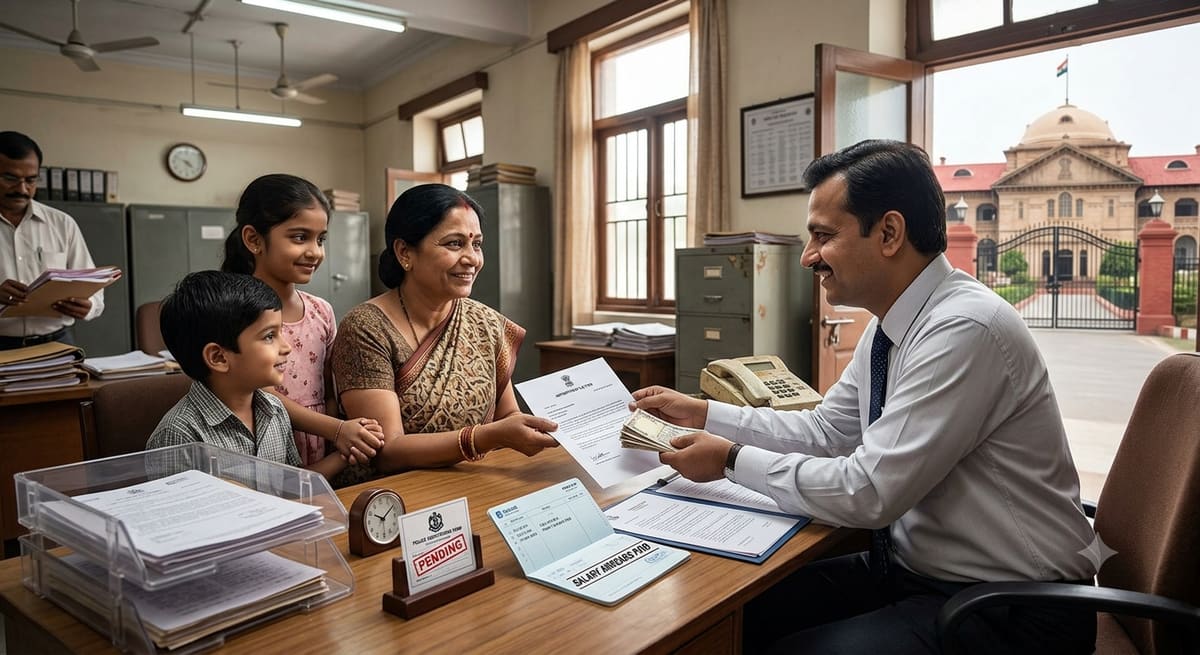
The DIOS referred the matter to the Deputy Director of Education seeking clarification on whether the petitioner's salary could be paid, resulting in no final decision for over five years.
The petitioner continued to work without receiving any remuneration despite rendering uninterrupted teaching services.
The Committee of Management passed multiple resolutions extending the petitioner's appointment until a regularly selected candidate became available.
The University categorically confirmed the approval of the petitioner's appointment to the Deputy Director of Education.
The petitioner and the Committee of Management repeatedly submitted representations before the competent educational authorities requesting release of the petitioner's salary, but no effective action was taken.
Procedural History
21.07.2000: Petitioner appointed as ad hoc teacher in the Department of Vyakaran.
24.02.2005: Interim order passed by the High Court directing payment of salary to the petitioner with effect from 01.02.2005 and continuation of payment until a duly selected candidate joins.
29.09.2005: District Inspector of Schools granted financial concurrence to the petitioner's appointment pursuant to the High Court's order.
16.07.2026: Present judgment delivered by the High Court disposing of the writ petition in terms of the interim order.
Relief Sought
The petitioner sought issuance of a writ of mandamus commanding the respondents to:
Ensure payment of salary to the petitioner along with arrears.
Allow the petitioner to continue teaching until a regularly selected candidate assumes charge.
Issue any other appropriate writ or direction.
The Legal Issue
The central question was whether the respondents' failure to release the petitioner's salary, despite his duly approved appointment and continuous service, amounted to a violation of his fundamental rights under Articles 14, 16, and 21 of the Constitution of India, warranting issuance of a writ of mandamus.
Arguments Presented
For the Petitioner
The petitioner contended that his appointment was duly approved by the Sampurnanand Sanskrit University and that he had continuously discharged his duties for over five years without remuneration. He argued that the respondents' inaction violated his right to livelihood and equal treatment under the Constitution.
For the Respondent
The respondents, represented by the State Counsel, did not contest the petitioner's appointment or his continuous service. However, they argued that the matter was administrative in nature and that the High Court's interim order had already addressed the issue of salary payment.
The Court's Analysis
The Court examined the petitioner's continuous service, the university's approval, and the respondents' repeated failure to release his salary despite multiple representations and confirmations from the university. The Court held that the petitioner's right to receive remuneration for his services was a fundamental right under Article 21 of the Constitution.
"The petitioner has continuously worked from the date of his initial ad hoc appointment and pursuant to his duly approved appointment. The Committee of Management has issued a certificate certifying that the petitioner has been regularly teaching in the institution and has continuously discharged his duties against the sanctioned vacancy."
The Court further observed that the respondents' inaction had resulted in an unjust enrichment of the institution at the expense of the petitioner's legitimate expectations. The Court relied on the principle of promissory estoppel and the doctrine of legitimate expectation to hold that the petitioner was entitled to his salary and arrears.
The Court also noted that the interim order passed on 24.02.2005 had already directed the respondents to pay the petitioner's salary, and the respondents had complied with the same. However, the Court emphasized that the petitioner's claim for regularization and promotional pay scale required further consideration by the competent authority.
The Verdict
The High Court disposed of the writ petition in terms of the interim order dated 24.02.2005. The Court directed:
Payment of the petitioner's regular monthly salary from 01.02.2005 onwards.
Payment of arrears of salary from 01.02.2005 within three months from the date of production of a certified copy of the order.
Payment of promotional pay scale and selection grade within three months from the date of production of a certified copy of the order.
The petitioner was granted liberty to move a representation to the Director of Education, U.P. at Allahabad within three weeks from the date of the order for regularization, which shall be considered by the Director within three months from the date of production of a certified copy of the order.
What This Means For Similar Cases
Continuous Service Creates Legitimate Expectations
Ad hoc or temporary appointments that are duly approved by competent authorities create legitimate expectations of payment and regularization.
Failure to release salary despite continuous service may violate fundamental rights under Articles 14, 16, and 21 of the Constitution.
Writ of Mandamus as a Remedy
A writ of mandamus is a potent remedy for enforcing the payment of salary to employees whose appointments are duly approved but denied remuneration by administrative authorities.
Courts are empowered to direct payment of arrears and regular monthly salaries where the respondents' inaction is arbitrary and unjustified.
Procedural Compliance Is Non-Negotiable
Educational institutions must comply with statutory provisions and obtain necessary approvals before appointing teachers.
Authorities must act promptly on representations and confirmations from competent bodies to avoid prolonged denial of salary.