The Allahabad High Court has affirmed that contractual teachers appointed by school management committees and later regularized under statutory amendments are entitled to full salary arrears from the date of their initial appointment, not from the date of regularization. This ruling resolves a long-standing ambiguity in the service rights of non-regularized teaching staff in Uttar Pradesh.
Background & Facts
The Dispute
The petitioner, Ram Dhani Vishwakarma, was appointed as an Assistant Teacher in L.T. Grade (Mathematics) at Gandhi Gramodyog Uchchatar Madhyamik Vidyalaya, Pindoria, district Ambedkar Nagar, on 06.10.1997 by the Committee of Management of the school. The District Inspector of Schools (D.I.O.S.) refused to approve the appointment, citing lack of statutory authority. Despite this, the petitioner continued to discharge duties without formal approval. His representations to the D.I.O.S. and the Director of Education were rejected, with the latter holding that the Committee of Management had no power to appoint. The petitioner filed a writ petition before the Allahabad High Court seeking regularization, payment of salary, and declaration that Sections 18 and 33-E of the U.P. Secondary Education Services Selection Board (Amendment) Act, 1999 were ultra vires.
Key Facts
- The petitioner was appointed on 06.10.1997 by the Committee of Management against a sanctioned post.
- The D.I.O.S. rejected the appointment on grounds of procedural irregularity on 07.11.2003.
- The Director of Education upheld the rejection on 17.07.2004, holding that only the U.P. Secondary Education Services Selection Board (S.S.B.) could make appointments.
- The petitioner filed a writ petition on 22.09.2003, which led to an interim order dated 16.12.2004 permitting him to continue working and receive monthly salary, but explicitly excluding arrears.
- The petitioner continued teaching under the interim order until his retirement on 31.03.2026.
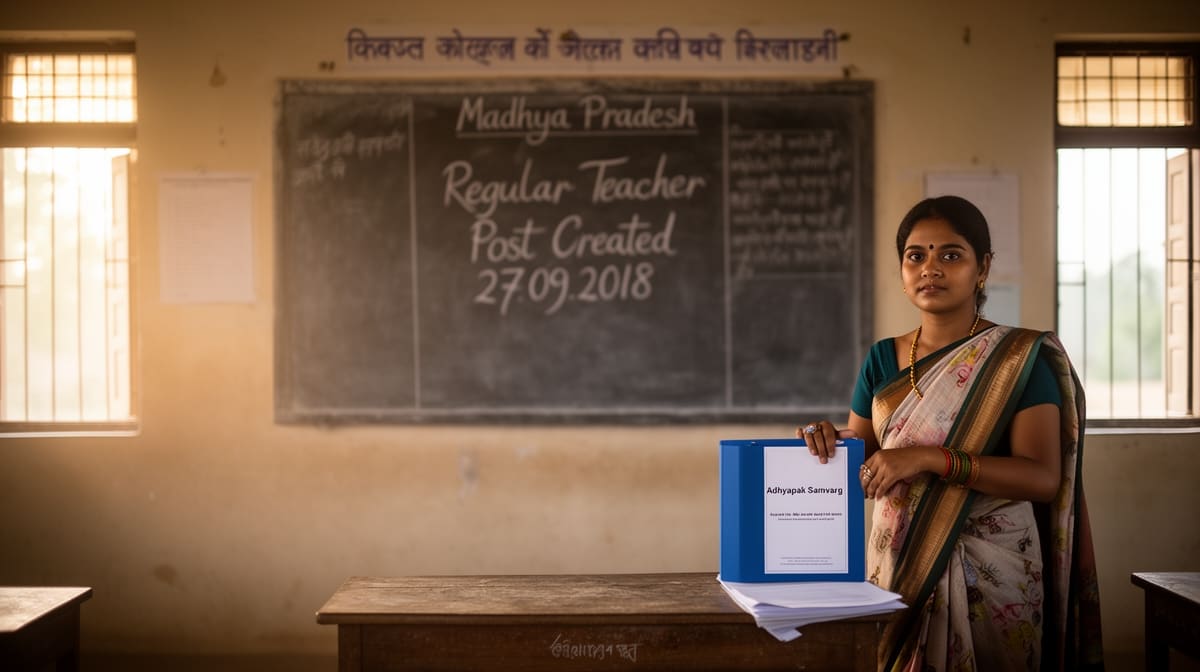
- On 15.03.2025, the petitioner’s services were regularized with effect from 07.10.1997 by an order issued by Sri Yogendra Kumar Singh, Joint Director of Education, Ayodhya Mandal.
- The regularization was made possible by the amendment to the U.P. Secondary Education (Services Selection Boards) Act, 1982, which introduced Section 13(3)(g) allowing regularization of teachers appointed by management committees.
Procedural History
- 06.10.1997: Petitioner appointed by Committee of Management.
- 03.07.1997: Requisition sent to D.I.O.S. for appointment.
- 07.11.2003: D.I.O.S. rejected appointment.
- 17.07.2004: Director of Education upheld rejection (impugned order).
- 22.09.2003: First writ petition filed.
- 16.12.2004: High Court granted interim relief: petitioner allowed to work and receive monthly salary; arrears to be decided at final disposal.
- 2023 - 2024: Writ-A No. 8437 of 2023 (Awadhesh Kumar Pandey v. State of U.P.) decided on 31.05.2024, establishing that teachers appointed by management committees were entitled to regularization under amended Section 13(3)(g), and that non-speaking orders rejecting regularization were void.
- 12.03.2025: Joint Director of Education issued regularization order with retrospective effect from 07.10.1997.
- 16.04.2026: Petitioner filed supplementary affidavit confirming regularization and retirement.
- 31.03.2026: Petitioner retired.
Relief Sought
The petitioner sought:
- Quashing of the order dated 17.07.2004 rejecting his appointment.
- A writ of mandamus directing the State to allow him to continue as Assistant Teacher and pay monthly salary w.e.f. 06.10.1997.
- Payment of arrears of salary from 06.10.1997 to 31.03.2026.
- Declaration that Sections 18 and 33-E of the U.P. Secondary Education Services Selection Board (Amendment) Act, 1999 were ultra vires.
The Parties' Positions
For the Petitioner: Argued that his appointment was valid under the Removal of Difficulties (Second) Order, 1985, which empowered management committees to appoint teachers. He relied on the precedent set in Awadhesh Kumar Pandey v. State of U.P. (2024) to establish that regularization under Section 13(3)(g) validated his service from the date of initial appointment. He emphasized that he had worked continuously for nearly 29 years under court-ordered interim relief.
For the Respondents: Contended that the appointment was void ab initio as it bypassed the statutory mandate of the S.S.B. They argued that regularization under the 2024 amendment could not be given retrospective effect beyond the date of the amendment and that arrears could not be granted for a period when no lawful appointment existed.
The Legal Issue
The central question was whether retrospective regularization of a contractual teacher under Section 13(3)(g) of the U.P. Secondary Education (Services Selection Boards) Act, 1982, as amended, entitles the teacher to arrears of salary from the date of initial appointment, even if the appointment was initially deemed irregular.
Arguments Presented
For the Petitioner
The petitioner relied on the judgment in Awadhesh Kumar Pandey v. State of U.P. (2024:AHC-LKO:41391), where the Court held that teachers appointed by management committees before the amendment were entitled to regularization under Section 13(3)(g), and that such regularization must be given retrospective effect to the date of initial appointment. He argued that the principle of equity and the doctrine of legitimate expectation required that service rendered for nearly three decades be recognized fully. He further submitted that the State had accepted his service by paying him monthly salary under interim orders for over two decades, thereby estopping it from denying the validity of his service.
For the Respondent
The State contended that the appointment was void under the original Act of 1982, and that the 2024 amendment could not revive or validate past illegal appointments. It argued that arrears could not be granted for a period when no lawful appointment existed, and that granting arrears would create fiscal liability for the State without legislative sanction. It also claimed that the petitioner’s petition was barred by laches and acquiescence.
The Court's Analysis
The Court examined the nature of the amendment to the U.P. Secondary Education (Services Selection Boards) Act, 1982, particularly the insertion of Section 13(3)(g), which explicitly provided for regularization of teachers appointed by management committees. The Court noted that the amendment was enacted to correct systemic irregularities and provide justice to thousands of teachers who had served in good faith.
"The amendment was not a new grant of benefit but a recognition of service already rendered under the belief of lawful authority, and to deny arrears would be to penalize the teacher for the State’s own failure to regularize appointments in a timely manner."
The Court distinguished the State’s argument that the appointment was void ab initio, holding that in service law, a voidable act is not the same as a void act. Where the State has accepted service for decades, paid salary under court orders, and later regularized the appointment with retrospective effect, the appointment cannot be treated as legally non-existent. The Court emphasized that the regularization order dated 12.03.2025 explicitly conferred service from 07.10.1997, and the State cannot now dispute the validity of its own order.
The Court further relied on the precedent in Awadhesh Kumar Pandey, where it had directed that regularization must be accompanied by payment of arrears from the date of initial appointment. The Court held that the petitioner, having retired on 31.03.2026, was entitled to the full arrears of salary from 06.10.1997 to 31.03.2026, as his service was now legally recognized from inception.
The Verdict
The petitioner succeeded. The Court disposed of the writ petition and directed the State to pay the petitioner arrears of salary from 06.10.1997 to 31.03.2026, calculated at the rate applicable to L.T. Grade (Mathematics) Assistant Teachers during each period of service. The State was directed to compute and disburse the arrears within 12 weeks from the date of this judgment. The petitioner’s claim for declaration of Sections 18 and 33-E as ultra vires was rendered infructuous due to the regularization.
What This Means For Similar Cases
Retrospective Regularization Triggers Arrears Liability
- Practitioners representing contractual teachers must now argue that retrospective regularization under statutory amendments automatically triggers liability for salary arrears from the date of initial appointment, regardless of initial procedural defects.
- The State cannot invoke the doctrine of void ab initio to deny arrears when it has accepted service for decades and later issued a regularization order with retrospective effect.
Interim Orders Create Legitimate Expectation
- Continuous service under interim court orders, coupled with payment of monthly salary, creates a legitimate expectation that service will be regularized.
- Courts are likely to treat such service as de facto lawful for the purpose of calculating benefits, even if the initial appointment was technically irregular.
Amended Statutes Are Remedial in Nature
- Amendments like Section 13(3)(g) are remedial and beneficial in nature and must be interpreted liberally to achieve social justice.
- Any attempt to limit the retrospective effect of such amendments to the date of enactment will be rejected by courts if the legislative intent is to correct past injustices.
Actionable Takeaways for Practitioners
- File applications for arrears calculation immediately upon receipt of regularization orders with retrospective dates.
- Cite Awadhesh Kumar Pandey v. State of U.P. and this judgment as binding precedent in all similar cases.
- Demand that the State compute arrears using pay scales applicable for each year of service, not a single rate.
- Challenge any denial of arrears on grounds of limitation or laches - courts will not apply limitation strictly in service matters where the State has acquiesced.