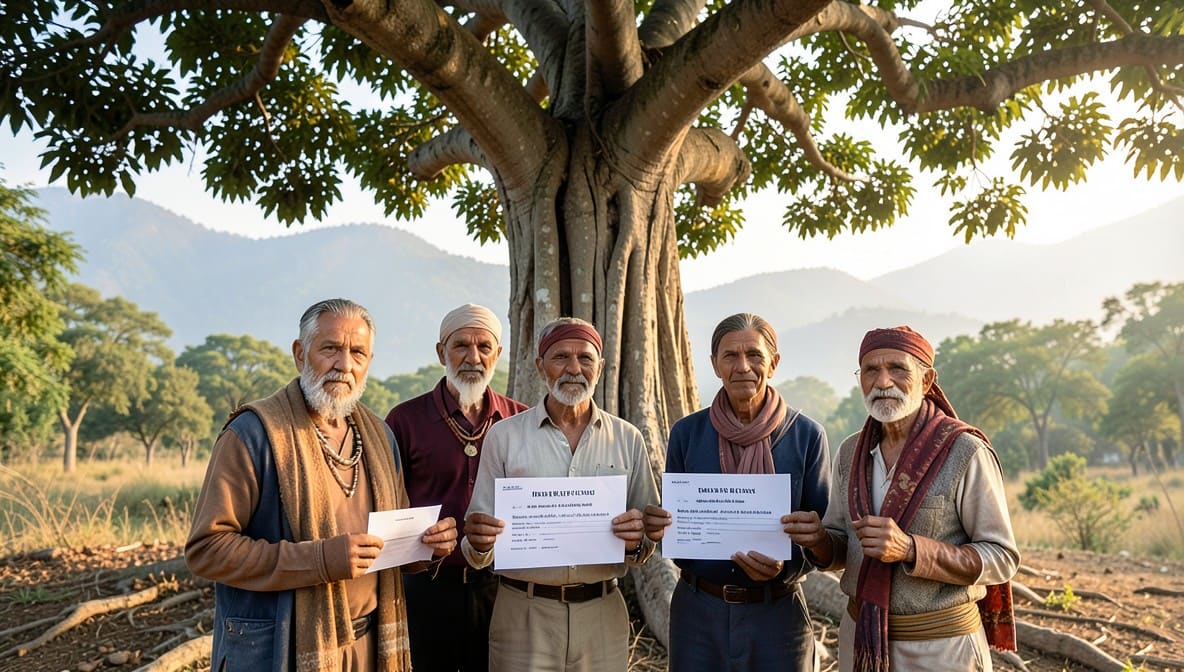
The Chhattisgarh High Court has affirmed that prolonged administrative inaction on land claims by Scheduled Tribe members cannot justify coercive eviction. In a significant ruling, the Court ordered the Collector to decide a decades-old application for Van Adhikar Patta within 90 days, while restraining any forcible removal of the petitioner’s residence.
Background & Facts
The Dispute
The petitioner, Dhobiya, a member of a Scheduled Tribe community, has resided on forest land in Compartment No. P-3394 near Bainka River, Village Bhanaura, since his forefathers first settled there 40 to 50 years ago. He is landless and owns no other property. The Forest Department issued a notice on 29 July 2025 alleging unauthorized occupation and demanding he vacate the land within seven days unless he produced valid documentation within three days.
Procedural History
- 2025: Forest Department issued notice (Annexure P/1) demanding proof of ownership or vacating the land.
- January 2026: Petitioner filed a formal application (Annexure P/2) with the Collector seeking grant of Van Adhikar Patta under Chhattisgarh Forest Rights Rules.
- No decision: The Collector has taken no action on the application despite its submission over five months prior.
- Writ Petition: Petitioner approached the High Court under Article 226 seeking quashing of the notice and direction to decide his application.
Relief Sought
The petitioner sought: (1) quashing of the impugned notice; (2) direction to the State to decide his Van Adhikar Patta application within a stipulated time; and (3) prohibition of coercive action pending decision.
The Legal Issue
The central question was whether the State can issue an eviction notice against a Scheduled Tribe member who has been in peaceful, long-term possession of forest land, while simultaneously ignoring a pending formal application for recognition of rights under the Van Adhikar Patta scheme.
Arguments Presented
For the Petitioner
Learned counsel argued that the notice violated principles of natural justice by denying the petitioner an opportunity to be heard. He emphasized that the petitioner’s family has occupied the land for over four decades, and the Forest Department had never challenged this possession until now. The delay in deciding the Van Adhikar Patta application - filed in January 2026 - constituted administrative arbitrariness. He relied on State of Chhattisgarh v. Ram Singh and the Scheduled Tribes and Other Traditional Forest Dwellers (Recognition of Forest Rights) Act, 2006, to assert that long-standing occupation by tribal communities must be recognized unless lawfully extinguished.
For the Respondent
The State counsel contended that the notice was merely a procedural inquiry to ascertain title and did not amount to a final order of eviction. He argued that the petitioner had not produced any documentary proof of ownership and that forest land cannot be claimed merely by long possession. The notice, he submitted, was a lawful step under the Chhattisgarh Forest Rules to verify encroachment.
The Court's Analysis
The Court rejected the State’s narrow interpretation of the notice as a mere inquiry. It held that the notice, by demanding eviction within seven days, carried coercive consequences and thus constituted a de facto adverse order. The Court emphasized that the petitioner, as a member of a Scheduled Tribe, is entitled to the protections under the Forest Rights Act, 2006, and the State’s duty to adjudicate claims under the Van Adhikar Patta scheme is not discretionary but mandatory.
"The State cannot remain silent on a claim for land rights for years, then suddenly issue an eviction notice without adjudicating the pending application. This amounts to procedural oppression."
The Court noted that the petitioner’s possession was continuous, peaceful, and undisputed for over four decades. The absence of prior action by the Forest Department indicated acquiescence. The Court further observed that the petitioner’s home is his only shelter and that eviction without a decision on his application would violate his right to life and dignity under Article 21.
The Court declined to rule on the merits of whether the petitioner is entitled to the Patta, but held that the State must first afford him a fair hearing and adjudicate his application in accordance with law.
The Verdict
The petitioner succeeded. The Court held that the State must decide pending Van Adhikar Patta applications within 90 days and that no coercive action can be taken against the applicant until such decision is rendered. The notice was not quashed, but its enforcement was stayed pending adjudication.
What This Means For Similar Cases
Administrative Silence Cannot Justify Eviction
- Practitioners representing tribal land claimants must now cite this judgment to oppose eviction notices issued while Van Adhikar Patta applications remain pending.
- Delay exceeding six months in deciding such applications may now be challenged as a violation of Article 14 and Article 21.
- Forest officials cannot treat long-term occupation as illegal without first examining the claim under statutory frameworks.
Van Adhikar Patta Applications Are Not Merely Administrative
- The Court treated the application as a substantive right claim, not a routine request.
- District Collectors must now treat these applications with urgency, especially where the applicant is landless and resides on the land.
- Failure to decide within 90 days may invite contempt proceedings or further writ petitions.
Procedural Fairness Trumps Technical Deficiencies
- Lack of formal title documents cannot be the sole ground for eviction where possession is longstanding and undisputed.
- Oral evidence, community testimony, and historical occupancy must be weighed alongside documentary proof.
- The burden shifts to the State to prove lawful extinguishment of rights, not to the claimant to prove absolute title.