The Supreme Court restored the uniform market value of Rs. 5,00,000/- per acre for land acquired under the Land Acquisition Act, 1894 for the Aspal Extension Drain project in Fazilka, Punjab, rejecting the High Court's radial step-down pricing model and reaffirming the doctrine of project-wide parity in land acquisition jurisprudence. The judgment comprehensively addressed five key issues: market valuation methodology, compensation for fruit-bearing trees, severance charges, entitlement to statutory benefits on auxiliary assets, and tubewell compensation, thereby providing critical clarity on the application of Sections 23(1), 23(1A), and 23(2) of the LA Act, 1894 in contiguous land acquisitions.
Background & Facts
The Dispute
The dispute arose from the acquisition of agricultural land in six villages - Karni Khera, Odian, Awa, Kotha, Alamshah, and Salem Shah - in Fazilka district, Punjab, for the construction of the Aspal Extension Drain (Ditch Canal) under the Land Acquisition Act, 1894. Landowners contended that the drain bifurcated their holdings into unusable fragments, necessitating enhanced compensation for severance charges, fruit-bearing trees, tubewells, and other auxiliary assets, while the State maintained that compensation should adhere strictly to statutory provisions and judicial precedents.
Key Facts
- The acquisition proceedings commenced with notifications under Section 4 of the LA Act, 1894 issued on November 14, 2000, and November 24, 2000
- A declaration under Section 6 of the LA Act, 1894 was made on March 2, 2001
- The Land Acquisition Collector (SDM), Fazilka announced the final award on August 6, 2001, fixing a uniform market rate of Rs. 2,25,000/- per acre across the project area but awarding nil compensation for severance charges
- Fruit-bearing trees were found only on acquired land at Village Karni Khera, with the LAC awarding Rs. 1,01,139.50/- each to Sh. Surinder Kumar and Sh. Vikram Aditya based on State Horticulture Department assessment
- Tubewell compensation varied: Village Karni Khera (Rs. 5,643/-), Odian (Rs. 4,559/- per tubewell), Alam Shah (Rs. 4,848/- to 10,567/- per tubewell), Awa (Rs. 4,559/- to 12,320/- per tubewell)
- The reference petition under Section 18 of the LA Act, 1894 was instituted on September 20, 2002 (LA Case No. 70), explicitly pleading orchard damages for only 280 trees (246 Malta orange and 34 Guava plants) standing on the acquired strip
- The Reference Court enhanced market value to Rs. 5,00,000/- per acre for Karni Khera (November 13, 2007), Odian (December 17, 2007), Alamshah (January 10, 2008), and maintained Rs. 2,25,000/- per acre for Salem Shah (no enhancement)
- The Reference Court awarded severance charges at 50% of market value for Karni Khera, Odian, and Alamshah, and 10% for Awa, Kotha, and Salem Shah
- The Reference Court awarded Rs. 9,00,000/- as lump-sum compensation for 946 fruit-bearing trees to Sh. Surinder Kumar and Sh. Vikram Aditya
- The Reference Court enhanced tubewell compensation to Rs. 1,00,000/- per tubewell based on private valuation reports
- The High Court modified the market value to graded radial rates: Rs. 3,19,000/- per acre for Karni Khera and Alamshah, Rs. 2,99,000/- per acre for Odian, and Rs. 3,39,000/- per acre for Awa, Kotha, and Salem Shah (March 29, 2019)
- The High Court restricted tree compensation to Rs. 5,38,300/- for 280 pleaded trees, reduced severance charges to a uniform 40% of acquired land value, denied statutory benefits on auxiliary assets, and standardized tubewell compensation at Rs. 50,000/- per tubewell
Procedural History
- September 20, 2002: Reference petition filed under Section 18 of LA Act, 1894 (LA Case No. 70) before the Reference Court
- November 13, 2007: Reference Court award enhancing market value for Karni Khera to Rs. 5,00,000/- per acre
- December 17, 2007: Reference Court award enhancing market value for Odian to Rs. 5,00,000/- per acre
- January 10, 2008: Reference Court award enhancing market value for Alamshah to Rs. 5,00,000/- per acre
- March 29, 2019: High Court of Punjab and Haryana at Chandigarh modified market value to graded radial rates and altered other compensation heads
- September 29, 2026: Supreme Court judgment delivered in Civil Appeal Nos. 3800-3803 of 2026 and related appeals
Relief Sought
The landowners sought: (i) restoration of the Reference Court's uniform market value of Rs. 5,00,000/- per acre; (ii) compensation for all 946 fruit-bearing trees at Rs. 1,922.50/- per tree; (iii) severance charges at 50% of the value of unacquired land; (iv) statutory solatium (@30%) and additional interest (@12% p.a.) on auxiliary assets; and (v) tubewell compensation reflecting actual displacement costs, with interest and costs.
The Legal Issue
The central questions were: (1) Whether the High Court was justified in modifying the market value to graded radial rates ranging from Rs. 2,99,000/- to Rs. 3,39,000/- per acre based on distance from municipal limits and proximity to the international border; (2) Whether the High Court correctly restricted compensation for fruit-bearing trees to the 280 pleaded trees standing on the acquired land portion, excluding 482 trees lost on unacquired land; (3) Whether the High Court correctly reduced severance charges from 50% of the value of unacquired land to a uniform 40% of the value of acquired land by applying Clause (2) of the Tehal Singh formula; (4) Whether statutory solatium under Section 23(2) and additional interest under Section 23(1A) of the LA Act, 1894 are legally payable on auxiliary assets such as standing fruit-bearing trees, tubewells, and kothas; and (5) Whether the High Court was legally right in modifying tubewell compensation to a standardized flat displacement sum of Rs. 50,000/- per tubewell while excluding statutory benefits thereon.
Arguments Presented
For the Appellants/Petitioners (Landowners)
The landowners argued that the High Court erred in applying a radial step-down model that ignored the principle of project-wide parity for contiguous lands acquired under a single notification. They relied on the Sultanpur benchmark (Ex. PW-7/1) where Rs. 5,00,000/- per acre was fixed for similar land acquired in 1996, contending that land appreciation over five years warranted at least Rs. 8,00,000/- per acre in 2001. They asserted that the Reference Court's reliance on transaction-based local evidence (9% urban stamp duty rate in Special Villages) and suburban potential validated the uniform Rs. 5,00,000/- per acre valuation. Regarding trees, they maintained that oral evidence of 482 additional trees lost due to drip-irrigation damage in 2005 should be admissible, citing the Reference Court's reliance on expert scientific evaluation. On severance, they argued that the drain's physical barrier (100-130 ft width, 7-ft bridges) rendered unacquired land practically inaccessible, necessitating compensation for diminution in value of the remaining land per Smt. Tribeni Devi v. Collector of Ranchi. They contended that statutory benefits under Sections 23(1A) and 23(2) apply to auxiliary assets per Improvement Trust, Jind v. Narinder Kumar, and that tubewell compensation should reflect actual displacement costs, not a standardized flat rate.
For the Respondent/State
The State defended the High Court's radial model, arguing that agricultural land potentiality decreases with distance from urban growth hubs and the international border, justifying lower baseline market value for border-adjacent villages due to security-depressed pricing. It contended that the Reference Court erred in relying on the Sultanpur benchmark, as Sultanpur lay within Fazilka's municipal limits while the acquired lands were strictly rural. On trees, the State insisted that evidence cannot be led beyond pleadings, and since the reference petition explicitly claimed damage for only 280 trees, compensation for 482 additional trees was inadmissible. Regarding severance, the State maintained that the High Court correctly applied Tehal Singh v. State of Punjab, holding that severance charges must be calculated as a percentage of acquired land value when the drain is constructed beyond the abadi side. It argued that statutory benefits under Sections 23(1A) and 23(2) are strictly restricted to the market value of bare land per State of Punjab v. Amarjit Singh, and that tubewell compensation at Rs. 50,000/- appropriately balances private inflation against government underestimation for movable assets like electric motors and diesel engines that can be reused on remaining holdings.
The Court's Analysis
The Supreme Court began by reaffirming the statutory mandate of Section 23(1) of the LA Act, 1894, which requires compensation to be based on the market value of the land at the date of publication of the Section 4 notification. The Court emphasized that contiguous tracts acquired for a unified public purpose must be awarded consistent, non-discriminatory compensation, evaluating both positive potentiality factors (proximity to urban centers, highways, institutional expansions) and negative factors.
On market valuation (Issue 1), the Court held that the High Court erred in rejecting the Sultanpur benchmark (Ex. PW-7/1). It cited Krishan Kumar v. State of Haryana to establish that lands with similar locational and developmental potential must be compensated equitably unless clear, objective distinctions justify otherwise. The Court found that the acquired lands in Karni Khera are merely 1.5 km from Sultanpur on the exact same road, acquired for identical public purpose (integrated drainage project), sharing identical agricultural potential. It noted that the High Court disregarded the State's own witness (SDO Irrigation RW-1), who conceded that Fazilka's urban abadi was expanding toward the acquired land. The Court further held that the High Court's 20% deduction for "smallness" on the rural sale exemplar (Ex. P-1) overlooked the land's suburban potential, as the tracts directly abut present-day National Highway 7 (historically NH 10, the Delhi-to-Sulemanki Road), making them premium orchard plots with commercial and industrial potential. The Court concluded that the Reference Court's uniform market value of Rs. 5,00,000/- per acre was legally and factually correct, grounded in project-wide contiguity, suburban potentiality (validated by the 9% urban stamp duty rate), and the 1996 Sultanpur benchmark.
On fruit-bearing trees (Issue 2), the Court affirmed the High Court's restriction to the 280 pleaded trees. It held that in reference proceedings under Section 18 of the LA Act, 1894, the reference petition stands as the "plaint" and strictly defines the dispute's scope. The landowners' original reference petition (September 20, 2002) explicitly pleaded orchard damages for only 280 trees on the acquired strip, and no formal amendment was ever sought to include the 482 trees lost on unacquired land in 2005. Applying the settled principle that evidence cannot be led beyond pleadings (Bach haj Nahar vs. Nilima Mandal), the Court held that the Reference Court committed a grave error by awarding lump-sum compensation for 946 trees. Using the scientifically accepted Nijjar Formula rate of Rs. 1,922.50/- per tree, the compensation was correctly restricted to Rs. 5,38,300/-.
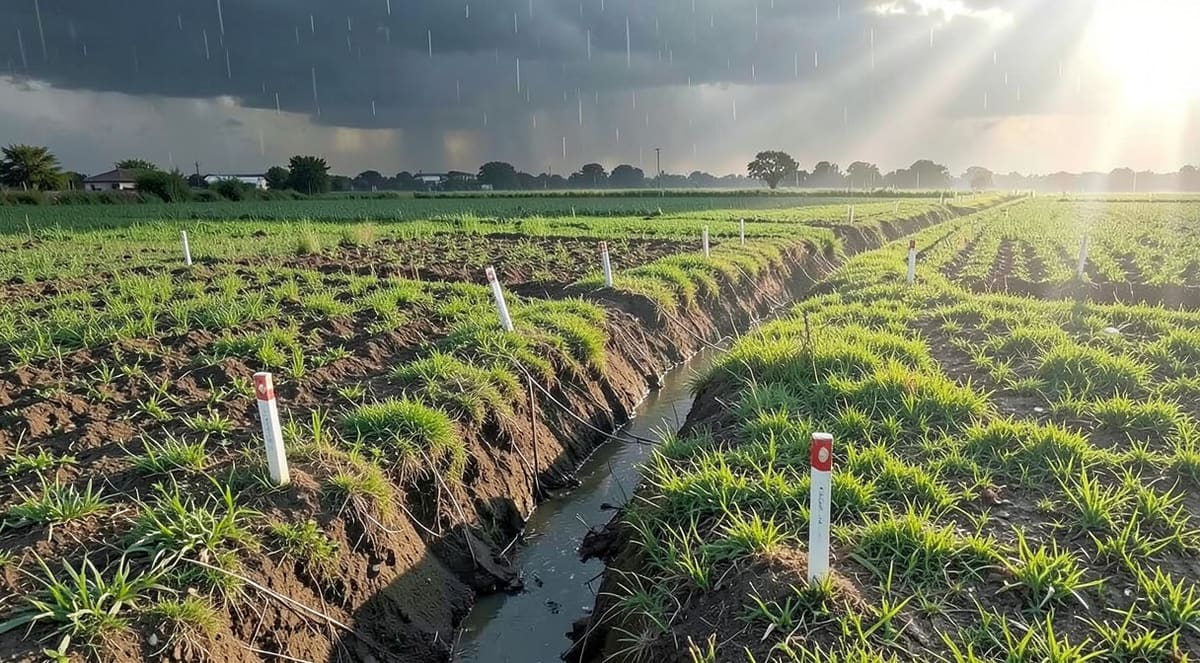
On severance charges (Issue 3), the Court found that the High Court committed a fundamental legal error by shifting the baseline from unacquired remaining land to acquired land under Section 23(1) Thirdly of the LA Act, 1894. It held that severance damage is explicitly designed to compensate for diminution in value of the unacquired remaining land, not the acquired portion. The Court cited Smt. Tribeni Devi v. Collector of Ranchi, which mandates robust severance compensation when a portion of land is acquired and a large portion is left behind, causing severe diminution in the value of the land left out. It noted that the High Court's mechanical application of Tehal Singh ignored the physical reality: the drain's width (100-130 ft), depth (10-15 ft), and side banks (10-30 ft high) created an insurmountable barrier, as modern mechanized farming machinery cannot cross the 7-ft bridges. The Court held that rendering unacquired land inaccessible constitutes a constructive total loss of agricultural utility, and accordingly restored the Reference Court's award of 50% severance charges on the market value of the unacquired remaining land.
On statutory benefits (Issue 4), the Court affirmed the High Court's denial of Sections 23(1A) and 23(2) benefits on auxiliary assets. It held that the statutory scheme of Section 23 provides that additional interest and solatium are related strictly to the market value of the land determined under Section 23(1) First Clause. Citing State of Punjab v. Amarjit Singh, the Court held that these benefits are payable only on the market value of the land and not on any other amount, including damages/expenses awarded under the second to sixth factors of Section 23(1) (which cover trees, crops, structures, and severance damages). It found that standing trees fall under the second factor, severance damages under the third, and tubewells/kothas under the fourth or fifth factors of Section 23(1), constituting separate and independent auxiliary heads of damage excluded from attracting statutory benefits.
On tubewell compensation (Issue 5), the Court affirmed the High Court's standardization at Rs. 50,000/- per tubewell. It held that the Reference Court erred in blindly adopting private valuation reports without examining the expert engineer's credibility, as mere marking of a document as an exhibit does not prove its truth under the law of evidence. The Court noted that tubewells, electric motors, and diesel engines are movable property that can be uninstalled, shifted, and reused on remaining holdings, making a flat displacement figure appropriate. It further held that the High Court correctly set aside the Reference Court's direction granting 30% solatium and 12% p.a. additional interest on tubewell awards, as such benefits are strictly restricted to bare land market value per Amarjit Singh.
The Verdict
The landowners succeeded in part. The Supreme Court set aside the High Court's judgment dated March 29, 2019, and: (i) restored the uniform market value of Rs. 5,00,000/- per acre across all six villages; (ii) affirmed the restriction of tree compensation to Rs. 5,38,300/- for 280 pleaded trees at Rs. 1,922.50/- per tree; (iii) restored the Reference Court's award of 50% severance charges calculated on the market value of the unacquired remaining land; (iv) affirmed the denial of statutory solatium (@30%) and additional interest (@12% p.a.) under Sections 23(1A) and 23(2) of the LA Act, 1894 on auxiliary assets, restricting such benefits to the market value of the bare land only; and (v) affirmed the High Court's award of Rs. 50,000/- flat per tubewell for displacement across all villages. The Court directed that additional compensation be worked out and paid within six (6) months from the date of communication of this order by the respondents to the landowners, with recovery proceedings to be initiated within nine (09) months if any amount becomes recoverable. No costs were awarded.
What This Means For Similar Cases
Project-Wide Parity Trumps Arbitrary Zonal Models
Practitioners must now argue that contiguous lands acquired under a single notification for a unified public purpose require consistent, non-discriminatory compensation unless clear, objective distinctions justify differentiation. The judgment reaffirms that administrative or revenue classifications (e.g., "Special Village" status) cannot override the fundamental principle of fairness in land acquisition. When challenging valuation models, focus on transaction-based local evidence (such as urban stamp duty rates), proximity to developed infrastructure, and benchmarks from similar acquisitions in the same geographical area. Arbitrary step-down formulas based solely on distance from municipal limits or international borders are legally unsustainable and violate constitutional principles of equality.
Pleadings Define the Scope of Evidence
In reference proceedings under Section 18 of the LA Act, 1894, the reference petition strictly delimits the dispute's scope, and evidence cannot be led beyond pleadings. Practitioners must ensure that all claimed heads of compensation (trees, crops, structures) are explicitly pleaded in the reference petition, with formal amendments sought if additional heads arise during litigation. Oral evidence alleging damage to unpleaded items (e.g., 482 additional trees lost on unacquired land) is inadmissible, and courts will restrict compensation to the pleaded scope. This principle applies uniformly across land acquisition cases, emphasizing the critical importance of precise pleading at the reference stage.
Severance Compensation Must Reflect Actual Loss of Utility
Severance charges under Section 23(1) Thirdly of the LA Act, 1894 must compensate for the diminution in value of the unacquired remaining land, not the acquired portion. Practitioners should present evidence of physical barriers (width, depth, bridge limitations) that render unacquired land practically inaccessible for cultivation, demonstrating a constructive total loss of agricultural utility. The judgment clarifies that compensation is not a geometric rule of thumb but must be based on the actual impact of the acquisition on the landowner's remaining estate, restoring the focus to the land left behind rather than the land taken.
Statutory Benefits Are Strictly Confined to Bare Land Value
Statutory solatium under Section 23(2) and additional interest under Section 23(1A) of the LA Act, 1894 are payable only on the market value of the land determined under Section 23(1) First Clause and not on any other compensation head. Practitioners must ensure that claims for these benefits are restricted to the bare land value and not extended to damages awarded for trees, structures, severance, or crops. This principle overrides conflicting High Court precedents and provides clear guidance on the limits of statutory benefits in land compensation.
Tubewell Compensation Requires Realistic Displacement Costs
Tubewell compensation should reflect a realistic, uniform displacement figure that balances private inflation against government underestimation, particularly for movable assets like electric motors and diesel engines that can be reused on remaining holdings. Practitioners must challenge private valuation reports by examining the expert's credibility and cross-examination history, as mere exhibit marking does not prove truth under the law of evidence. Standardized flat rates (e.g., Rs. 50,000/-) are appropriate for such assets, and statutory benefits cannot be layered thereon.