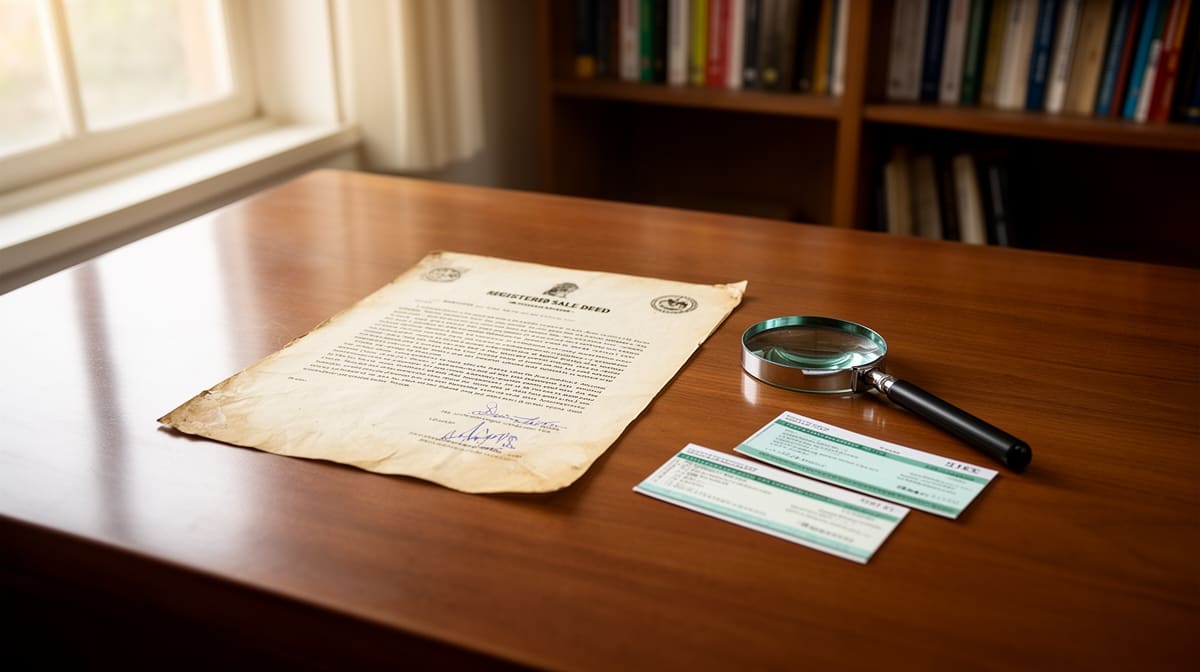
The Income Tax Appellate Tribunal, Delhi, has delivered a significant ruling clarifying the limits of evidentiary reliance on unsigned, unwitnessed agreements to sell recovered during search proceedings. This judgment reinforces that mere possession of a document by a third party, without authentication by all parties or corroboration, cannot sustain additions of unaccounted cash income under search assessments.
Background & Facts
The Dispute
The appellants, Amit Jain and Nidhi Jain, jointly purchased a commercial property in Greater Noida for Rs. 79,78,030. In 2020, a search was conducted at the premises of the buyers, Pranjil Batra and Poonam Batra, during which an unsigned agreement to sell dated 17.07.2018 was recovered. This document purportedly showed a sale consideration of Rs. 1,92,00,000, with Rs. 1,15,00,000 received in cash. The Assessing Officer, relying on this document, made an addition of Rs. 58,50,000 in the hands of each appellant as unexplained short-term capital gain under Section 153C of the Income-tax Act, 1961.
Procedural History
The case progressed through the following stages:
- 2022: Assessing Officer issued assessment order under Section 153C, adding Rs. 58,50,000 per appellant on the basis of the agreement to sell.
- 2023: First Appellate Authority (CIT(A)) upheld the addition, finding the agreement to be a reliable document despite lack of signatures from buyers.
- 2026: Appeals filed before the Income Tax Appellate Tribunal (ITAT), Delhi.
Relief Sought
The appellants sought deletion of the addition and the penalty levied under Section 270A, arguing that the agreement to sell was inadmissible as evidence due to absence of signatures from purchasers, lack of witnesses, and material inconsistencies with the registered sale deed.
The Legal Issue
The central question was whether an unsigned, unwitnessed agreement to sell, recovered during a search of the buyer and not executed by both parties, can constitute sufficient evidence to infer receipt of unaccounted cash income under Section 153C.
Arguments Presented
For the Petitioner
The appellants contended that the agreement to sell was a "dumb document" - lacking signatures of the buyers, witnesses, or drafting details. They emphasized that the cheques referenced in the agreement (dated 01.07.2018 and 05.07.2018) predated the agreement itself, raising questions about its authenticity. Further, the sale deed registered on 25.09.2018 showed a lower consideration of Rs. 75,00,000 and did not reflect any cash component. The appellants relied on CIT v. Smt. Sushma Gupta to argue that uncorroborated documents recovered during search cannot be the sole basis for income addition.
For the Respondent
The Revenue argued that the agreement, though unsigned by buyers, was found in their possession and contained detailed transactional information matching the sale deed. It was contended that the sellers’ signatures on the agreement constituted an admission of receipt of cash consideration. The Revenue relied on CIT v. Ramesh Kumar to assert that documents recovered during search are presumed authentic unless disproved by the assessee.
The Court's Analysis
The Tribunal undertook a meticulous review of the agreement’s formal defects and its inconsistency with the registered sale deed. It noted that the agreement to sell, despite being on stamp paper, bore no signatures from the purchasers, no witness attestations, and no indication of who drafted it. Crucially, the cheques cited in the agreement as received on 01.07.2018 and 05.07.2018 were issued before the agreement’s date of 17.07.2018, rendering the chronology implausible.
"The agreement is not a document executed by both the parties. An admission to be conclusive must be established to be unambiguous and unconditional."
The Tribunal further observed that the sale deed, which was registered and legally enforceable, disclosed only bank-based payments totaling Rs. 75,00,000. The discrepancy in cheque numbers - where the agreement cited cheque No. 419828 dated 01.07.2018, but the sale deed referenced a cheque dated 05.07.2018 for the same amount - undermined the reliability of the agreement. Additionally, the property was a leasehold, and the transfer permission from the Greater Noida Industrial Development Authority was granted only on 25.09.2018, meaning the appellants could not have legally entered into a binding agreement on 17.07.2018.
The Tribunal rejected the Revenue’s reliance on mere possession of the document during search, holding that possession alone does not equate to authenticity. It emphasized that Section 153C permits assessment based on seized material, but such material must still meet the threshold of admissibility under the Indian Evidence Act. The absence of corroboration, combined with patent inconsistencies, rendered the agreement inadmissible as conclusive proof of cash receipt.
The Verdict
The appellants succeeded. The Tribunal held that the agreement to sell lacked the essential attributes of a valid, enforceable document and could not support an addition of unaccounted cash income. The addition of Rs. 58,50,000 and the penalty under Section 270A were deleted.
What This Means For Similar Cases
Unsigned Search-Recovered Documents Are Not Conclusive Evidence
- Practitioners must challenge additions based solely on unsigned agreements recovered during search proceedings.
- The burden shifts to the Revenue to prove authenticity through independent corroboration, not mere possession.
- Courts will not accept documents lacking signatures, witnesses, or chronological consistency as proof of income.
Registration and Legal Capacity Trump Informal Agreements
- Registered sale deeds carry superior evidentiary weight over unregistered agreements.
- If the seller lacked legal authority to transfer at the time of the alleged agreement (e.g., pending government approval), the agreement is void ab initio.
- Assessing Officers must verify statutory compliance before relying on transactional documents.
Chronological Inconsistencies Invalidate Assumptions
- Cheques dated before the agreement’s execution cannot be treated as consideration for that agreement.
- Any addition based on such inconsistencies must be set aside unless the Revenue provides a plausible explanation.
- Tax professionals should scrutinize transaction timelines in search assessments for anomalies.