The Bombay High Court has quashed a Special Court order granting bail to former Assistant Police Inspector Sachin Waze in the Antilia bomb scare and Mansukh Hiran murder case, holding that the statutory embargo under Section 43D(5) of the Unlawful Activities (Prevention) Act, 1967 operates with full force when the prosecution material discloses reasonable grounds to believe the accusation is prima facie true. The Division Bench found the Special Judge's reasoning "bizarre" and "perverse," rejecting arguments that prolonged incarceration or parity with co-accused could override the UAPA's restrictive bail regime.
Background & Facts
The Dispute
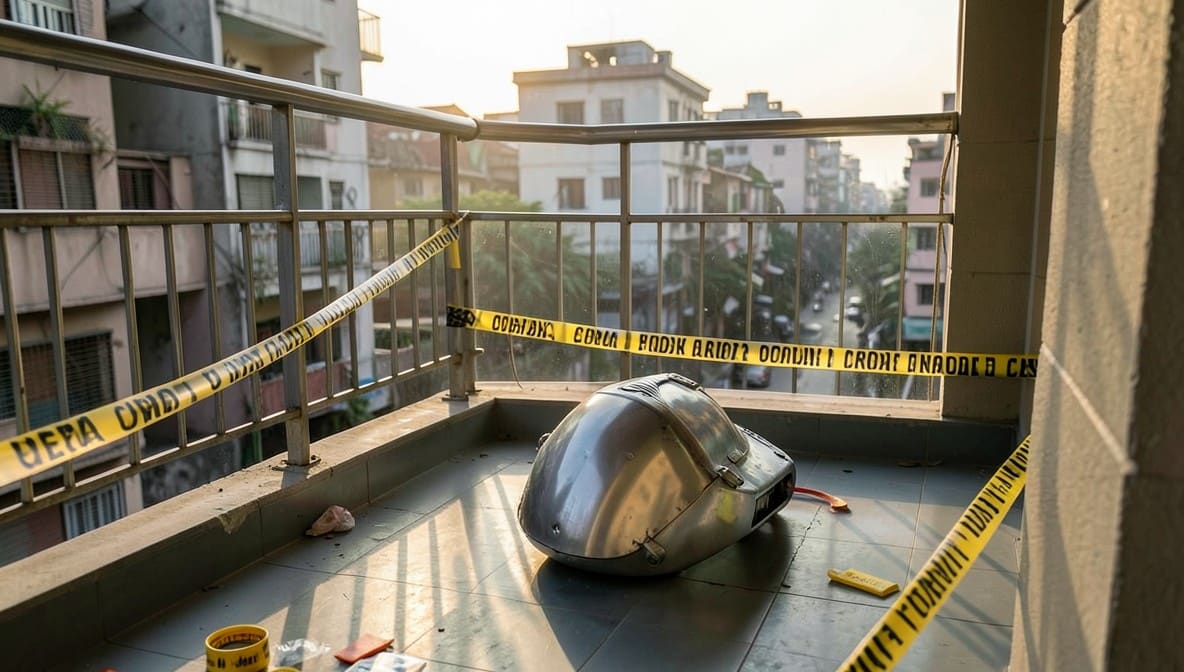
The National Investigation Agency (NIA) appealed against an order dated 29 September 2026 passed by the Special Judge, NIA Court, Mumbai, in Special Case No. 1090 of 2021, granting bail to Respondent No. 2, Sachin Hindurao Waze (Accused No. 1). Accused No. 1, a former Assistant Police Inspector in the Crime Intelligence Unit (CIU), Crime Branch, Mumbai, stands charged with offences under Sections 120-B, 201, 302, 364 and 403 of the Indian Penal Code, 1860, Section 25 of the Arms Act, 1959, and Sections 16, 18 and 20 of the UAPA. The case arises from three interlinked First Information Reports concerning the placement of an explosive-laden Scorpio vehicle near the Ambani family residence "Antilia" on 25 February 2021, the staged theft of that vehicle, and the subsequent murder of its owner, Mansukh Hiran.
Key Facts
- 25 February 2021: A Mahindra Scorpio (registration MH-01-DK-9945, later found to be fake) containing 20 gelatin sticks and a threat note addressed to the Ambani family was found parked on Carmichael Road, Mumbai, near "Antilia". The threat note warned of a future attack with "fully connected" material.
- 18 February 2021: FIR No. 47/2021 registered at Vikhroli Police Station by Mansukh Hiran reporting theft of his Scorpio (actual registration MH-02-AY-2815). Investigation revealed Accused No. 1 directed Hiran to file this false theft report.
- 4-5 March 2021: Mansukh Hiran went missing on 4 March after leaving to meet a police officer named Tawde; his body was found in Retibunder Creek on 5 March. ADR No. 39/2021 registered at Mumbra Police Station, later converted to FIR No. 12/2021 under Sections 302, 201, 34, 120-B IPC.
- 6 March 2021: Maharashtra Government transferred all three cases to the Anti-Terrorism Squad (ATS).
- 7 March 2021: ATS re-registered ADR as FIR No. 12/2021 for murder of Mansukh Hiran.
- 8, 20, 21 March 2021: Ministry of Home Affairs directed NIA to take over investigation. Cases re-registered as NIA RC 01/2021/NIA/MUM.
- 13 March 2021: NIA arrested Accused No. 1, Sachin Waze.
- 3 September 2021: First chargesheet filed; cognizance taken on 7 September 2021.
- 22 October 2021: Default bail application under Section 167(2) CrPC rejected.
- 18 April 2023: Regular bail application filed; rejected on 16 September 2023 by Special Judge, who found prima facie material connecting Accused No. 1 to the offences, including witness statements under Section 164 CrPC, confession of Accused No. 9 (Manish Soni), and evidence of number plate substitution and vehicle parking near Antilia.
- 24 March 2024: Writ Petition No. 2485/2024 (habeas corpus) dismissed by High Court on 6 March 2026.
- 29 May 2026: Supplementary chargesheet filed.
- 15 July 2026: Discharge application rejected.
- 1 August 2026: Charges framed against Accused No. 1 and co-accused, including under Section 16(1)(a) UAPA (terrorist act resulting in death).
- 7 August 2026: Division Bench of Bombay High Court disposed of Criminal Appeal (St) No. 24687/2025 (challenging 16 September 2023 bail rejection) with liberty to file fresh bail application, noting investigation complete and chargesheet filed. Delay of 778 days in filing appeal not condoned; question of law kept open.
- 29 September 2026: Special Judge allowed fresh bail application (Exhibit 601), granting bail on conditions.
Procedural History
- 25.02.2021: Explosive-laden Scorpio discovered near Antilia; FIR No. 35/2021 registered at Gamdevi PS.
- 18.02.2021: FIR No. 47/2021 (theft of Scorpio) registered at Vikhroli PS.
- 04.03.2021: Mansukh Hiran goes missing.
- 05.03.2021: Hiran's body found; ADR No. 39/2021 registered at Mumbra PS.
- 06.03.2021: Cases transferred to ATS Maharashtra.
- 07.03.2021: ATS re-registers ADR as FIR No. 12/2021 (murder).
- 08.03.2021, 20.03.2021, 21.03.2021: MHA directs NIA takeover.
- 10.03.2021: ATS hands over case papers to NIA.
- 13.03.2021: Accused No. 1 arrested by NIA.
- 03.09.2021: First chargesheet filed.
- 07.09.2021: Cognizance taken.
- 22.10.2021: Default bail application rejected.
- 18.04.2023: Regular bail application filed.
- 16.09.2023: Regular bail application rejected by Special Judge.
- 2024: Writ Petition No. 2485/2024 filed.
- 06.03.2026: Writ petition dismissed.
- 29.05.2026: Supplementary chargesheet filed.
- 15.07.2026: Discharge application rejected.
- 01.08.2026: Charges framed under UAPA Sections 16, 18, 20 and IPC provisions.
- 07.08.2026: Division Bench disposes appeal against 2023 bail rejection, grants liberty for fresh bail application.
- 29.09.2026: Fresh bail application (Exhibit 601) allowed by Special Judge.
- 05.11.2026: Present appeal decided; bail order quashed.
Relief Sought
The NIA sought quashing of the impugned bail order dated 29 September 2026, cancellation of bail granted to Accused No. 1, and his remand to judicial custody pending trial.
The Legal Issue
The central questions were: (1) Whether the Special Judge erred in granting bail despite the statutory embargo under Section 43D(5) of the UAPA where the prosecution material, including the chargesheet and witness statements, disclosed reasonable grounds to believe the accusation against Accused No. 1 was prima facie true; (2) Whether the ingredients of a "terrorist act" under Section 15 of the UAPA were satisfied by the placement of an explosive-laden vehicle with a threat note near a prominent industrialist's residence, without proof of actual terror in the targeted family or a detonator in the explosives; (3) Whether the murder of Mansukh Hiran constituted an outcome of the terrorist act under Section 16(1)(a) UAPA or was an independent IPC offence; (4) Whether prolonged incarceration of approximately five years or parity with co-accused granted bail could override the UAPA's restrictive bail regime.
Arguments Presented
For the Appellant/NIA
Mr. Anil C. Singh, Additional Solicitor General, submitted that Accused No. 1 is the principal architect of a conspiracy involving three interlinked FIRs: the staged theft of the Scorpio, its use to plant explosives and a threat note near Antilia, and the murder of the vehicle owner to silence him. The Special Judge had himself framed charges under Section 16(1)(a) UAPA (terrorist act resulting in death) on 1 August 2026, which necessarily implied a finding of prima facie truth of the accusation. Under Section 43D(5) UAPA, once the court forms an opinion on perusal of the case diary or chargesheet that there are reasonable grounds to believe the accusation is prima facie true, bail must be refused - the court has no discretion. The satisfaction required is lighter than that for framing charges, as held in NIA v. Zahoor Ahmad Shah Watali. The prosecution material, taken as a whole, must prevail until rebutted; admissibility of documents cannot be questioned at the bail stage. The Special Judge's observation that the test for bail is on a "higher pedestal" than for framing charges is legally perverse - the Supreme Court in Watali held the opposite. Section 15 UAPA is attracted because the act was "likely to strike terror in the people or any section of the people"; a vehicle with explosives on a public road in a residential area satisfies this. The threat to "economic security" under Section 15(1)(a)(iiia) is not limited to counterfeit currency. Section 18 UAPA (conspiracy) independently attracts the bail bar. The confession of Accused No. 9 (Manish Soni) recorded under Section 164 CrPC must be taken at face value at this stage. Prolonged incarceration does not automatically displace the statutory embargo (Gulfisha Fatima v. State). Parity is inapplicable as Accused No. 10 (Pradeep Sharma) had a qualitatively distinct, lesser role. Witness tampering risk is real given Accused No. 1's position as former CIU head and his alleged destruction of CCTV evidence.
For the Respondent/Accused No. 1
Mr. V. M. Thorat submitted that Accused No. 1 is entitled to bail on grounds of prolonged incarceration (over five years) with no prospect of early trial. The ingredients of Section 15 UAPA are not satisfied: the gelatin sticks lacked a detonator or fuse and were "useless"; no actual terror was caused to the Ambani family, whose statements were not recorded; the motive alleged (regaining "supercop" status and extortion) is not a terrorist motive. The murder of Mansukh Hiran, even if proven, is an independent IPC offence, not an outcome of a terrorist act. The UAPA provisions have been wrongly invoked. Reliance was placed on Syed Iftikhar Andrabi v. NIA where the Supreme Court granted bail despite UAPA charges after prolonged incarceration. The degree of satisfaction for "prima facie true" requires at least surface analysis of probative value (Vernon v. State of Maharashtra). Parity applies as co-accused (Pradeep Sharma, Accused Nos. 2-5) have been granted bail. Accused No. 1 has been on bail in other serious cases (Khwaja Yunus murder, extortion cases) without witness tampering. Delay in trial is not attributable to the accused.
The Court's Analysis
The Division Bench (G.S. Kulkarni & Dr. Neela Gokhale, JJ.) began by emphasizing the object of the UAPA: effective prevention of unlawful and terrorist activities. The Court extracted Sections 15, 16, 18, 20 and 43D(5) of the UAPA, noting that Accused No. 1 is charged under Chapter IV provisions attracting the Section 43D(5) embargo.
The Court expressed "profound concern" at the "casual manner" and "bizarre observations" in the impugned order, quoting passages where the Special Judge used language such as "cutting the crap," "happily abided," "repetitive recrimination at utmost tolerable extent," "hoteliers and bar owners are often hard nuts to crack," and "still my withers remain unwrung." The Special Judge's observation that he would have "outrightly turned down the applicant's prayer" but for the High Court's 7 August 2026 order revealed a "very odd approach."
On the Section 43D(5) standard, the Court reviewed the binding precedents: NIA v. Zahoor Ahmad Shah Watali ("Watali"), Vernon v. State of Maharashtra, Gurwinder Singh v. State of Punjab, Union of India v. Barakathullah, Gulfisha Fatima v. State, and Syed Iftikhar Andrabi v. NIA. From Watali, the Court reiterated eight guiding propositions: (i) "prima facie true" means materials must show complicity on their face, prevailing until rebutted; (ii) once charges are framed, a very strong suspicion is founded, making it arduous for the accused to displace the prima facie case; (iii) the court records a finding on broad probabilities, not proof beyond doubt; (iv) no detailed evaluation of evidence is required; (v) the embargo applies from FIR registration until trial conclusion; (vi) material must be analysed as a whole, not piecemeal; (vii) contents of documents are presumed true; (viii) admissibility cannot be questioned at bail stage.
From Barakathullah, the Court underscored that Section 18 UAPA does not require proof of a completed terrorist act under Section 15 - conspiracy or preparatory acts suffice. The High Court in Barakathullah committed "gross error" by requiring Section 15 to be made out for Section 18.
From Gulfisha Fatima, the Court noted the structured inquiry: (i) whether prosecution material discloses statutory ingredients; (ii) whether the accused's role reflects a real nexus to the unlawful activity, distinguishing conspiratorial centrality from peripheral association; (iii) whether the statutory threshold is crossed qua the individual accused.
From Syed Iftikhar Andrabi, the Court highlighted the binding authority of the three-Judge Bench in K.A. Najeeb: Section 43D(5) does not oust constitutional courts' power to grant bail where prolonged incarceration and delayed trial violate Article 21; the "rigours" of Section 43D(5) "melt down" in such circumstances. However, Andrabi clarified that Najeeb does not create a mechanical entitlement to bail based on mere passage of time. The two-Judge Bench in Andrabi expressed reservations on Gurwinder Singh and Gulfisha Fatima for departing from Najeeb, but acknowledged judicial discipline binds them to Najeeb.
From Tasleem Ahmed, the Court noted the Supreme Court's referral to a larger Bench to settle the correct approach where Article 21, prolonged incarceration, and statutory restrictions intersect.
Applying these principles, the Court held that the Special Judge failed to apply any settled legal parameters. The earlier bail rejection (16 September 2023) had recorded reasonable grounds for prima facie truth. The Special Judge was duty-bound to consider those grounds (Prasad Shrikant Purohit v. State of Maharashtra). The prosecution material - including statements of Key Witnesses KW-1, KW-13, KW-14, Meet Hiran, Vimla Hiran, Vinod Hiran, Advocate Kalpanath Giri, Sameer Gawkar, Yuvraj Shelar, Umang Lodhaya, and Prakash Howal - overwhelmingly established Accused No. 1's complicity: directing number plate substitution, parking the Scorpio near Antilia, using a fake Aadhaar to book a hotel room, destroying CCTV evidence by dumping DVRs in Mithi River, pressuring Mansukh Hiran to claim responsibility, and orchestrating his murder upon refusal. Accused No. 1's criminal antecedents (CR No. 272/2004, CR No. 34/2017), his clout as CIU head, access to influential persons, and history of extortion demonstrated a real risk of witness tampering.
The Court rejected the Special Judge's finding that the test for bail is on a "higher pedestal" than for framing charges, calling it "absolute legal perversity" contrary to Watali (para 23: satisfaction for prima facie truth is "lighter than the degree of satisfaction to be recorded for considering a discharge application or framing of charges"). The Special Judge's misreading of the 7 August 2026 High Court order as a "carte blanche to avoid looking at any material" was "egregiously flawed."
On Section 15 UAPA, the Court held the act of parking a vehicle with 20 gelatin sticks and a threat note from "Jaish-ul-Hind" on a busy public road near a prominent industrialist's residence was "likely to strike terror in the people or any section of the people". The phrase "people or any section of the people" is not limited to large groups based on sect, religion, or ideology. The threat to "economic security" under Section 15(1)(a)(iiia) is not confined to counterfeit currency; Section 2(1)(ea) defines economic security broadly. The absence of a detonator does not negate the offence - Section 15(1)(a) covers "explosive substances" used "to cause or likely to cause" death or injury; gelatin sticks are explosives under the Explosive Substances Act.
On the murder of Mansukh Hiran, the Court held it cannot be severed from the terrorist act. The Special Judge himself framed charges under Section 16(1)(a) (terrorist act resulting in death). A murder committed to protect the conspiracy by eliminating a "weak link" is part of the same terrorist design. Sections 16(1)(b), 18, and 20 UAPA and Section 364 IPC all carry life imprisonment; five years' incarceration does not answer the Section 43D(5) inquiry.
On prolonged incarceration, the Court applied Kalyan Chandra Sarkar v. Rajesh Ranjan: mere period of custody and prospect of long trial do not entitle an accused to bail when the offence is severe. State of Karnataka v. Sri Darshan reiterated that charge-sheet filing, long witness lists, or trial delay cannot outweigh gravity of offence, incriminating material, or witness tampering risk. The trial is set to commence; the appropriate response is prioritization and expedition, not bail in disregard of the statutory mandate.
The Court concluded that the prosecution material "overwhelmingly demonstrates" reasonable grounds to believe the accusation is prima facie true. The statutory embargo under Section 43D(5) operates with full force. Accused No. 1's position, clout, affluence, and antecedents make witness tampering a real apprehension. Granting bail would be against larger public interest and the rule of law, invoking Prakash Kadam v. Ramprasad Vishwanath Gupta: "the protectors have become the predators."
The Verdict
The Division Bench allowed the NIA's appeal and quashed and set aside the impugned bail order dated 29 September 2026. Accused No. 1, Sachin Hindurao Waze, shall stand remanded to judicial custody. The Court directed that the trial be prioritized and expedited. Interim Application No. 3559 of 2026 (not pressed) was disposed of. No costs were awarded.
What This Means For Similar Cases
Section 43D(5) UAPA Embargo Is Not Displaced by Prolonged Incarceration Alone
- The statutory bar under Section 43D(5) operates with full force once the court finds reasonable grounds to believe the accusation is prima facie true, based on the chargesheet and case diary taken at face value.
- Prolonged incarceration (here, ~5 years) does not automatically override the embargo, especially when the offence carries life imprisonment and the accused's role is central.
- K.A. Najeeb (three-Judge Bench) remains binding: constitutional courts retain power to grant bail where delay and incarceration violate Article 21, but this is a contextual, not mechanical, inquiry. The "rigours melt down" only when trial is unlikely to conclude within a reasonable time and incarceration exceeds a substantial part of the prescribed sentence.
- Practitioners must argue both the statutory threshold (prima facie truth) and the constitutional limitation (Article 21) as distinct, sequential inquiries.
Terrorist Act Under Section 15 UAPA Does Not Require Actual Terror or Detonator
- "Likely to strike terror in the people or any section of the people" is satisfied by the nature of the act itself - a vehicle with explosives and a threat note on a public road in a residential area.
- The targeted "section of the people" need not be a large group defined by sect, religion, or ideology; a named prominent family in a public space suffices.
- "Economic security" under Section 15(1)(a)(iiia) is not limited to counterfeit currency; Section 2(1)(ea) defines it broadly to include financial, monetary, and fiscal stability.
- Explosive substances under Section 15(1)(a) include gelatin sticks even without a detonator or fuse; the standard is "to cause or likely to cause" death or injury.
- Section 18 UAPA (conspiracy/preparatory acts) independently attracts the Section 43D(5) bar; actual commission of a Section 15 terrorist act is not a prerequisite (Barakathullah).
Murder to Silence a Witness Is Part of the Terrorist Act, Not an Independent Offence
- When charges are framed under Section 16(1)(a) (terrorist act resulting in death), the murder of a co-conspirator to prevent exposure is an outcome of the terrorist act, not a standalone IPC offence.
- The Special Judge cannot sever the conspiracy into two parts after framing charges under Section 16(1)(a).
- Parity with co-accused granted bail is inapplicable where the accused is the "principal architect" with a "qualitatively distinct and graver role" (Rajendra Prasad v. State of Goa; Gulfisha Fatima).
Judicial Discipline Requires Adherence to Higher Bench Precedents
- Two-Judge Benches are bound by three-Judge Bench decisions (K.A. Najeeb). Departures must be referred to a larger Bench, not circumvented.
- The Watali principles (eight propositions) remain the governing framework for Section 43D(5) bail inquiries: material analysed as a whole, documents presumed true, no mini-trial on admissibility, finding on broad probabilities.
- A Special Judge's observation that the bail test is "higher" than the charge-framing test is perverse and will be corrected on appeal.
Witness Tampering Risk Is Real for Accused with Institutional Clout
- Accused's position as former head of the investigating unit (CIU), access to police machinery, proximity to political leadership, and history of evidence destruction (dumping DVRs in Mithi River) create a concrete, not hypothetical, risk of witness influence.
- Conditions restricting movement (e.g., barring from five districts) acknowledge the risk but cannot override the Section 43D(5) embargo.
- The "protectors becoming predators" principle (Prakash Kadam) applies with full force to police officers accused of using their office to commit terror crimes.