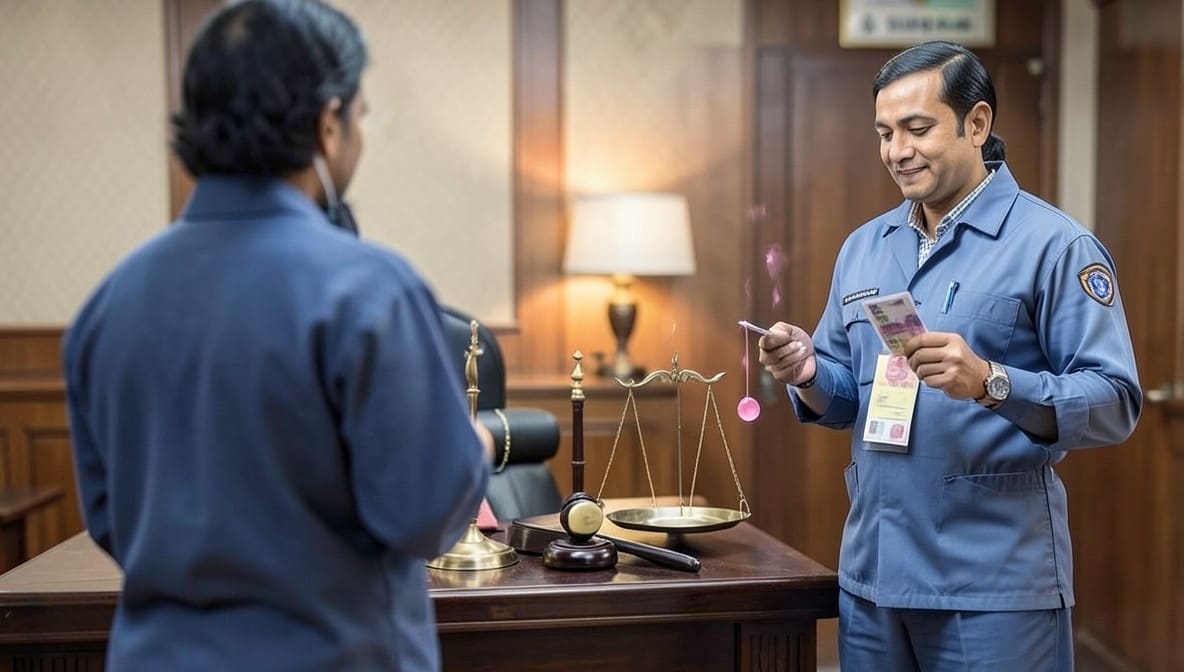
The Allahabad High Court recently dismissed a criminal appeal, affirming the conviction of a Lekhpal under Section 161 of the Indian Penal Code (IPC) and Section 5(2) of the Prevention of Corruption Act, 1947. The judgment underscores the sufficiency of trap evidence, recovery of bribe money, and corroborative testimony in establishing guilt beyond reasonable doubt, even in the absence of the complainant’s direct testimony due to medical incapacity.
Background & Facts
The Dispute
The appellant, Mahesh Chand, a Lekhpal in the Consolidation Department at Tehsil-Derapur, Kanpur, was accused of demanding and accepting a bribe of Rs. 300 from Virendra Singh, a litigant involved in a consolidation dispute. The dispute pertained to the allotment of Chak No. 193 to Virendra Singh and Chak No. 7 to Smt. Asha Devi during consolidation proceedings. The appeal against the allotment was pending before the Settlement Officer (Consolidation) (SOC), Mr. Sirohi, with hearings scheduled on 31.03.1977 and 05.04.1977.
Key Facts
- 01.04.1977: Virendra Singh boarded a bus to Kanpur to attend the hearing, accompanied by the appellant (Mahesh Chand) and Kanoongo Chandra Sen. During the journey, both accused demanded Rs. 400 as illegal gratification, promising to dismiss Smt. Asha Devi’s appeal.
- Virendra Singh disembarked at Chunniganj Bus Stand and paid Rs. 50 (one Rs. 50 note and five Rs. 10 notes) to Chandra Sen.
- He then proceeded to his son Jai Vijai Singh’s office at Maal Road, Kanpur, where he was advised to report the matter to the Vigilance Department.
- Jai Vijai Singh drafted a complaint (Ext. Ka.1) and submitted it to Mr. D.K. Panda, Superintendent of Police (SP), Vigilance, Kanpur, along with three Rs. 100 notes for the trap.
- 01.04.1977: SP Vigilance ordered Inspector R.B. Tiwari to lay a trap. The currency notes were treated with phenolphthalein powder, and their serial numbers were recorded.
- Virendra Singh, accompanied by Constable Gaya Prasad, met the appellant and Chandra Sen at the SOC office. Chandra Sen directed Virendra Singh to pay the money to Mahesh Chand.
- The parties proceeded to Chaurasiya Hotel, where Virendra Singh handed over the three Rs. 100 notes to Mahesh Chand, who pocketed them. The trap team, including public witnesses Shyamlal and Onkar Singh, apprehended Mahesh Chand and recovered the notes.
- Mahesh Chand’s hands and pant pocket were washed with sodium carbonate solution, which turned pink, confirming the presence of phenolphthalein powder. The recovery memo (Ext. Ka.3) was prepared, and samples were sealed in bottles (Ext. 5 and 6).
Procedural History
- 16.06.1979: SP Vigilance sought sanction from the District Magistrate to prosecute Chandra Sen.
- 19.06.1979: Sanction (Ext. Ka-4) was granted under Section 6(1)(c) of the Prevention of Corruption Act.
- Post-investigation: Charge-sheet (Ext. Ka.6) was filed against both accused before the competent court.
- Trial Proceedings:
- The trial court framed charges under Section 161 IPC and Section 5(2) of the Prevention of Corruption Act.
- The prosecution examined six witnesses, including Inspector Ram Bahadur Tiwari (PW1), Constable Gaya Prasad (PW2), Public Witness Mewa Lal (PW3), Jai Vijai Singh (PW4), Retired Inspector Basdeo Sahai (PW5), and Sub-Inspector Rajbeer Singh (PW6).
- The appellant denied the charges, alleging false implication at the behest of Jai Vijai Singh to prevent the SOC’s judgment from being reduced to writing.
- 09.10.1985: The trial court convicted Mahesh Chand under Section 161 IPC and Section 5(2) of the Prevention of Corruption Act, sentencing him to rigorous imprisonment for one year on both counts, to run concurrently. Chandra Sen was acquitted.
- Post-conviction: The appellant filed Criminal Appeal No. 2870 of 1985 before the Allahabad High Court.
Relief Sought
The appellant sought acquittal, arguing:
- Material contradictions in prosecution witnesses’ statements.
- Non-examination of Virendra Singh, the complainant.
- Improbability of accepting bribes in a public place like Chaurasiya Hotel.
- Absence of independent public witnesses.
- Alleged false implication due to a Vigilance Department drive against bribery.
The Legal Issue
The central question was whether the prosecution had established guilt beyond reasonable doubt under Section 161 IPC and Section 5(2) of the Prevention of Corruption Act, given:
- The reliance on trap evidence and phenolphthalein test.
- The absence of the complainant’s (Virendra Singh) testimony.
- The appellant’s claim of false implication and procedural irregularities.
Arguments Presented
For the Appellant
- Contradictions in Evidence: The prosecution witnesses’ statements contained material contradictions, casting doubt on the case.
- Non-Examination of Complainant: Virendra Singh, the alleged bribe-giver, was not examined, weakening the prosecution’s case.
- Public Place for Bribe: It was improbable that the appellant would demand/accept a bribe in a public place like Chaurasiya Hotel.
- Lack of Independent Witnesses: No independent public witnesses were examined to corroborate the trap proceedings.
- False Implication: The appellant was falsely implicated due to a Vigilance Department drive against bribery, orchestrated by Jai Vijai Singh to confiscate the SOC’s judgment record.
For the Respondent (State)
- Consistent Testimony: The prosecution witnesses’ statements were consistent, reliable, and trustworthy.
- No Motive to Falsely Implicate: There was no reason for public servants (e.g., Inspector Tiwari) to falsely depose against the appellant.
- Trap Evidence: The appellant was caught red-handed accepting the bribe, as evidenced by the phenolphthalein test and recovery of currency notes.
- Public Witnesses: Two public witnesses (Mewa Lal and Onkar Singh) corroborated the recovery.
- No Evidence of Drive: There was no evidence of a Vigilance Department drive or collusion to falsely implicate the appellant.
The Court's Analysis
The High Court meticulously examined the evidence and legal submissions, addressing each of the appellant’s contentions:
-
Sufficiency of Trap Evidence:
- The court relied on the testimony of PW1 (Inspector Tiwari), who led the trap team, and PW2 (Constable Gaya Prasad), who accompanied Virendra Singh. Both witnesses deposed that the appellant accepted Rs. 300 from Virendra Singh at Chaurasiya Hotel.
- The phenolphthalein test confirmed the presence of the treated currency notes on the appellant’s hands and pant pocket, turning the solution pink. This scientific evidence corroborated the recovery.
-
"The serial numbers of the recovered notes were matched with the fard baramadagi, which was also got down having small initials. Mahesh Chand’s hands were washed from sodium carbonate solution, as a result the solution turned red in colour."
-
Absence of Complainant’s Testimony:
- The appellant argued that Virendra Singh’s non-examination weakened the case. However, the court noted that PW4 (Jai Vijai Singh) testified that his father’s mental condition was unstable and he was undergoing treatment in Gwalior.
- The court held that even if Virendra Singh’s testimony was deliberately withheld, it did not adversely affect the prosecution’s case, as the recovery was witnessed by PW4, the trap team, and public witnesses.
-
"Even, if for the sake of argument, it is accepted that Virendra Singh was deliberately withheld by the prosecution to depose before the court then it has no adverse effect over the prosecution case because the alleged taking of illegal gratification has taken place not only before Jai Vijai Singh... but also before the Inspector of Vigilance Department... and also before the public witness."
-
Existence of the Dispute:
- The appellant contended that there was no evidence of a pending dispute between Virendra Singh and Smt. Asha Devi. The court rejected this, noting that the appellant himself admitted in his written statement under Section 313 CrPC that the dispute existed and was pending before the SOC.
-
"The appellant Virendra Singh in his written statement before the court... has admitted that the dispute between Virendra Singh and Smt. Asha Devi was pending before SOC with regard to chak No.193 and Chak No.7."
-
Public Witnesses:
- The appellant argued that no independent public witnesses were examined. The court dismissed this, observing that two public witnesses (PW3 Mewa Lal and Onkar Singh) testified to the recovery, alongside the trap team.
-
"There are two public witness of the alleged recovery, beside Jai Vijai Singh and his father Virendra Singh, so if no other person, present at Chaurasiya Hotel was made a witness, then it would have no adverse effect over the prosecution case."
-
Improbability of Public Place:
- The appellant claimed it was improbable to demand/accept a bribe in a public place. The court rejected this, noting that traps are often laid in secrecy, and the appellant admitted to being present at Chaurasiya Hotel with Virendra Singh.
-
"Such kind of trap are laid in secrecy and the information is kept secret between the members of raiding party and the place is arranged in such a manner that the accused would not have any apprehension of his being caught red handed."
-
False Implication:
- The appellant alleged false implication due to a Vigilance Department drive. The court found no evidence to support this claim, emphasizing the lack of motive for the trap team and public witnesses to collude against the appellant.
-
"There is no evidence that any such drive was going on in Vigilance Department and there is also no reason why the Superintendent of Police, Vigilance Department, the Inspector and other police personnel of the raiding party as well as public witness would all be pressurized by Jai Vijay Singh and they would collude with him to falsely implicate the appellant."
-
Appellant’s Admissions:
- The court highlighted the appellant’s admissions, including his presence at Chaurasiya Hotel with Virendra Singh and the preparation of the fard baramadagi (recovery memo).
- The appellant’s claim that Jai Vijai Singh conspired to falsely implicate him to confiscate the SOC’s judgment record was deemed unconvincing, as there was no evidence that the judgment was ever dictated or confiscated.
The Verdict
The Allahabad High Court dismissed the appeal, upholding the trial court’s judgment. The court affirmed:
- The appellant’s conviction under Section 161 IPC and Section 5(2) of the Prevention of Corruption Act.
- The sentence of rigorous imprisonment for one year on both counts, to run concurrently.
- The appellant, who was on bail, was directed to surrender before the trial court within four weeks to serve the remaining sentence. Failure to comply would result in coercive measures to secure his presence.
- A copy of the order was directed to be forwarded to the trial court for compliance.
What This Means For Similar Cases
Trap Evidence and Corroboration Suffice for Conviction
- Courts may rely on trap evidence, phenolphthalein tests, and corroborative testimony to establish guilt under Section 161 IPC, even if the complainant is not examined due to incapacity.
- The absence of the complainant’s direct testimony does not fatalize the prosecution’s case if the recovery is witnessed by independent witnesses and police personnel.
Public Servants Held to Higher Standards
- Public servants, including Lekhpals and Kanoongos, are held to stringent standards under the Prevention of Corruption Act. Demanding or accepting bribes, even in public places, can lead to conviction if trap evidence is robust.
- The court rejected the argument that a public place negates the possibility of bribery, emphasizing that traps are designed to avoid detection.
False Implication Claims Require Concrete Evidence
- Allegations of false implication must be substantiated with evidence. Mere claims of a Vigilance Department drive or conspiracy are insufficient without proof of collusion among witnesses.
- The court will scrutinize the accused’s admissions and inconsistencies in their defense to assess credibility.