The Delhi High Court has reaffirmed that prior legitimate use of a trade mark can override subsequent registration, even when the later user has built substantial goodwill in related product categories. In a significant ruling on trade mark conflicts, the Court denied interim relief to a water purifier manufacturer seeking to block a cable company from using the mark 'KENT' for fans, emphasizing that the latter’s continuous use since 2009 established superior rights.
Background & Facts
The Dispute
The dispute centers on competing claims to the trade mark 'KENT' for electrical appliances, particularly fans. The appellants, Kent RO Systems Limited and associated entities, have used the mark since 1988 for oil meters and later expanded into water purifiers, air purifiers, and kitchen appliances under the same mark. They registered 'KENT' in Class 7 and Class 11 for water purifiers and related devices. The respondents, Kent Cables Private Limited and Kent Fans and Electricals Private Limited, have used 'KENT' since 1984 for insulated wires, cables, and switches, registering the mark in Class 9 in 1986. They began selling fans under the 'KENT' mark around 2009.
Procedural History
- 1984: Respondents adopted 'KENT' for electrical cables and wires.
- 1986: Respondents obtained first registration of 'KENT' in Class 9.
- 1998: Respondents filed application for registration of 'KENT' in Class 11 for fans (proposed use).
- 1999: Appellants launched water purifiers under 'KENT' and registered mark in Class 7.
- 2007: Appellants opposed respondents’ Class 11 fan application.
- 2011: Appellants issued cease and desist notice to respondents regarding fan use.
- 2022: Appellants filed suit seeking injunction against respondents’ fan use; respondents filed counter-suit seeking injunction against appellants’ proposed fan launch.
- May 2023: Single Judge granted interim injunction restraining appellants from using 'KENT' for fans; dismissed appellants’ application.
- March 2026: Delhi High Court dismissed appellants’ appeal.
Relief Sought
The appellants sought an interim injunction to restrain respondents from using 'KENT' for fans, while respondents sought to restrain appellants from launching fans under the same mark. The Single Judge granted the latter relief, which the appellants now challenge.
The Legal Issue
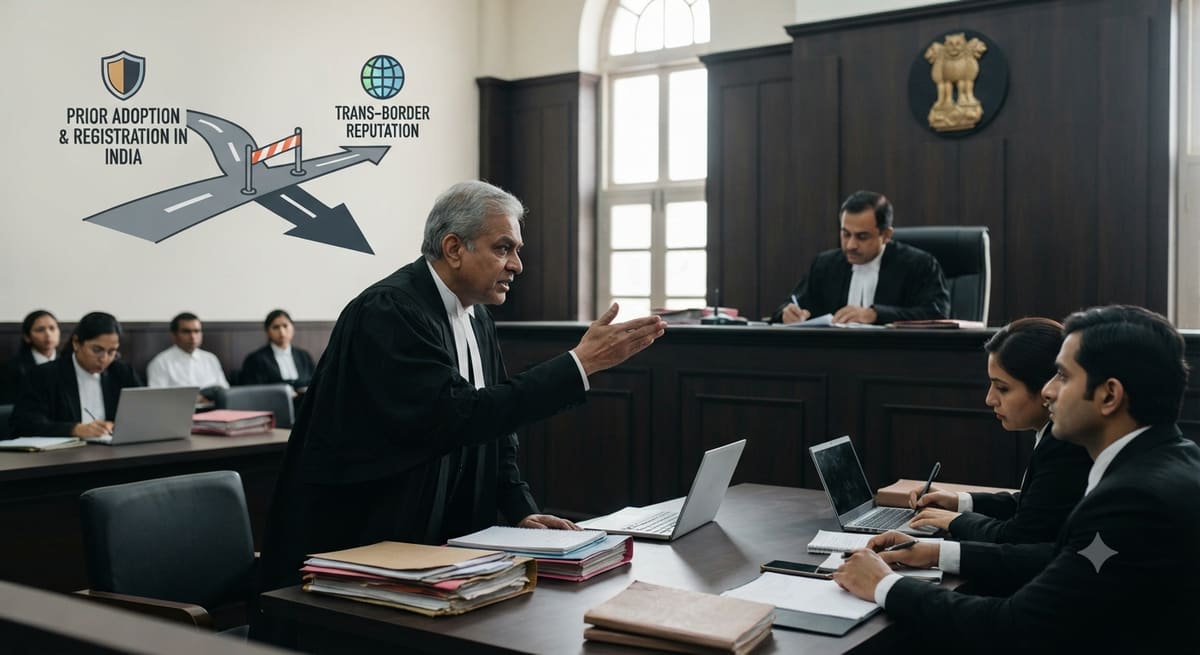
The central question was whether a prior user of a trade mark for one category of goods (electrical cables) can prevent a later registrant from using the same mark for a different but related product (fans), and whether delay in challenging such use constitutes acquiescence.
Arguments Presented
For the Appellant
The appellants argued that 'fans' are cognate goods to air purifiers and water purifiers under Class 11 of the Trade Marks Act, 1999, and that their extensive use and registration since 1999 established prior rights. They contended that respondents had no registration for fans and that their use was mala fide, evidenced by a 2009 name change from Goldage Plastic to Kent Fans. They cited Raman Kwatra v. KEI Industries to argue that Class 11 does not automatically make all goods cognate. They emphasized their well-known mark status and claimed respondents’ use caused confusion, citing Amazon reviews and e-commerce listings.
For the Respondent
The respondents asserted they were the first adopters of 'KENT' since 1984 and had continuously used it for electrical goods, including fans since 2009, supported by invoices, certifications, and government approvals. They argued that Class 11 registration is not determinative of similarity of goods, citing FDC Limited v. Docsuggest Healthcare Services. They relied on Section 34 of the Trade Marks Act to assert vested rights from prior use and claimed the appellants’ 11-year delay after issuing a cease and desist notice amounted to acquiescence. They cited Khoday Distilleries and Power Controls Appliances to argue that delay defeats equitable relief.
The Court's Analysis
The Court conducted a meticulous analysis of prior use, statutory provisions, and equitable principles. It held that while the appellants had substantial goodwill in 'KENT' for water purifiers and home appliances, they had never used the mark for fans prior to the respondents’ launch. The respondents, by contrast, had used 'KENT' for electrical products since 1984 and for fans since at least 2009, with documented evidence including vendor approvals, e-commerce invoices, and advertising records.
"The respondents are the proprietor of the mark, having adopted the same and using the same since 1984 with respect to goods like electric wires and cables... They have also, at least prima facie, been able to show the use of the said mark by them for fans since 2009."
The Court rejected the appellants’ argument that Class 11 registration automatically conferred rights over all goods in that class, citing FDC Limited and Nandhini Deluxe, and emphasized that similarity of goods must be determined by market perception, not classification. It noted that fans are a natural extension of the respondents’ core business in electrical components.
The Court found the appellants’ conduct constituted acquiescence. Despite opposing the respondents’ 1998 Class 11 application and issuing a cease and desist notice in 2011, the appellants took no legal action for over a decade. The Court held this inaction, coupled with the respondents’ established market presence, barred the appellants from seeking injunctive relief under the equitable doctrine of laches.
"By doing so, the appellants clearly acquiesced in the use of the mark by the respondents. It appears that the primary product of the appellants being water purifiers, they did not deem it necessary to seek protection of their mark against the respondents for use of the same for other products like electric wires and fans."
The Court also invoked Section 34 of the Trade Marks Act, which protects prior users from interference by later registrants. It concluded that the respondents’ prior use established a vested right that could not be extinguished by the appellants’ subsequent registration.
The Verdict
The appellants lost. The Delhi High Court upheld the Single Judge’s order, holding that the respondents’ prior and continuous use of 'KENT' for fans since 2009 established superior rights under Section 34 of the Trade Marks Act, 1999. The appellants’ delay and acquiescence barred them from obtaining an interim injunction, even though they held earlier registrations for related goods. The Court dismissed the appeal with no order as to costs.
What This Means For Similar Cases
Prior Use Trumps Registration
- Practitioners must prioritize documenting and proving continuous use over relying solely on registration dates.
- A registrant cannot claim exclusivity over a mark if another party has used it in good faith for similar goods prior to registration.
- Evidence of sales, certifications, advertising, and government approvals are critical to establish prior use.
Acquiescence Is a Powerful Defense
- Delay of more than five years after knowledge of infringement, especially after issuing a cease and desist notice, may constitute acquiescence.
- Filing oppositions or notices without initiating litigation may be interpreted as tacit acceptance of continued use.
- Courts will not grant equitable relief to parties who have slept on their rights.
Class Classification Is Not Determinative
- Goods in the same class (e.g., Class 11) are not automatically cognate; market perception and consumer confusion are decisive.
- Water purifiers and fans, though both in Class 11, are distinct in function, distribution, and consumer base.
- Legal arguments must focus on actual market overlap, not administrative classifications.