The Delhi High Court has clarified that a defendant cannot invoke Section 34 of the Trade Marks Act to defeat an injunction claim based on foreign use alone, and that international exhaustion under Section 30(3) is strictly limited to goods bearing marks registered in India. The judgment reverses a Single Judge’s order that had vacated an ad interim injunction, restoring critical protections for Indian trademark holders against unauthorized imports.
Background & Facts
The Dispute
The dispute centers on the use of the mark "STELLADEXIN" in India for commercial induction cookers. The appellant, M/s Products and Ideas India Pvt. Ltd., claimed exclusive rights to the mark through an Exclusive Agency Agreement (EAA) with Stella Industrial Co. Ltd. (SIC), a Chinese entity. The appellant registered the STELLADEXIN word mark in India on 5 February 2022 under Classes 7, 9, and 11 of the Nice Classification, and obtained a copyright registration for its logo on 12 July 2024. The appellant began selling induction cookers under this mark in India from at least 2017, with sales turnover reaching ₹16.27 crores in 2022-2023.
Respondents 1 and 2, Nilkamal Ltd and Cambro-Nilkamal Pvt. Ltd., began selling induction cookers under the mark "STELLA" in June 2024, which the appellant alleged was deceptively similar to its registered STELLADEXIN mark. Respondent 5, SIC, asserted that it was the original owner of the STELLA and STELLADEXIN marks and had been selling products in India since 2013 through M/s Mittal International.
Key Facts
- The EAA between SIC and the appellant was executed on 1 April 2017 and allegedly renewed until 31 March 2027.
- SIC claimed termination of the EAA on 13 November 2024.
- The appellant obtained registration of STELLADEXIN on 5 February 2022 under the Trade Marks Act, 1999.
- The appellant’s earliest invoice evidencing sales in India is dated 2017.
- SIC produced four invoices dated 25 December 2012, 23 September 2015, and two proforma invoices from 2014 and 2016 to establish prior use.
- None of the four invoices explicitly bore the mark "STELLA" or "STELLADEXIN".
- SIC’s application for registration of STELLA/ in Class 11 in India was abandoned.
- Respondent 2 claimed authorization from SIC to import and sell products under the STELLA mark, relying on letters dated 5 March 2024 and 5 June 2024.
- The appellant’s copyright registration for its logo was granted on 12 July 2024.
Procedural History
- 1 April 2017: Exclusive Agency Agreement executed between SIC and the appellant.
- 5 February 2022: Appellant registered STELLADEXIN under Classes 7, 9, and 11 of the Trade Marks Act.
- 12 July 2024: Appellant obtained copyright registration for its logo.
- June 2024: Appellant discovered Respondent 2’s use of the mark "STELLA".
- 27 August 2024: Single Judge granted ex parte ad interim injunction restraining respondents from using STELLA or STELLADEXIN.
- 1 July 2025: Single Judge dismissed appellant’s application under Order XXXIX Rules 1 and 2 CPC and allowed Respondent 2’s application under Order XXXIX Rule 4 CPC, vacating the injunction.
- 23 January 2026: Appeal heard and reserved.
- 23 March 2026: Judgment pronounced by Division Bench.
The Parties' Positions
Appellant: Argued that it was the lawful registered proprietor of STELLADEXIN in India, that Respondent 2’s use of "STELLA" was deceptively similar, and that SIC’s prior use in China did not confer rights in India. It relied on Section 29(2)(b) of the Act and submitted evidence of goodwill and sales.
Respondent 2 and SIC: Contended that SIC was the prior user of STELLA and STELLADEXIN in India since 2013, invoking Section 34. They also claimed protection under Section 30(3) and international exhaustion, arguing that Respondent 2 was merely importing and selling genuine goods from SIC.
Relief Sought
The appellant sought restoration of the ad interim injunction dated 27 August 2024 and continuation of the restraint against respondents’ use of STELLA or any confusingly similar mark pending final adjudication of the suit.
The Legal Issue
The central questions were: (1) Whether prior use under Section 34 of the Trade Marks Act can be established by foreign sales or proforma invoices without continuous, documented use in India prior to the plaintiff’s registration; (2) Whether Section 30(3) permits import and sale of goods bearing a foreign-registered trademark in India without the consent of the Indian registered proprietor; and (3) Whether an authorized reseller of a foreign trademark owner can be held liable for infringement of a mark registered in India by a third party.
Arguments Presented
For the Appellant
The appellant argued that Section 34 requires continuous use of the mark in India prior to both registration and use by the plaintiff. It contended that SIC’s invoices were insufficient: two were proforma, and two lacked any reference to the STELLA or STELLADEXIN marks. It relied on Karn Vir Mehta v. Collector of Customs to argue that proforma invoices cannot prove commercial transactions. It further submitted that Section 30(3) applies only when the goods bear a mark registered in India, and that SIC had no Indian registration. It cited Western Digital Technologies Inc. v. Geonix International to affirm that international exhaustion cannot override Indian registration rights.
For the Respondent
Respondents argued that SIC had been using the STELLA mark in India since 2013 through Mittal International, and that the four invoices constituted proof of prior continuous use under Section 34. They contended that Respondent 2 was merely an authorized importer of genuine goods and thus protected under Section 30(3) and the principle of international exhaustion. They relied on Kapil Wadhwa v. Samsung Electronics to assert that any person may import and sell genuine goods bearing a trademark, regardless of Indian registration.
The Court's Analysis
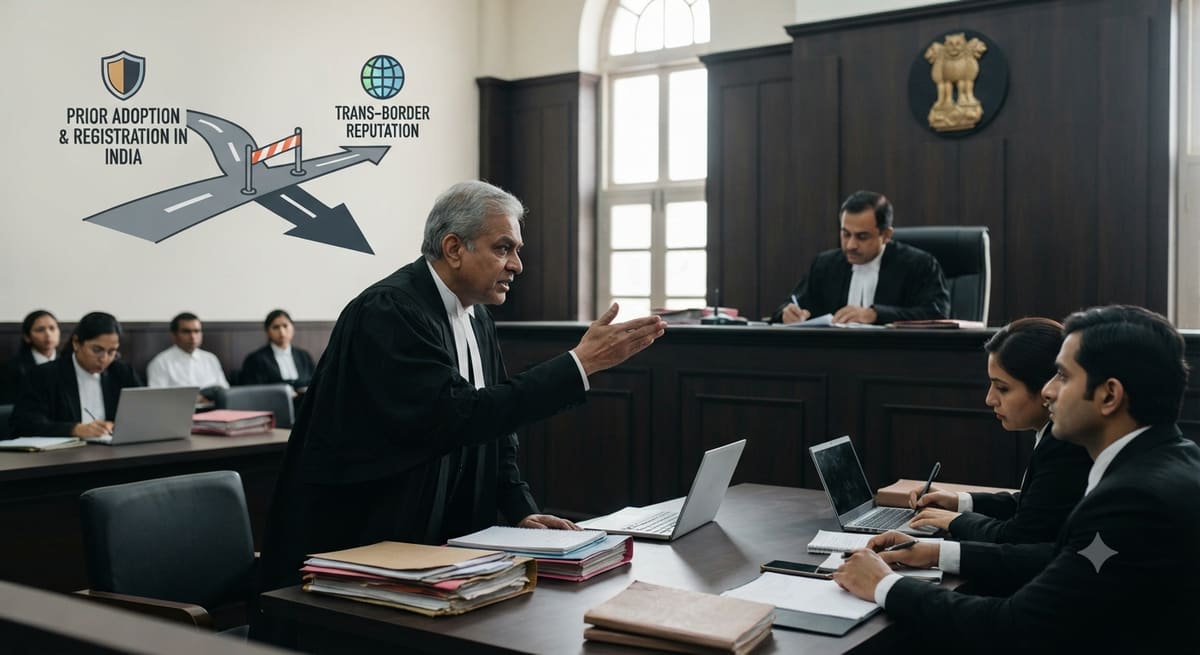
The Division Bench conducted a rigorous analysis of Sections 34 and 30(3) of the Trade Marks Act, 1999, and found the Single Judge’s reasoning legally flawed on all counts.
"On its plain words, Section 34 requires not mere prior user by the respondent, but prior continuous user, antedating both registration and user of the asserted mark by the plaintiff."
The Court held that SIC’s reliance on four invoices - two of which were proforma and two lacking any mark identification - was insufficient to establish continuous use in India. The Court emphasized that proforma invoices, as held in Karn Vir Mehta, are merely tentative and cannot substitute for evidence of actual sales. The absence of any invoice bearing the STELLA or STELLADEXIN mark before 2017 rendered the claim of prior use untenable.
"The words 'registered trade mark' cannot include registration outside India, as Section 2(w) defines 'registered trade mark' as meaning 'a trade mark which is actually on the register and remaining in force' and 'register' is defined, in Section 2(t), as meaning 'the Register of Trade Marks referred to in sub-section (1) of Section 6'."
The Court rejected the application of Section 30(3) on the ground that the provision applies only when goods bear a mark registered in India. SIC had no Indian registration. Respondent 2 imported goods bearing the appellant’s registered mark without consent, thereby constituting infringement under Section 29(6)(c). The Court explicitly overruled the Single Judge’s misreading of Kapil Wadhwa, noting that international exhaustion does not permit importation of goods bearing a mark registered by a third party in India.
The Court further held that even if SIC were not an infringer (which it was not), Respondent 2’s independent importation and sale of goods bearing the appellant’s registered mark constituted separate actionable infringement. The principle that "if the principal is not liable, the agent is not liable" does not apply in trademark law where the agent uses a mark registered to another.
The Verdict
The appeal was allowed. The Division Bench set aside the impugned order dated 1 July 2025 and restored the ad interim injunction dated 27 August 2024. The applications IA 37339/2024, IA 49076/2024, and IA 41504/2024 were remanded to the Single Judge for de novo consideration. The parties were directed to appear before the Single Judge on 2 April 2026, with no adjournments permitted. No costs were awarded.
What This Means For Similar Cases
Prior Use Must Be Documented and Continuous in India
- Practitioners must now demand concrete, dated invoices bearing the exact mark in dispute to establish prior use under Section 34.
- Proforma invoices, purchase orders, or foreign sales records are insufficient without corroborating evidence of actual market presence in India.
- The burden of proving continuous use since before the plaintiff’s first use or registration is on the defendant - and must be met with contemporaneous, verifiable records.
International Exhaustion Does Not Override Indian Registration
- Importers cannot rely on foreign registrations to justify sale of goods bearing Indian-registered trademarks.
- Consent of the Indian registered proprietor is mandatory for lawful import under Section 30(3).
- The Kapil Wadhwa principle applies only when the trademark is registered in India - not when it is registered abroad.
Authorized Resellers Are Not Immune from Infringement Claims
- An authorized distributor of a foreign brand is not shielded from liability if it imports goods bearing a mark registered in India by a third party.
- Each party’s use must be evaluated independently under Section 29; authorization by a foreign owner does not negate infringement of an Indian registration.
- Trademark litigation strategy must now account for the distinction between foreign ownership and Indian registration rights.