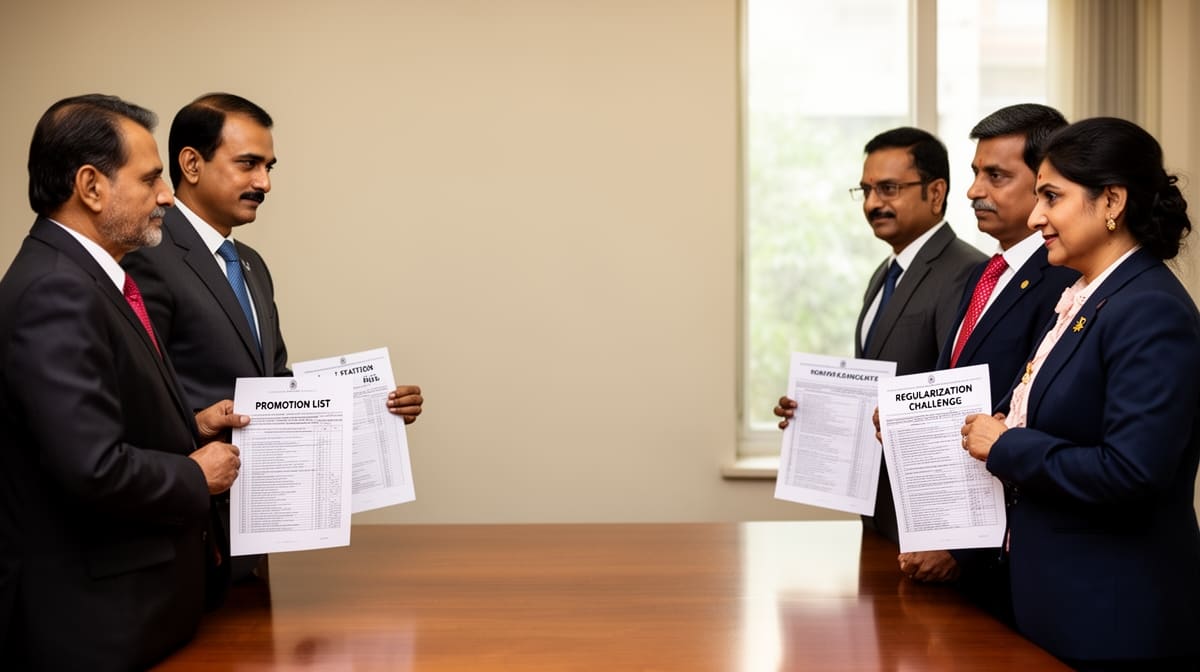
The High Court of Manipur has affirmed that competing groups of government employees with overlapping claims to promotion must be heard as parties in related proceedings. This judgment reinforces the principle that procedural fairness cannot be sacrificed when multiple sets of service beneficiaries are locked in a legal tussle over limited promotional opportunities.
Background & Facts
The Dispute
The dispute arises between two groups of Field Assistants (FAs) in the Agriculture Department of Manipur. One group, comprising 36 respondents (R-1 to R-36), was absorbed/regularized as FAs under an order dated 07.01.2022. A second group of 33 applicants, also FAs, challenged this regularization in W.P.(C) No. 619 of 2025, arguing that the absorption was illegal and that they, as long-serving diploma holders, were equally or more entitled to such benefits. Both groups now seek promotion to Assistant Agriculture Officer (AAO) posts, with only 41 vacancies available.
Procedural History
- January 2022: 36 FAs were regularized under ASRB-302/1/2022-Agri-AGRI order.
- 2025: The 33 applicants filed W.P.(C) No. 619 of 2025 challenging the regularization.
- 2025: The 36 regularized FAs filed W.P.(C) No. 808 of 2025 seeking promotion to AAO posts, mentioning the pendency of W.P.(C) No. 619 of 2025 in Paragraph 19.
- 09.02.2026: A Single Bench allowed W.P.(C) No. 808 of 2025, directing MPSC to consider the 36 FAs for promotion within two months, without impleading the 33 applicants.
- February 2026: The 33 applicants filed MC(WA) No. 7 of 2026 seeking leave to file a third-party writ appeal against the 09.02.2026 order.
Relief Sought
The applicants sought permission to file a writ appeal challenging the 09.02.2026 order, arguing that their rights to equal opportunity and procedural fairness were violated by their exclusion from proceedings that directly impacted their promotional prospects.
The Legal Issue
The central question was whether a group of employees, whose claims are directly antagonistic to those of parties in a pending writ petition, can be denied third-party standing to challenge an order that may render their own claims nugatory.
Arguments Presented
For the Appellant/Petitioner
The applicants argued that W.P.(C) No. 808 of 2025 and W.P.(C) No. 619 of 2025 were interlinked and effectively cross-suits. They contended that the Single Bench’s order granting promotion to the 36 FAs prejudiced their own claim to the same posts, especially since the regularization of the 36 FAs was under challenge. They relied on State of U.P. v. Raj Narain to assert that natural justice demands notice and hearing to all directly affected parties.
For the Respondent/State
The respondents, through senior counsel, argued that the 33 applicants were not parties to W.P.(C) No. 808 of 2025 and that their claims were distinct - 36 FAs were graduates, while the applicants were diploma holders pursuing degrees. They claimed the promotion order was based on eligibility criteria and did not affect the applicants’ rights, which were already being adjudicated in W.P.(C) No. 619 of 2025.
The Court's Analysis
The Court rejected the respondents’ contention that the two groups’ claims were separate. It observed that the regularization of R-1 to R-36 was the very foundation upon which their promotion claim rested. If W.P.(C) No. 619 of 2025 succeeded, the regularization would be void, and so would the basis for promotion. The Court held that the two writ petitions were in the nature of cross-suits, where the outcome of one directly determined the viability of the other.
"If W.P.(C) No. 619 of 2025 is allowed, the very absorption/regularization of R-1 to R-36 as FAs will stand effaced and therefore the question of their promotion as AAOs will not arise."
The Court emphasized that the respondents themselves had acknowledged the pendency of W.P.(C) No. 619 of 2025 in Paragraph 19 of their petition, demonstrating awareness of the competing claims. Denying the 33 applicants third-party standing would violate the principle of audi alteram partem. The Court further noted that the State and MPSC had taken a neutral stance, reinforcing that no substantive objection existed to granting leave.
The Court concluded that procedural justice required the 33 applicants to be heard before any order was passed that could extinguish their legitimate expectations. The failure to implead them rendered the 09.02.2026 order procedurally defective.
The Verdict
The applicants won. The Court granted leave to file a writ appeal against the 09.02.2026 order, holding that third-party standing must be granted when competing claims over limited public employment opportunities are interdependent. The Registry was directed to process the writ appeal expeditiously.
What This Means For Similar Cases
Competing Claims Require Joint Hearing
- Practitioners must identify and implead all groups with directly conflicting claims to the same promotional posts or benefits.
- Courts cannot adjudicate one group’s claim without considering the legal status of the other, especially when the validity of one claim is foundational to the other.
- Failure to implead such parties may render orders liable to be set aside on grounds of natural justice.
Writ Petitions Cannot Be Used to Prejudice Pending Litigation
- A party cannot seek relief in one writ petition that depends on the validity of an action being challenged in another pending writ petition, without disclosing the pendency and giving notice to affected parties.
- Mentioning a related case in pleadings is insufficient; actual impleadment or third-party leave must be sought where rights are directly affected.
- Courts must treat such matters as cross-suits and consolidate or permit third-party intervention to avoid contradictory outcomes.
Procedural Fairness Trumps Technical Standing
- The Court prioritized substantive fairness over rigid procedural technicalities.
- Even non-parties with a legitimate, direct, and adverse interest in the outcome of a proceeding are entitled to be heard.
- This principle applies equally to promotions, transfers, and regularization cases in public employment where eligibility criteria overlap.