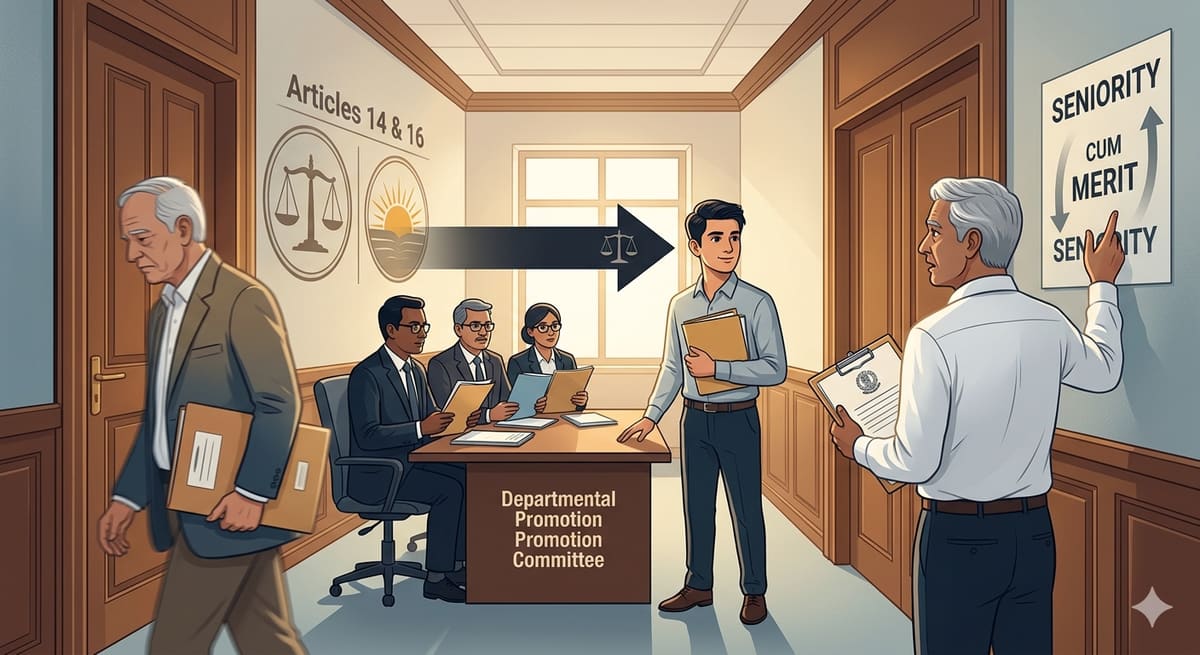
The Madhya Pradesh High Court has reaffirmed that the principle of natural justice is non-negotiable when administrative orders directly affect civil rights, particularly seniority in public service. A failure to provide a hearing before altering seniority lists, even if framed as a mere correction, renders the order legally unsustainable.
Background & Facts
The Dispute
The petitioners, government employees in Madhya Pradesh, were placed in the main seniority list for their respective posts. Respondent No. 4, who was on the waitlist, was subsequently brought over the petitioners in seniority by an order dated 01.05.2019 issued by Respondent No. 3, the Under Secretary, General Administration Department, Bhopal. This adjustment adversely impacted the petitioners’ prospects for promotion, pay fixation, and future postings.
Key Facts
- The petitioners were duly appointed and included in the main seniority list based on their date of appointment and service records.
- Respondent No. 4 was initially placed on the waitlist, indicating his position was subordinate to the petitioners.
- On 01.05.2019, Respondent No. 3 issued an order (Annexure P/2) reordering seniority by placing Respondent No. 4 above the petitioners without any prior notice or hearing.
- The petitioners filed representations challenging the order on 15.07.2019 and 20.09.2020, which were dismissed by Respondent No. 3 via order dated 07.11.2020 (Annexure P/3).
- No reasons were recorded in either order for the deviation from the established seniority list.
- Respondent No. 4 was served with notice on 16.11.2022 but did not appear or file any response.
Procedural History
- 01.05.2019: Impugned seniority order (Annexure P/2) issued by Respondent No. 3.
- 15.07.2019: First representation filed by petitioners challenging the order.
- 20.09.2020: Second representation submitted.
- 07.11.2020: Representation dismissed by Respondent No. 3 (Annexure P/3).
- 20.11.2022: Writ Petition No. 21003 of 2022 filed before the High Court of Madhya Pradesh, Jabalpur.
- 16.11.2022: Respondent No. 4 served with notice.
- 01.07.2026: Judgment delivered by Justice Vishal Dhagat.
The Parties' Positions
Petitioners: Argued that the seniority adjustment was arbitrary, violative of Article 14 and Article 21 of the Constitution, and breached the rule of audi alteram partem. They emphasized that seniority is a vested right with direct civil consequences, including promotion, pay, and retirement benefits. The order was passed without any opportunity to be heard, despite clear adverse impact.
Respondent No. 1 & 3 (State): Contended that the order merely corrected an inadvertent error in seniority and did not require a hearing. They argued that no substantive right was violated and that the correction was administrative in nature.
Respondent No. 2 (MPPSC): Supported the State’s position, asserting that seniority lists are subject to revision and hearings are not mandatory in such cases.
Respondent No. 4: Did not appear or file any reply despite service.
Relief Sought
The petitioners sought quashing of the orders dated 01.05.2019 and 07.11.2020, restoration of their original seniority position, and a direction to conduct a fair hearing before any fresh order is passed.
The Legal Issue
The central question was whether the principle of natural justice, specifically the right to a fair hearing under audi alteram partem, must be observed before an administrative authority alters the seniority of government employees, resulting in adverse civil consequences.
Arguments Presented
For the Petitioner
The petitioners relied on the foundational doctrine of natural justice, citing State of U.P. v. Mohd. Noor and A.K. Kraipak v. Union of India, to argue that any administrative action affecting a vested right - such as seniority - requires an opportunity to be heard. They emphasized that seniority determines promotion, pay, and career progression, and thus constitutes a civil right protected under Article 21. The absence of any reasoning or opportunity to rebut the basis of the adjustment rendered the order arbitrary and illegal.
For the Respondent
The State and MPPSC contended that the order was a mere administrative correction and did not involve adjudication of rights. They cited K. Sankaran v. State of Tamil Nadu to argue that internal administrative revisions do not always require a hearing, especially when no substantive rights are extinguished. They further argued that granting a hearing would cause unnecessary delay and administrative burden.
The Court's Analysis
The Court rejected the State’s contention that seniority adjustments are purely administrative and immune from natural justice norms. It held that when an order directly affects the vested rights of employees - particularly in matters of promotion, pay, and service conditions - the principle of audi alteram partem becomes mandatory.
"The petitioners are suffering adverse civil consequences by virtue of the impugned order. Seniority is not a mere formality; it is a substantive right with direct impact on career progression and financial benefits. Denial of hearing in such cases is a violation of fundamental principles of fairness."
The Court observed that Respondent No. 4, though not appearing, was also directly affected by the order and thus had a right to be heard. The Court emphasized that the absence of a hearing cannot be excused on grounds of administrative convenience or alleged minor nature of the correction.
It further noted that the order dated 07.11.2020, dismissing the representations, was passed without addressing the core grievance of denial of hearing, thereby compounding the illegality.
The Court declined to express any opinion on the merits of the seniority dispute, clarifying that its role was limited to ensuring procedural fairness.
The Verdict
The petitioners succeeded. The Court quashed the orders dated 01.05.2019 and 07.11.2020. The State and MPPSC are directed to provide a fair opportunity of hearing to both the petitioners and Respondent No. 4. A fresh order on seniority shall be passed within 30 days of receipt of the certified copy of this judgment. No opinion is expressed on the merits of the seniority claim.
What This Means For Similar Cases
Hearing Is Mandatory Before Seniority Adjustments
- Practitioners must now argue that any order altering seniority - whether upward or downward - triggers the right to a hearing under natural justice.
- Administrative convenience cannot override procedural fairness when vested rights are at stake.
- Representations dismissed without addressing the denial of hearing are themselves invalid.
Respondents Cannot Be Ignored Even If They Remain Silent
- Even if a party (like Respondent No. 4) does not appear, the authority must still afford them an opportunity to be heard before passing an order affecting them.
- Ex parte orders against absent parties in service matters are legally unsustainable.
Seniority Is a Vested Civil Right
- Seniority is not a procedural formality but a substantive right impacting pay, promotion, and retirement benefits.
- Courts will intervene where seniority is adjusted without reasoned order or hearing, regardless of whether the adjustment appears minor.
Documentation Must Reflect Reasoning
- Orders must record reasons for deviation from established seniority lists.
- Blanket corrections without justification invite judicial review.
Procedural Compliance Is Non-Negotiable
- Failure to comply with audi alteram partem renders an order void ab initio, regardless of the outcome’s fairness.
- This judgment reinforces that procedural justice is as critical as substantive justice in service law.