The Telangana High Court has reaffirmed that administrative rejections of land survey applications under the Telangana Bhu Bharati Act, 2025, cannot be arbitrary and must strictly adhere to procedural fairness and binding judicial precedent. This ruling reinforces the obligation of revenue authorities to follow due process when adjudicating boundary demarcation requests.
Background & Facts
The Dispute
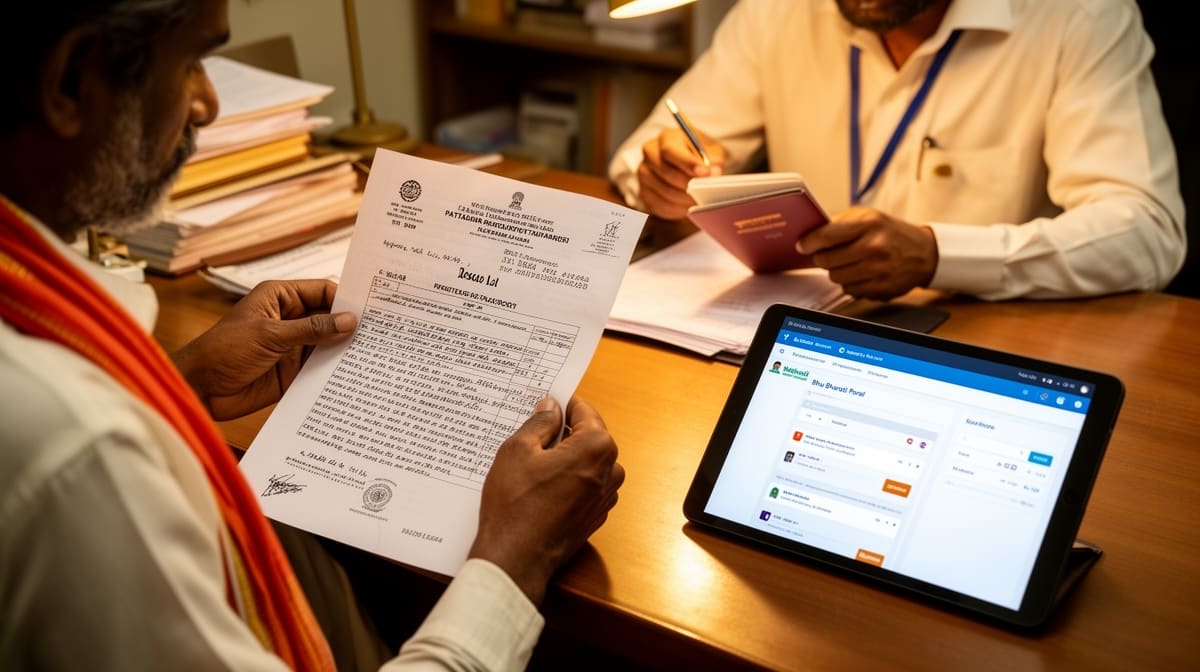
The petitioner, A. Ravi Prakash Yadav, filed an F-line application dated 19.02.2026 (Receipt No. DER022601260105) seeking survey, demarcation, and subdivision of his land measuring 16.36 guntas in Survey Nos. 252A and 253AE at Maddur Village, Chinna Chintha Kunta Mandal, Mahabubnagar District. The application sought formal fixation of boundaries in accordance with the Telangana Bhu Bharati (Record of Rights in Land) Act, 2025 (Act 1 of 2025) and the Bhu Bharati Rules, 2025 (G.O.Ms. No. 39 dated 14.04.2025). On 26.02.2026, Respondent No. 7, the Tahsildar, issued an endorsement letter (PV.No.00239) rejecting the application without assigning any substantive reason or providing an opportunity of hearing.
Key Facts
- The petitioner’s land is located in Survey Nos. 252A and 253AE, Maddur Village, Chinna Chintha Kunta Mandal, Mahabubnagar District
- The total area claimed is 16.36 guntas (approximately 1.636 acres)
- The F-line application was submitted on 19.02.2026 under the procedural framework of the Telangana Bhu Bharati Act, 2025
- The rejection order dated 26.02.2026 was issued by the Tahsildar (Respondent No. 7) without notice to the petitioner or adjoining landowners
- No opportunity was afforded to the petitioner to present his case or to rebut any alleged grounds for rejection
- The rejection did not reference any statutory provision, rule, or factual deficiency in the application
Procedural History
- 19.02.2026: Petitioner filed F-line application (Receipt No. DER022601260105) for survey and demarcation
- 26.02.2026: Tahsildar (Respondent No. 7) issued rejection order via endorsement letter PV.No.00239
- 01.03.2026: Writ Petition No. 7892 of 2026 filed before the High Court of Telangana
- 16.03.2026: Hearing conducted before Justice B. Vijaysen Reddy
The Parties' Positions
Petitioner’s Position: The rejection was illegal, arbitrary, and violative of natural justice. The petitioner relied on the binding precedent in W.P. No. 37496 of 2022, wherein the Court had laid down a clear procedural roadmap for processing F-line applications. The rejection failed to comply with the mandatory requirements of notice, opportunity of hearing, and adherence to statutory framework.
Respondents’ Position: The Assistant Government Pleader for Revenue did not contest the legal principles cited by the petitioner but submitted that the matter was under administrative review. No specific grounds for rejection were advanced in writing or orally.
Relief Sought
The petitioner sought:
- Declaration that the rejection order dated 26.02.2026 is illegal, arbitrary, and violative of natural justice
- Setting aside of the rejection order
- Direction to Respondents Nos. 4 and 7 to re-consider the F-line application by following due process
- Conducting subdivision survey and preparing a demarcation sketch in accordance with the Telangana Bhu Bharati Act, 2025
- Compliance with the directions issued in W.P. No. 37496 of 2022
The Legal Issue
The central question was whether the rejection of an F-line application for land survey and demarcation, without notice, hearing, or reasoned order, violates the principles of natural justice and the binding judicial directions issued in W.P. No. 37496 of 2022 under the Telangana Bhu Bharati Act, 2025.
Arguments Presented
For the Petitioner
Learned counsel for the petitioner relied on W.P. No. 37496 of 2022, wherein the High Court had laid down a four-point procedural framework for processing F-line applications: (i) mandatory consideration of the application; (ii) intimation of any additional fees required; (iii) opportunity to pay such fees; and (iv) conduct of survey after notice to all interested parties, including adjoining owners. The counsel argued that the impugned order completely ignored this precedent and amounted to an arbitrary administrative refusal. The petitioner emphasized that the Telangana Bhu Bharati Act, 2025, mandates transparent and participatory land record processes, and the rejection violated Section 12(3) and Rule 15 of the Bhu Bharati Rules, 2025, which require notice and hearing.
For the Respondent
The Assistant Government Pleader for Revenue did not dispute the applicability of the precedent or the procedural requirements. No counter-affidavit or written submission was filed to justify the rejection. The respondent’s oral submission was limited to stating that the matter was under review, without offering any legal or factual basis for the rejection.
The Court's Analysis
The Court observed that the rejection order dated 26.02.2026 was devoid of any reasoning, failed to cite any statutory provision, and did not afford the petitioner an opportunity to be heard. Such an action is a clear violation of the principles of natural justice, particularly the rule of audi alteram partem. The Court emphasized that administrative bodies cannot act as arbiters of land rights without following the procedural safeguards mandated by law and judicial precedent.
"The directions issued in W.P. No. 37496 of 2022 are binding and must be followed in all similar cases involving F-line applications for survey and demarcation. The rejection without notice, without opportunity of hearing, and without reference to any statutory ground is legally unsustainable."
The Court noted that the Telangana Bhu Bharati Act, 2025, was enacted to modernize land records and ensure clarity in ownership and boundaries. The Act and its Rules contemplate a participatory process where all affected parties are notified and heard. The rejection in this case not only ignored the petitioner’s rights but also disregarded the Court’s own prior directive, which was issued to prevent precisely such arbitrary conduct.
The Court further held that the respondents’ failure to even contest the petitioner’s reliance on the precedent indicated an absence of any legitimate administrative basis for the rejection. The Court concluded that the only lawful course was to set aside the order and direct a fresh consideration in accordance with law.
The Verdict
The writ petition was allowed. The rejection order dated 26.02.2026 issued by Respondent No. 7 is set aside. Respondent Nos. 4 and 7 are directed to re-consider the F-line application No. DER022601260105 dated 19.02.2026. They shall issue notice to the petitioner and all adjoining landowners, afford an opportunity of hearing, and complete the survey and demarcation process in strict compliance with the directions in W.P. No. 37496 of 2022. The entire exercise shall be concluded within forty-five (45) days from the date of receipt of a copy of this order. There shall be no order as to costs.
What This Means For Similar Cases
Due Process Is Non-Negotiable in Land Demarcation
- Practitioners must now insist on written, reasoned orders for any rejection of F-line applications
- Administrative silence or non-response to applications cannot be treated as valid dispositions
- Any rejection without notice or hearing is void ab initio under Article 14 and Article 21 of the Constitution
Precedent Binding on Revenue Authorities
- W.P. No. 37496 of 2022 now serves as a mandatory procedural checklist for all F-line applications in Telangana
- Revenue officers must: (i) acknowledge receipt, (ii) notify fees if applicable, (iii) allow payment, and (iv) conduct survey after notice to all stakeholders
- Failure to follow this four-step protocol renders any subsequent order liable to be set aside
Statutory Framework Overrides Discretion
-
The Telangana Bhu Bharati Act, 2025, and its Rules override unfettered administrative discretion
-
Survey and demarcation are not discretionary acts but statutory obligations
-
Petitioners may now invoke this judgment to challenge delays or refusals in any district of Telangana
-
Always file a copy of W.P. No. 37496 of 2022 alongside F-line applications to establish binding precedent
-
If rejected without reason, immediately move the High Court under Article 226
-
Demand written compliance with the four-step protocol in all correspondence with revenue authorities