Topic

maintenance law

Maintenance law in India governs financial support obligations under Section 125 of the CrPC and other personal laws for spouses, children, and parents unable to maintain themselves.

24 articlesLatest 2 weeks ago
Limitation for Maintenance Arrears Under Section 125(3) CrPC Starts from Date of Order | Rajasthan High Court Clarifies : Raj HC
Case Law Analysis
|Rajasthan High Court

Limitation for Maintenance Arrears Under Section 125(3) CrPC Starts from Date of Order | Rajasthan High Court Clarifies : Raj HC

The Rajasthan High Court ruled that the twelve-month limitation for recovering maintenance arrears under Section 125(3) CrPC begins from the date of the maintenance order, not from when each arrear accrued. This allows claimants to recover arrears for up to a year preceding the order, even if the arrears span a longer period, benefiting maintenance seekers and defining the liability of payers.
Section 125 CrPC | Husband’s Maintenance Obligation Not Discharged by Wife’s Parental Financial Support : Allahabad HC
Case Law Analysis
|Allahabad High Court

Section 125 CrPC | Husband’s Maintenance Obligation Not Discharged by Wife’s Parental Financial Support : Allahabad HC

The Allahabad High Court has ruled that a husband cannot evade his statutory maintenance duty under Section 125 CrPC by pointing to his wife’s family’s financial support. The judgment affirms that marital responsibility is independent of third-party assistance, reinforcing that economic vulnerability stemming from marital breakdown must be addressed by the spouse, not shifted to extended family.

Section 125 CrPC | One-Month Imprisonment for Maintenance Default Cannot Be Extended Without Fresh Application : MP HC Indore
Case Law Analysis
|Madhya Pradesh High Court

Section 125 CrPC | One-Month Imprisonment for Maintenance Default Cannot Be Extended Without Fresh Application : MP HC Indore

The Madhya Pradesh High Court has ruled that under Section 125 CrPC, a court cannot extend a one-month imprisonment sentence for maintenance default beyond the statutory limit without a fresh application. This clarifies that each enforcement action must be independently justified, protecting defaulters from indefinite detention under a single order and reinforcing the limited punitive intent of the provision.

Senior Citizens Act 2007 | OCI Cardholders Entitled to Protection; Eviction Orders Must Balance DV Act Rights : Bombay HC
Case Law Analysis
|Bombay High Court

Senior Citizens Act 2007 | OCI Cardholders Entitled to Protection; Eviction Orders Must Balance DV Act Rights : Bombay HC

Bombay High Court rules that Overseas Citizen of India (OCI) cardholders are protected under the Senior Citizens Act 2007, even when the property is a shared household under the Domestic Violence Act. The Court held that eviction orders must balance the rights of senior citizens with those of daughter-in-law occupants, restoring the Maintenance Tribunal’s order for unrestricted access without eviction.

Section 12 DV Act | Bigamy & Emotional Abuse Constitute Domestic Violence Justifying Maintenance & Compensation: Karnataka HC
Case Law Analysis
|Karnataka High Court

Section 12 DV Act | Bigamy & Emotional Abuse Constitute Domestic Violence Justifying Maintenance & Compensation: Karnataka HC

Karnataka High Court affirms Rs. 20,000/month maintenance and Rs. 3,00,000 compensation under the Domestic Violence Act, ruling that bigamy and sustained emotional abuse qualify as domestic violence even if prior litigation attained finality. The judgment reinforces that economic relief under Section 12 is not barred by res judicata when new acts of violence emerge.

PWDVA Section 3 | Prolonged Non-Payment of Maintenance Since 2013 Constitutes Economic Abuse : Bombay HC
Case Law Analysis
|Bombay High Court

PWDVA Section 3 | Prolonged Non-Payment of Maintenance Since 2013 Constitutes Economic Abuse : Bombay HC

The Bombay High Court has ruled that sustained financial neglect of a spouse and children since 2013, with no provision for basic livelihood, qualifies as economic abuse under the Protection of Women from Domestic Violence Act. This sets a critical precedent for recognizing financial control and deprivation as forms of domestic violence, expanding access to interim maintenance for economically dependent survivors.

Section 12 & 23 DV Act | Ex Parte Interim Maintenance Permissible Despite Parallel CrPC 125 Order: Allahabad HC
Case Law Analysis
|Allahabad High Court

Section 12 & 23 DV Act | Ex Parte Interim Maintenance Permissible Despite Parallel CrPC 125 Order: Allahabad HC

The Allahabad High Court has affirmed that a Magistrate under the Protection of Women from Domestic Violence Act may grant ex parte interim maintenance even when a parallel maintenance order exists under Section 125 CrPC. This reinforces the DV Act’s independent remedial purpose and ensures women are not denied urgent financial relief due to procedural overlaps in civil and criminal forums.

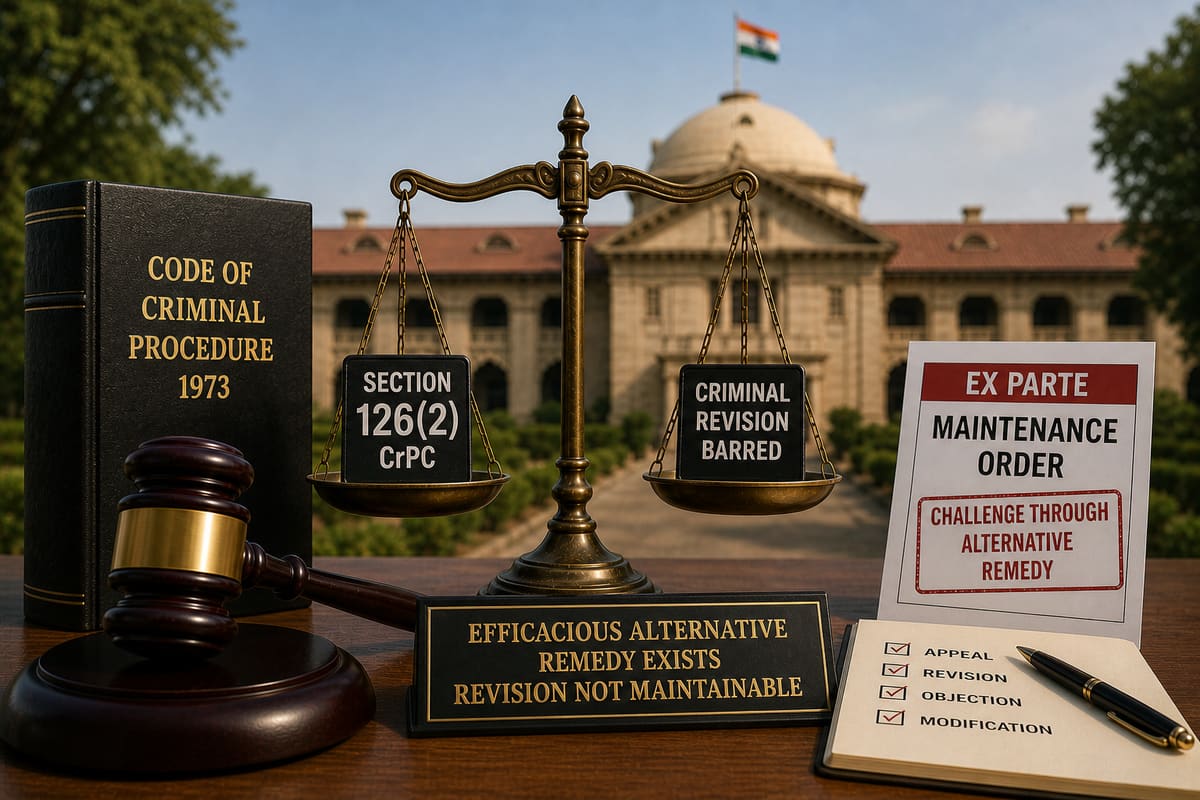
Section 126(2) CrPC | Criminal Revision Barred When Efficacious Alternative Remedy Exists to Challenge Ex Parte Maintenance Orders : Allahabad HC
Case Law Analysis
|Allahabad High Court

Section 126(2) CrPC | Criminal Revision Barred When Efficacious Alternative Remedy Exists to Challenge Ex Parte Maintenance Orders : Allahabad HC

Allahabad High Court dismisses a criminal revision petition, ruling that Section 126(2) CrPC provides an efficacious alternative remedy to set aside ex parte maintenance orders, thereby barring parallel revision proceedings. The decision reinforces procedural hierarchy in maintenance disputes under the CrPC, impacting litigants seeking redressal against ex parte orders.

Section 125 CrPC | Daughter’s Maintenance Continues Post-Majority If Application Filed During Minority : MP HC Clarifies Pendency Period
Case Law Analysis
|Madhya Pradesh High Court

Section 125 CrPC | Daughter’s Maintenance Continues Post-Majority If Application Filed During Minority : MP HC Clarifies Pendency Period

MP High Court rules that a daughter’s maintenance under Section 125 CrPC extends beyond attaining majority if the application was filed during her minority, covering the entire pendency period. The ruling reinforces child welfare principles and statutory interpretation of maintenance entitlements, impacting ongoing and future maintenance claims.

Section 482 CrPC | Concurrent Findings on Maintenance Cannot Be Revisited Unless Manifestly Illegal : AP HC Upholds Child Support in Live-In Relationships
Case Law Analysis
|Andhra Pradesh High Court

Section 482 CrPC | Concurrent Findings on Maintenance Cannot Be Revisited Unless Manifestly Illegal : AP HC Upholds Child Support in Live-In Relationships

The Andhra Pradesh High Court ruled that maintenance orders based on concurrent factual findings cannot be re-examined under Section 482 CrPC unless they are perverse or illegal. The judgment extends maintenance obligations to children born from live-in relationships, reinforcing that inherent powers under Section 482 are not a substitute for appeal.