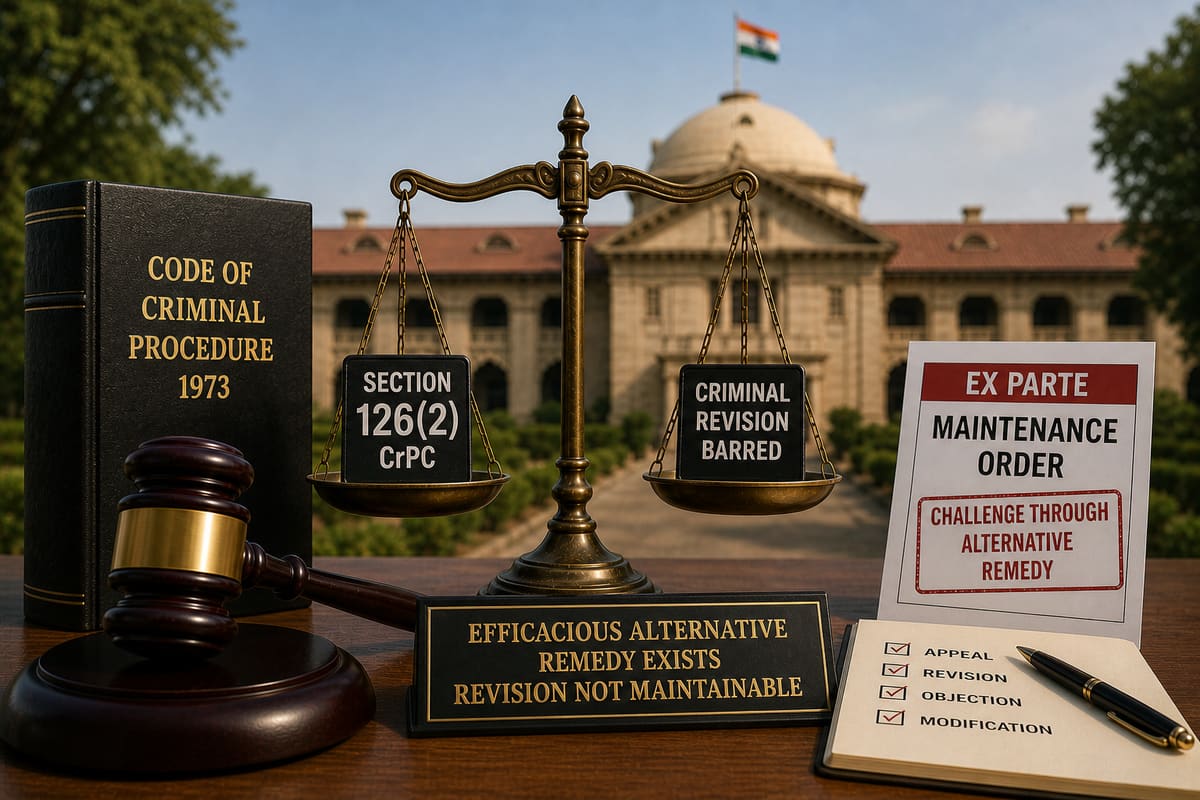
The Allahabad High Court has reaffirmed that a criminal revision under Section 119 CrPC cannot be entertained when a specific statutory remedy exists under Section 126(2) CrPC to challenge an ex parte maintenance order. This decision reinforces procedural discipline in family law proceedings and clarifies the limits of revisional jurisdiction.
Background & Facts
The Dispute
The revisionist, Taufik, was served with a maintenance petition under Section 125 CrPC filed by his wife, Tarannum Bano (Opposite Party No. 2), and their minor child (Opposite Party No. 3), in Criminal Misc. Case No. 238 of 2024 before the First Family Court, Jaunpur. The petition sought monthly maintenance for both the wife and child. The revisionist filed objections on 02.04.2025, contesting the quantum and his financial capacity. However, he failed to appear in subsequent hearings due to personal reasons, resulting in an ex parte order.
Key Facts
The maintenance petition was filed in 2020, indicating prolonged litigation
Revisionist filed written objections on 02.04.2025
No hearing was held on the merits of the objections
Ex parte order dated 18.02.2026 directed payment of Rs. 2,500 per month to the wife and Rs. 1,000 per month to the minor child
Revisionist claims his income is insufficient to support the awarded amount
No evidence of income or expenditure was recorded by the Family Court before passing the order
Procedural History
2020: Maintenance petition initiated under Section 125 CrPC
02.04.2025: Revisionist filed objections before the Family Court
18.02.2026: Family Court passed ex parte order awarding maintenance without considering objections
2026: Criminal Revision No. 2620 of 2026 filed before the Allahabad High Court seeking quashing of the order
30.03.2026: High Court delivered a prior order in Anup Kumar v. Smt. Pratibha Kushwaha (Criminal Revision Defective No. 141 of 2026), holding that Section 126(2) CrPC provides an efficacious remedy
Relief Sought
The revisionist sought setting aside of the ex parte maintenance order dated 18.02.2026, reduction of maintenance to a reasonable amount commensurate with his income, and a direction to the Family Court to adjudicate his objections.
The Legal Issue
The central question was whether a criminal revision under Section 119 CrPC is maintainable to challenge an ex parte order under Section 125 CrPC when a specific statutory remedy is available under Section 126(2) CrPC.
Arguments Presented
For the Appellant/Petitioner
Learned counsel for the revisionist argued that the Family Court’s failure to consider his objections rendered the order illegal and violative of natural justice. He relied on the Supreme Court’s decision in Rajnesh v. Neha (2021) 2 SCC 324, which mandates a detailed inquiry into income, expenses, and standard of living before fixing maintenance. He contended that the quantum of Rs. 3,500 per month was grossly disproportionate and that the revision was the only available recourse to prevent irreparable harm.
For the Respondent/State
The Additional Government Advocate contended that Section 126(2) CrPC explicitly provides a remedy to set aside ex parte orders by filing an application before the same court. He cited the High Court’s own precedent in Anup Kumar v. Smt. Pratibha Kushwaha to argue that the revisionist’s failure to avail this remedy rendered the revision non-maintainable. He emphasized that revisional jurisdiction under Section 119 CrPC is discretionary and should not be invoked where an alternative remedy exists.
The Court's Analysis
The Court examined the statutory framework under the CrPC and reaffirmed the well-established principle that revisional jurisdiction under Section 119 CrPC is not a substitute for an efficacious statutory remedy. The Court observed that Section 126(2) CrPC specifically empowers a court to set aside or modify an ex parte order passed under Section 125 CrPC upon application by the aggrieved party.
"A statutory remedy provided by law cannot be bypassed merely because the party prefers a different forum or seeks a faster resolution."
The Court noted that the Family Court had not adjudicated the revisionist’s objections, which were filed on 02.04.2025, and that the ex parte order was passed without affording him a fair hearing. However, the Court held that this procedural lapse does not convert the matter into a revisionable error under Section 119 CrPC. The revisionist’s remedy lies squarely within Section 126(2), which permits the court to recall, modify, or set aside the order upon application.
The Court further emphasized that the revisionist’s delay in appearing before the Family Court did not absolve him of the obligation to pursue the remedy provided by law. The High Court also took note of the prolonged pendency since 2020 and directed that any application under Section 126(2) CrPC must be decided expeditiously.
The Verdict
The criminal revision was dismissed on the ground of alternative remedy. The Court held that the revisionist must file an application under Section 126(2) CrPC before the Family Court, Jaunpur, to challenge the ex parte order dated 18.02.2026. The Family Court is directed to decide such application expeditiously, within six weeks of filing, and in accordance with the principles laid down in Rajnesh v. Neha, including a detailed assessment of income, expenses, and the standard of living of both parties.
What This Means For Similar Cases
Alternative Remedy Bars Revisional Jurisdiction
Practitioners must first exhaust remedies under Section 126(2) CrPC before approaching High Courts under Section 119 CrPC for ex parte maintenance orders
Revision petitions filed solely to bypass procedural delays in Family Courts will be dismissed summarily
Ex Parte Orders Are Not Per Se Illegal, But Require Prompt Redress
Courts must record reasons for ex parte orders and ensure the aggrieved party is aware of the remedy under Section 126(2)
Failure to consider objections does not automatically invalidate the order - it triggers the statutory remedy, not revisional intervention
Rajnesh v. Neha Is Now Procedurally Enforceable
Maintenance orders must be based on verified income, expenditure, and living standards
Practitioners should file affidavits of income and expenses at the earliest stage to avoid ex parte adverse orders
Family Courts must conduct at least one hearing on merits before passing maintenance orders, even if objections are filed