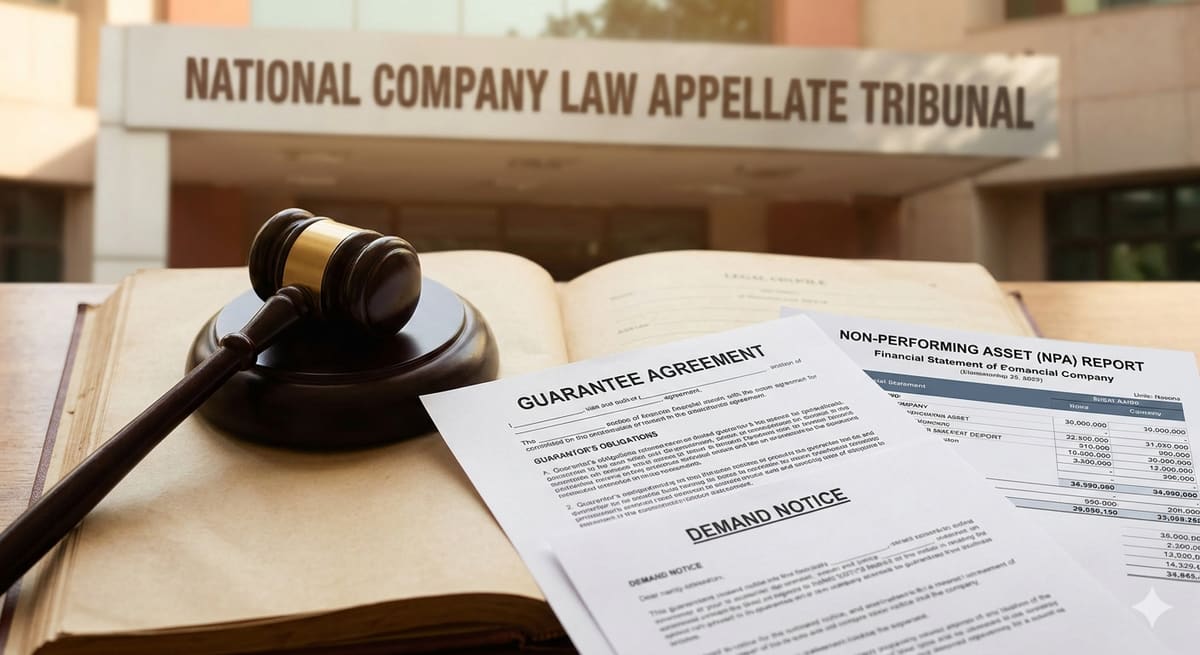
The National Company Law Appellate Tribunal has clarified that while a personal guarantor’s liability under a guarantee deed is contingent upon a prior demand, the absence of formal postal receipts does not invalidate invocation if contractual service mechanisms and cumulative evidence establish notice and knowledge. This judgment reinforces the primacy of contractual terms over hyper-technical objections in insolvency proceedings.
Background & Facts
The Dispute
The present appeals arise from the initiation of Personal Insolvency Resolution Process (PIRP) against two individuals, Vijay Pandey and Maya Pandey, who are husband and wife and personal guarantors to the corporate debtor M/s Bhartiya Micro Credit. The financial creditor, Small Industries Development Bank of India (SIDBI), initiated PIRP under Section 95(1) of the Insolvency and Bankruptcy Code, 2016 (IBC), following the corporate debtor’s default. The Appellants challenged the admission of the application on the ground that no valid demand was made upon them prior to the statutory notice under Rule 7(1) of the IBC (Application to Adjudicating Authority for Insolvency Resolution Process of Personal Guarantors to Corporate Debtors) Rules, 2019.
Key Facts
- On 23.05.2017, SIDBI sanctioned a term loan of Rs. 2,00,00,000 to M/s Bhartiya Micro Credit.
- On 22.09.2017, a Deed of Guarantee was executed by Vijay Pandey and Maya Pandey in favour of SIDBI, wherein Clause 03 stipulated that the guarantor’s liability would arise only "upon demand" by the financial creditor.
- The corporate debtor’s account was classified as a Non-Performing Asset (NPA) on 12.12.2019.
- On 01.06.2021, SIDBI issued a recall notice to the corporate debtor, calling for immediate repayment of the entire outstanding amount.
- On 26.11.2021, SIDBI issued an invocation letter to the guarantors, demanding payment under the guarantee.
- On 04.02.2022, SIDBI’s counsel issued a legal recall notice to the guarantors, reiterating the demand.
- On 05.03.2022, SIDBI filed Original Application No. 264 of 2022 before the Debts Recovery Tribunal (DRT), Lucknow, against the corporate debtor and the guarantors, annexing the invocation letter and recall notice.
- On 20.12.2022, SIDBI issued a statutory demand notice under Rule 7(1) of the IBC Rules, Form-B, referencing the 26.11.2021 invocation letter as Annexure-9.
- The Appellants did not respond to the statutory demand notice.
- The DRT passed an ex parte judgment on 17.07.2023, recognizing the debt, default, and invocation, and issued a Recovery Certificate.
- On 22.06.2023, SIDBI filed applications under Section 95(1) of the IBC before the NCLT, Allahabad Bench.
- On 17.01.2024, the NCLT appointed Mr. Rakesh Kumar Jindal as Resolution Professional.
- On 15.09.2024, the Resolution Professional submitted a report under Section 99 recommending admission of the application.
- On 13.02.2025, the NCLT admitted the applications and initiated PIRP against both Appellants.
Procedural History
- 22.09.2017: Execution of Deed of Guarantee by Vijay Pandey and Maya Pandey.
- 12.12.2019: Corporate debtor’s account classified as NPA.
- 01.06.2021: Loan recall notice issued to corporate debtor.
- 26.11.2021: Invocation letter issued to guarantors.
- 04.02.2022: Legal recall notice issued by SIDBI’s counsel.
- 05.03.2022: DRT OA No. 264/2022 filed against guarantors and corporate debtor.
- 20.12.2022: Statutory demand notice under Rule 7(1) issued to Appellants.
- 17.07.2023: DRT passed ex parte judgment and issued Recovery Certificate.
- 22.06.2023: Section 95(1) applications filed before NCLT, Allahabad.
- 17.01.2024: Resolution Professional appointed.
- 15.09.2024: Resolution Professional’s report under Section 99 submitted.
- 13.02.2025: NCLT admitted applications and initiated PIRP.
- 13.02.2025: Impugned orders passed.
- 28.03.2025: Appeals filed before NCLAT under Section 61(1) of IBC.
The Parties' Positions
The Appellants contend that no valid demand was made prior to the statutory notice under Rule 7(1), as the invocation letter dated 26.11.2021 was not served with proof of delivery, was not filed with the Section 95 application, and was only introduced via rejoinder. They argue that Clause 03 of the Deed of Guarantee requires a prior demand, and without it, no default arises against the guarantor.
SIDBI contends that the invocation was validly effected through the 26.11.2021 letter, reinforced by the 04.02.2022 recall notice, the DRT proceedings, and the statutory demand notice. It relies on Clause 23 of the Deed of Guarantee, which deems service complete upon dispatch to the last known address, certified by a responsible officer. SIDBI further argues that the Appellants admitted the invocation and service in their rejoinder.
Relief Sought
The Appellants seek quashing of the NCLT’s order dated 13.02.2025, setting aside the initiation of PIRP, and a declaration that no valid default existed against them at the time of filing the Section 95 application.
The Legal Issue
The central question was whether the liability of a personal guarantor under a guarantee deed requiring "demand" can be triggered by a combination of contractual invocation, subsequent legal notices, and statutory proceedings - even in the absence of formal postal receipts - provided the contractual service mechanism is satisfied and the guarantor had actual knowledge of the demand.
Arguments Presented
For the Appellant
The Appellant’s counsel argued that Clause 03 of the Deed of Guarantee makes the guarantor’s liability contingent upon a prior demand, which must be distinct from the statutory notice under Rule 7(1). The invocation letter dated 26.11.2021 was not filed with the Section 95 application and was only produced in the rejoinder, violating procedural norms. No proof of service - such as postal receipts or delivery acknowledgments - was annexed. The legal notice dated 04.02.2022 was not part of the record before the NCLT and cannot be introduced at the appellate stage. Reliance on SBI v. Deepak Kumar Singhania was made to argue that statutory demand cannot substitute for contractual invocation. The Appellant further contended that mere publication in DRT proceedings does not equate to service under the guarantee deed.
For the Respondent
SIDBI’s counsel argued that Clause 23 of the Deed of Guarantee governs service and provides that certification by a responsible officer of SIDBI constitutes conclusive proof of dispatch. Multiple affidavits from SIDBI officers confirmed dispatch of the 26.11.2021 letter to the address provided in the guarantee. The recall notice dated 04.02.2022 and the DRT proceedings independently established demand. The Appellants admitted the facts of invocation, service, and DRT proceedings in their rejoinder, thereby estopping them from denying knowledge. The DRT judgment conclusively established the existence of debt, default, and invocation. The Appellant’s objections were hyper-technical and ignored the substantive reality of notice and knowledge.
The Court's Analysis
The NCLAT began by acknowledging that the liability of a personal guarantor under Clause 03 of the Deed of Guarantee is not automatic upon the borrower’s default but arises only upon demand. However, the Court emphasized that the nature and sufficiency of such demand must be assessed in light of the contractual framework agreed upon by the parties.
"The significance of Clause 23 lies in the fact that it represents the contractual arrangement voluntarily agreed upon between the parties. Once the parties have agreed to a particular mode of service and a particular method of proving such service, the issue cannot be examined in disregard of those contractual terms."
The Court found that SIDBI had not relied solely on the 26.11.2021 invocation letter. The recall notice dated 04.02.2022, issued through counsel and supported by proof of dispatch, independently satisfied the demand requirement under Clause 03. The statutory demand notice dated 20.12.2022 explicitly referenced the prior invocation, thereby creating a cumulative chain of enforcement.
Crucially, the Appellants had admitted in their rejoinder to paragraphs 4.5, 4.6, and 4.7 of SIDBI’s reply, which explicitly stated:
"4.5... the Answering Respondent issued an invocation of the Guarantee Notice dated 26.11.2021... which was duly served to the Appellant."
"4.6... Answering Respondent... issued a formal recall legal notice dated 04.02.2022..."
"4.7... the Answering Respondent has also initiated recovery proceedings before the Debts Recovery Tribunal... the notice invoking the guarantee dated 26.11.2021 was duly annexed to the said OA."
The Court held that such admissions are binding and cannot be retracted. It relied on State Bank of India v. Dr. Jitendra Das Maganti to affirm that when knowledge is established through multiple channels, technical objections to service are redundant.
The DRT proceedings, which resulted in a final Recovery Certificate, further corroborated the existence of demand and default. The Appellants had appeared in the DRT proceedings only to the extent of filing a writ petition before the Supreme Court, indicating actual knowledge of the proceedings.
The Court rejected the argument that the invocation letter was not filed with the Section 95 application, noting that the material was before the NCLT at the time of final adjudication. The Resolution Professional’s report was merely recommendatory; the final decision rested with the Adjudicating Authority, which had considered all evidence.
The Court distinguished SBI v. Deepak Kumar Singhania, noting that in that case, the statutory demand notice was the first and only notice. Here, a prior contractual demand existed.
The Verdict
The appeals were dismissed. The NCLAT upheld the NCLT’s order dated 13.02.2025 initiating Personal Insolvency Resolution Process against Vijay Pandey and Maya Pandey. The Court held that the financial creditor validly invoked the guarantee through the 26.11.2021 letter, reinforced by the 04.02.2022 recall notice, the DRT proceedings, and the statutory demand notice. The contractual service mechanism under Clause 23 was satisfied by certified affidavits of dispatch, and the Appellants’ admissions rendered their technical objections untenable. There would be no order as to costs.
What This Means For Similar Cases
Contractual Service Clauses Override Technical Defects
- Practitioners must now treat Clause 23-type service provisions as binding and conclusive, even without postal receipts, if supported by officer affidavits.
- Objections based solely on non-production of envelopes or delivery slips will fail if the contract prescribes a different mode of proof.
- Always verify the service clause in guarantee deeds before challenging notice validity.
Cumulative Evidence Suffices for Demand
- A single notice need not be the sole basis for invocation; a chain of communications (recall notice, DRT filing, statutory demand) can collectively establish demand.
- Statutory demand notices under Rule 7(1) can reference prior contractual demands, creating a unified enforcement record.
- DRT proceedings and judgments can serve as independent proof of notice and default in IBC proceedings.
Admissions Are Fatal to Technical Defences
- Any admission in pleadings - whether in rejoinder, affidavit, or application - binds the party and precludes later denial.
- Counsel must carefully review all pleadings before asserting non-service or non-demand.
- Strategic use of admissions can preempt challenges to notice validity in both DRT and IBC proceedings.